"Marty Marion, Austin, and Kyle Roof: De-positioning, problem-solving under stress, and why keyword math still beats unguided AI"
Day 1's opening block bundles Marty Marion on de-positioning, Austin on problem-solving under stress, and Kyle Roof on why SEO fundamentals (and keyword math) still beat unguided AI content.
On this page
The opening block of Day 1 ran three back-to-back talks. Marty Marion, a self-described former Madison Avenue strategist, opened the conference (as he says he has every year since SEO Spring Training began in 2019) with a workshop on "de-positioning," the discipline of weakening a prospect's attachment to their current provider before any positioning can land. Austin (last name not given), a leadership and mindset speaker, followed with an emotionally framed talk on solving problems under stress, anchored to his own brain-tumor diagnosis and surgery. Kyle Roof, the technical SEO tester, closed the segment by arguing that SEO fundamentals (keyword density math, contextual terms, and links) still drive ranking, and that large language models produce poor SEO content out of the box. The through-line across all three: tools and tactics change, but the underlying mechanics (human decision psychology, problem-solving discipline, the algorithm's math) do not.
Main takeaways
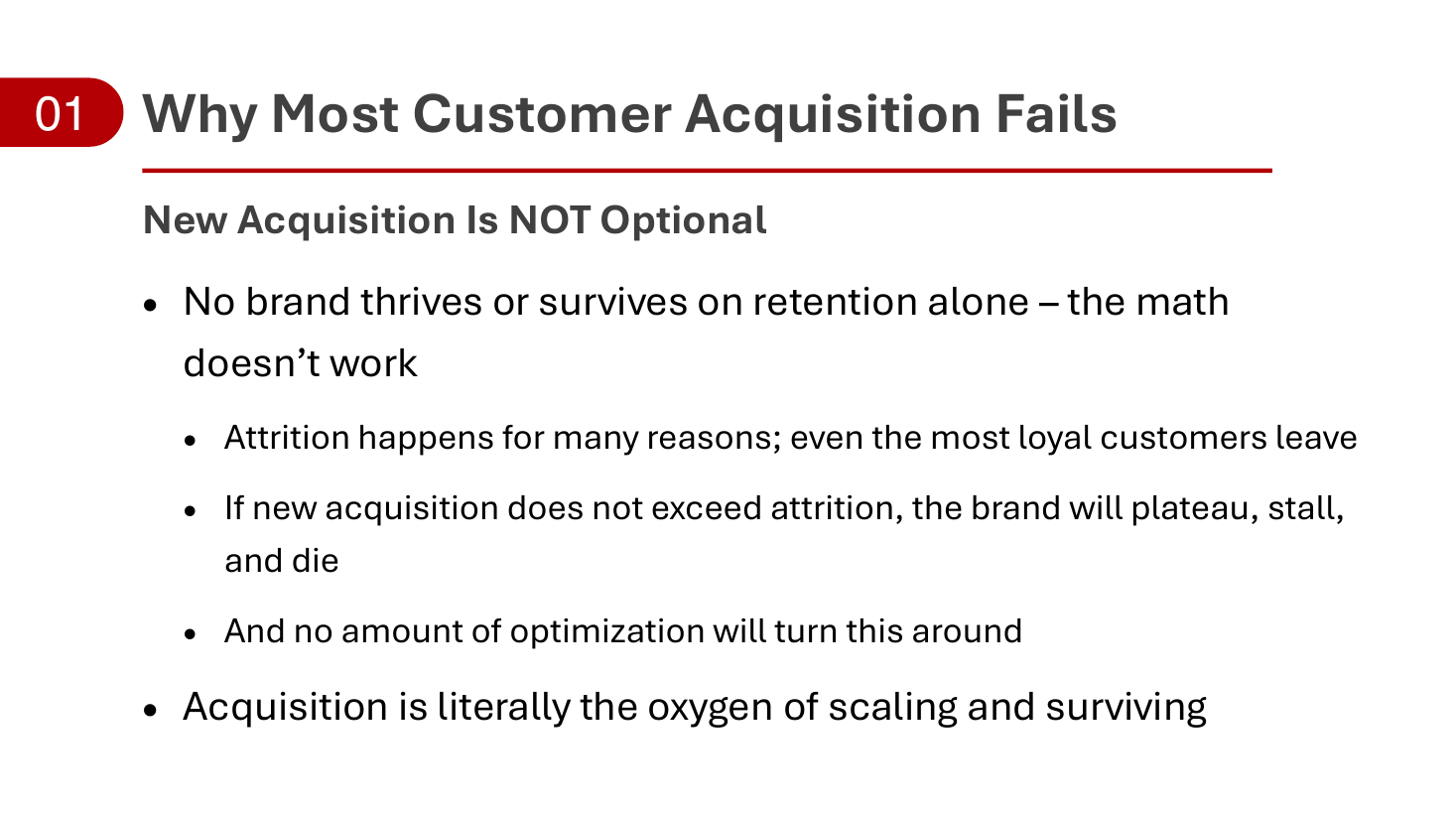
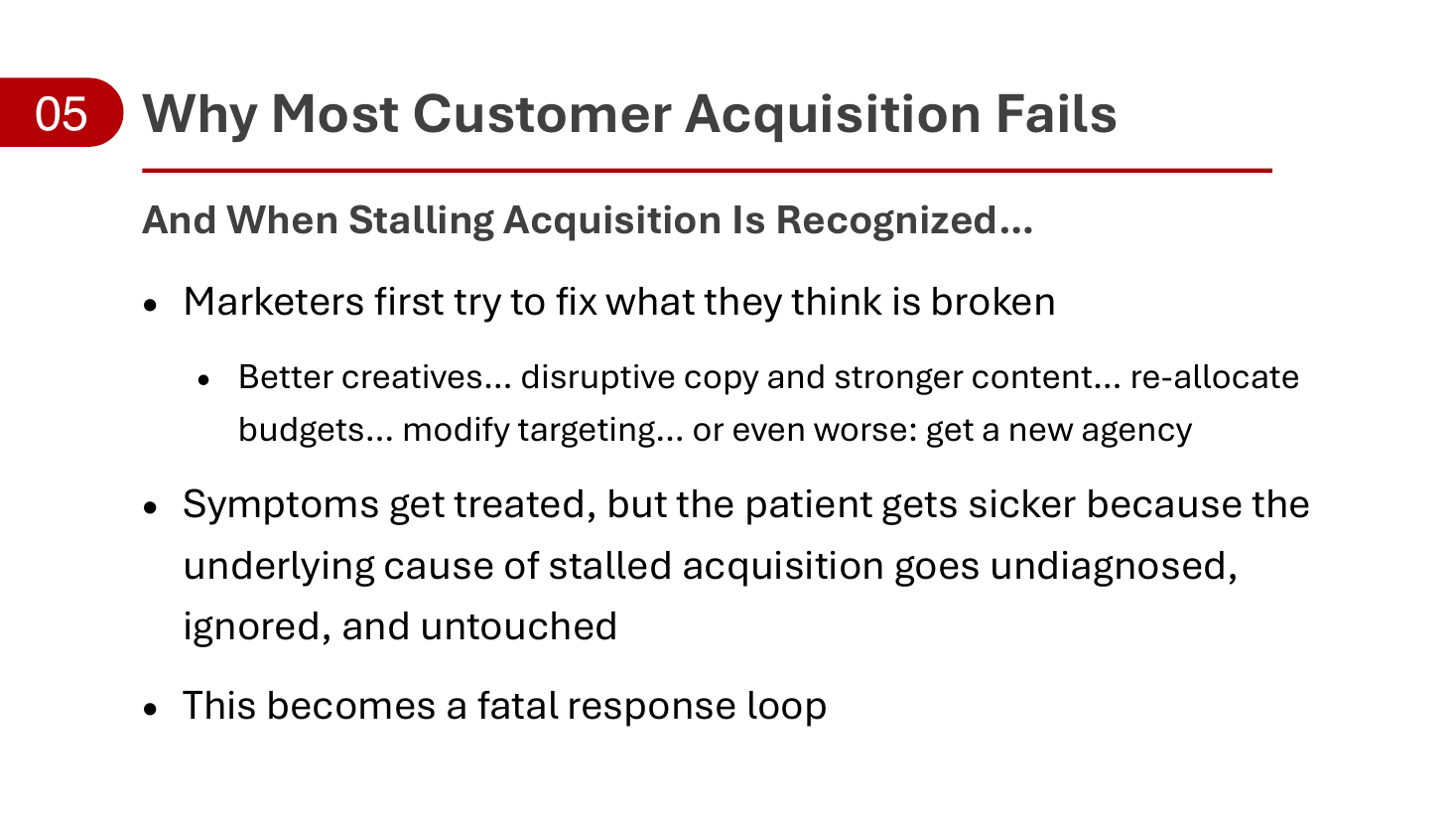
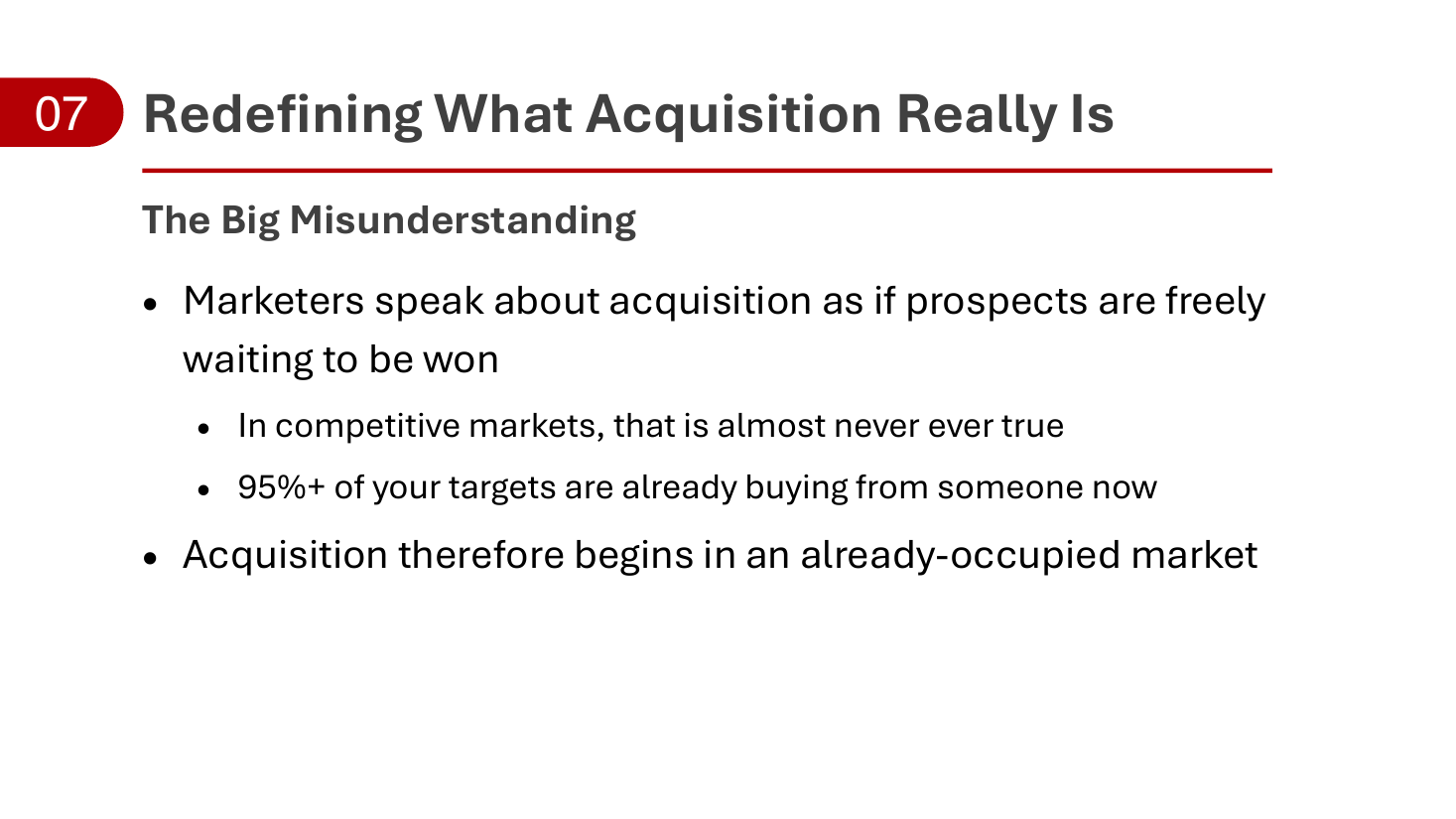
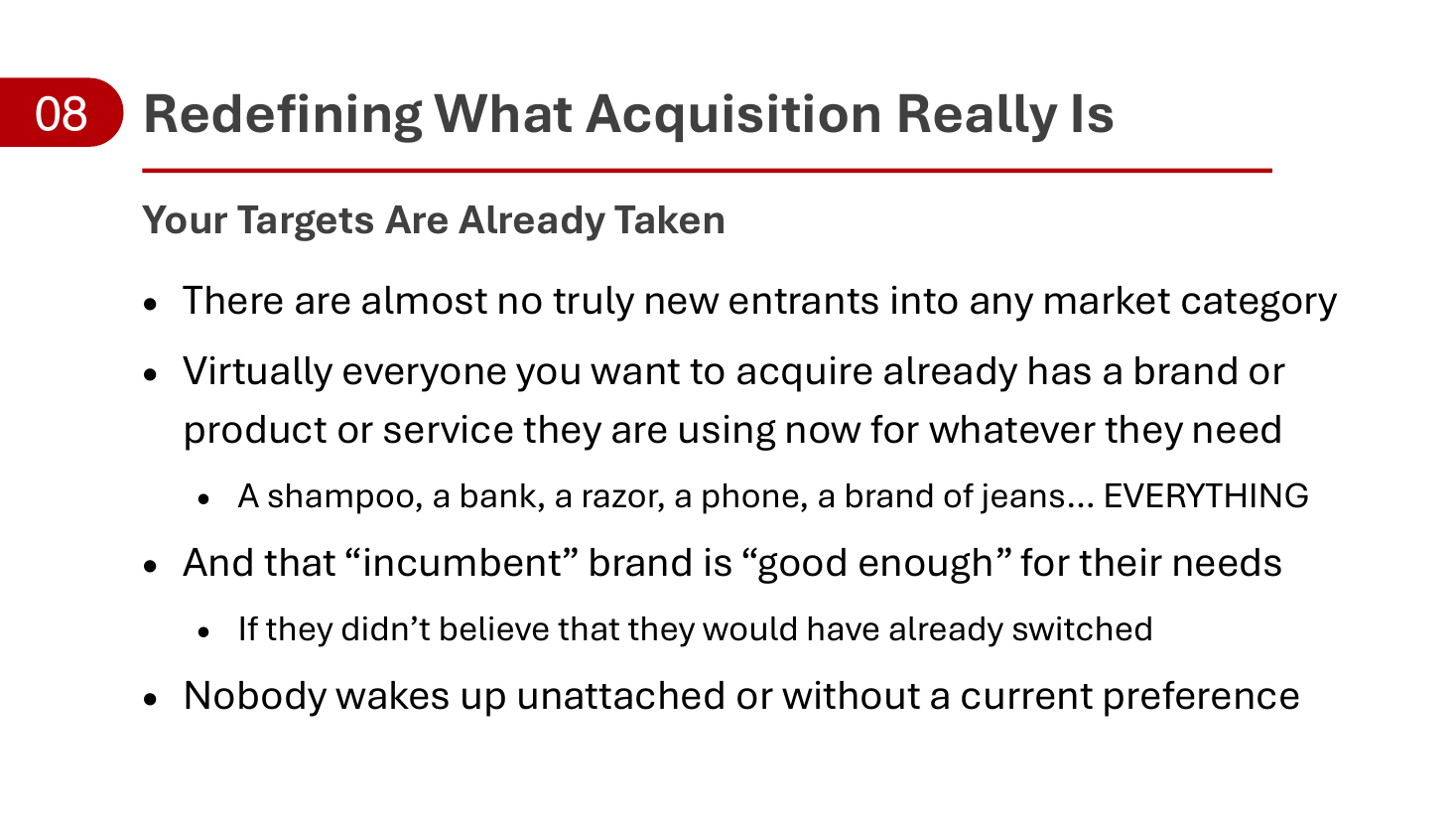
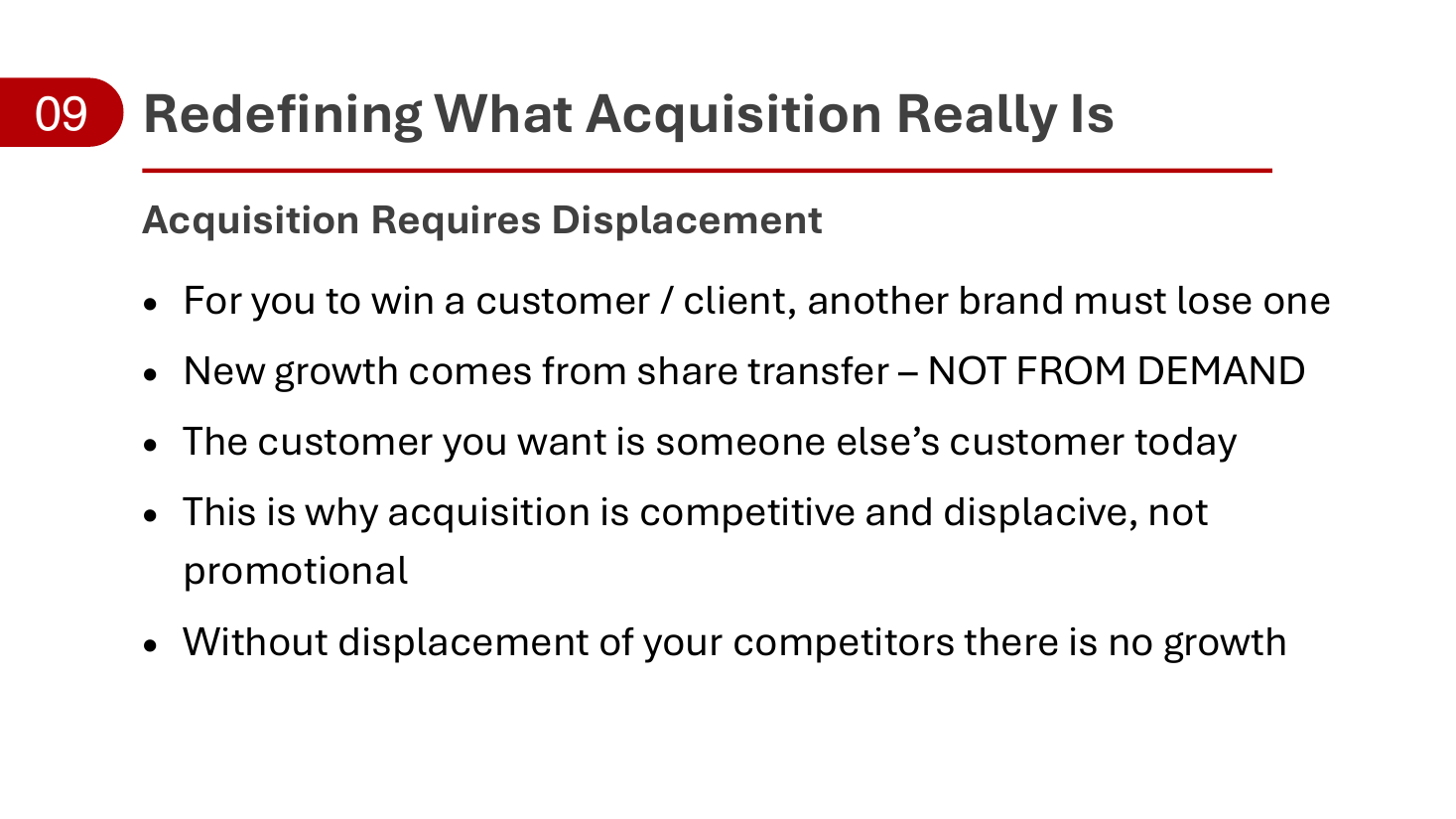
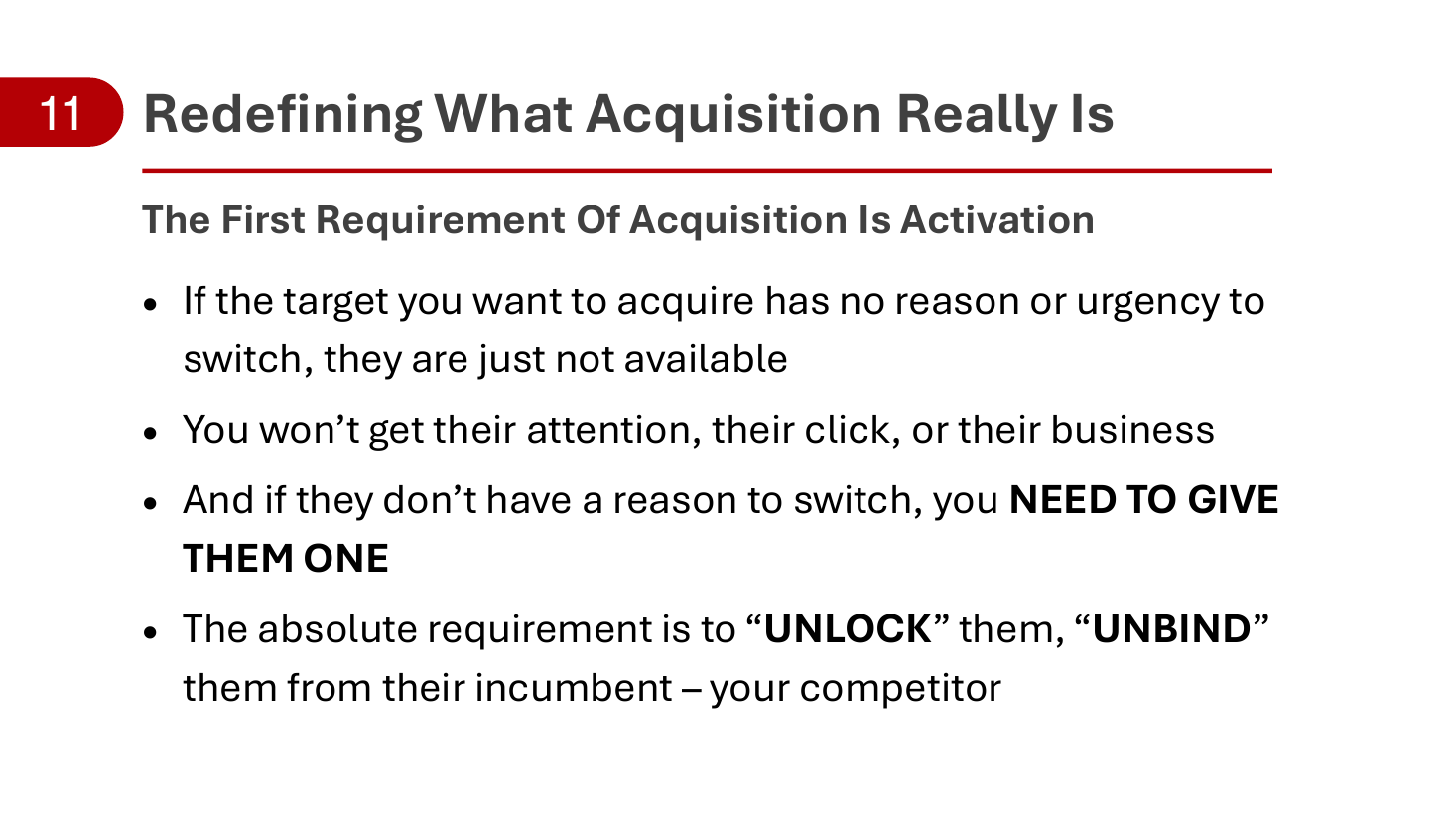
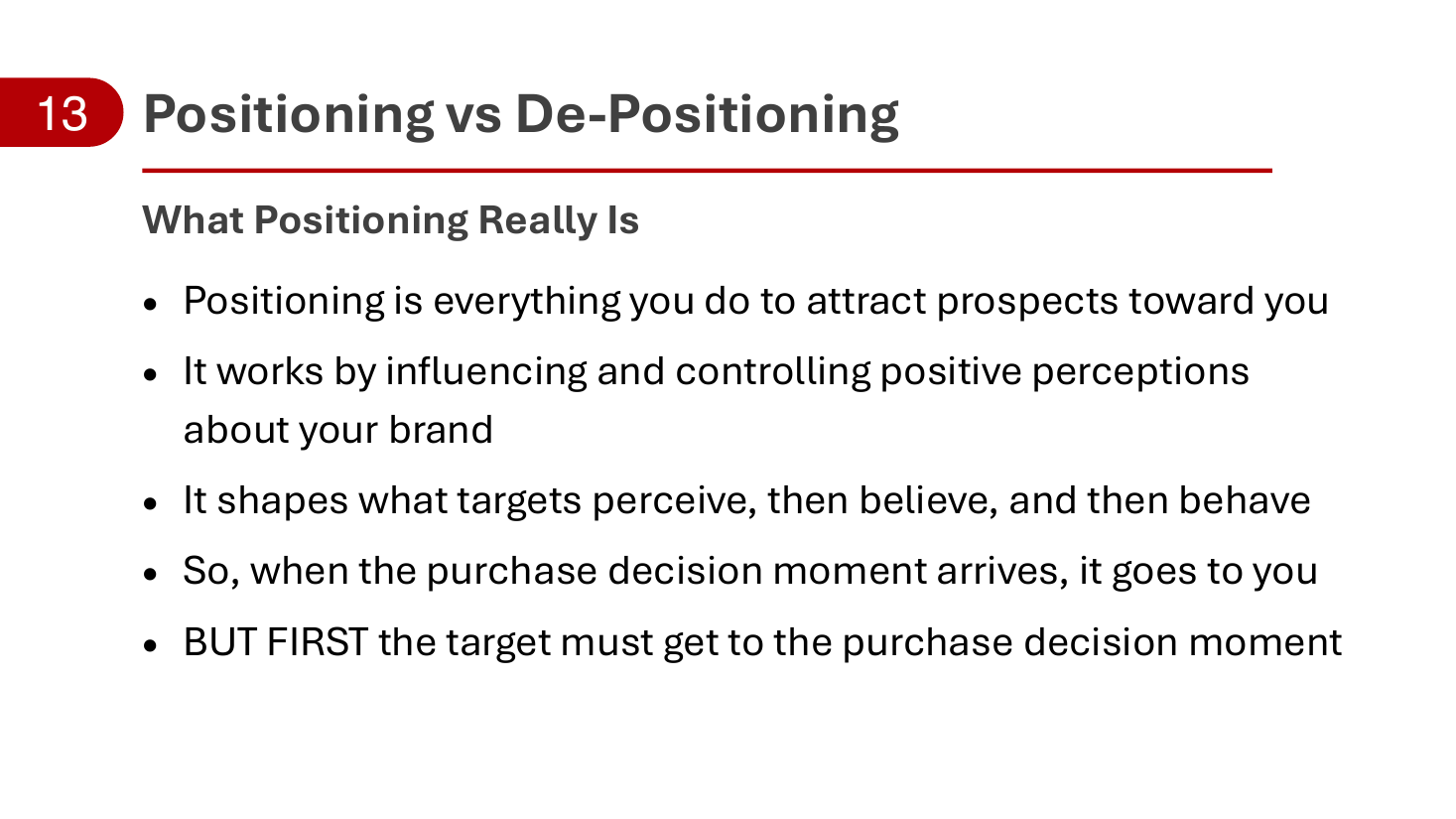
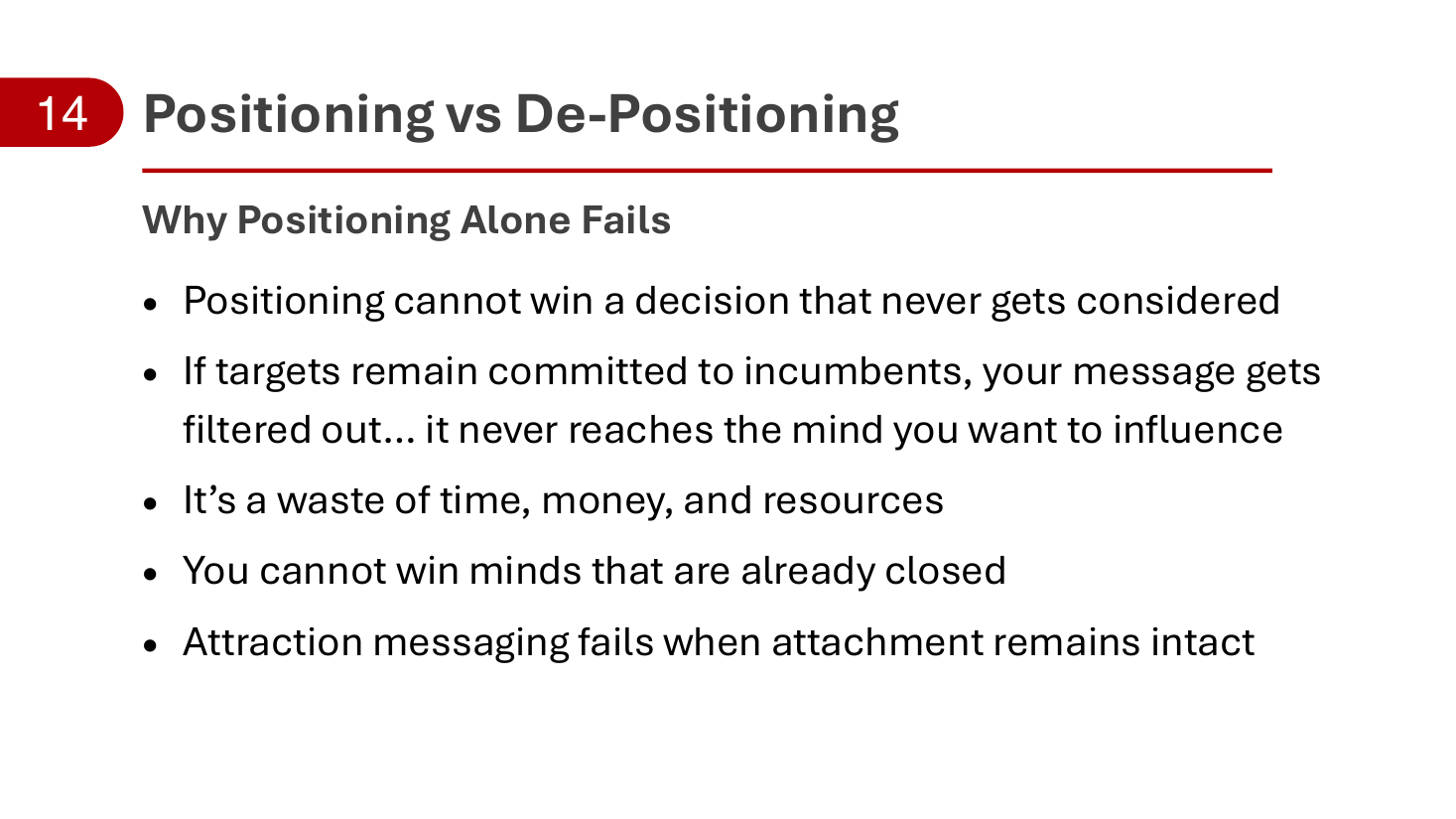
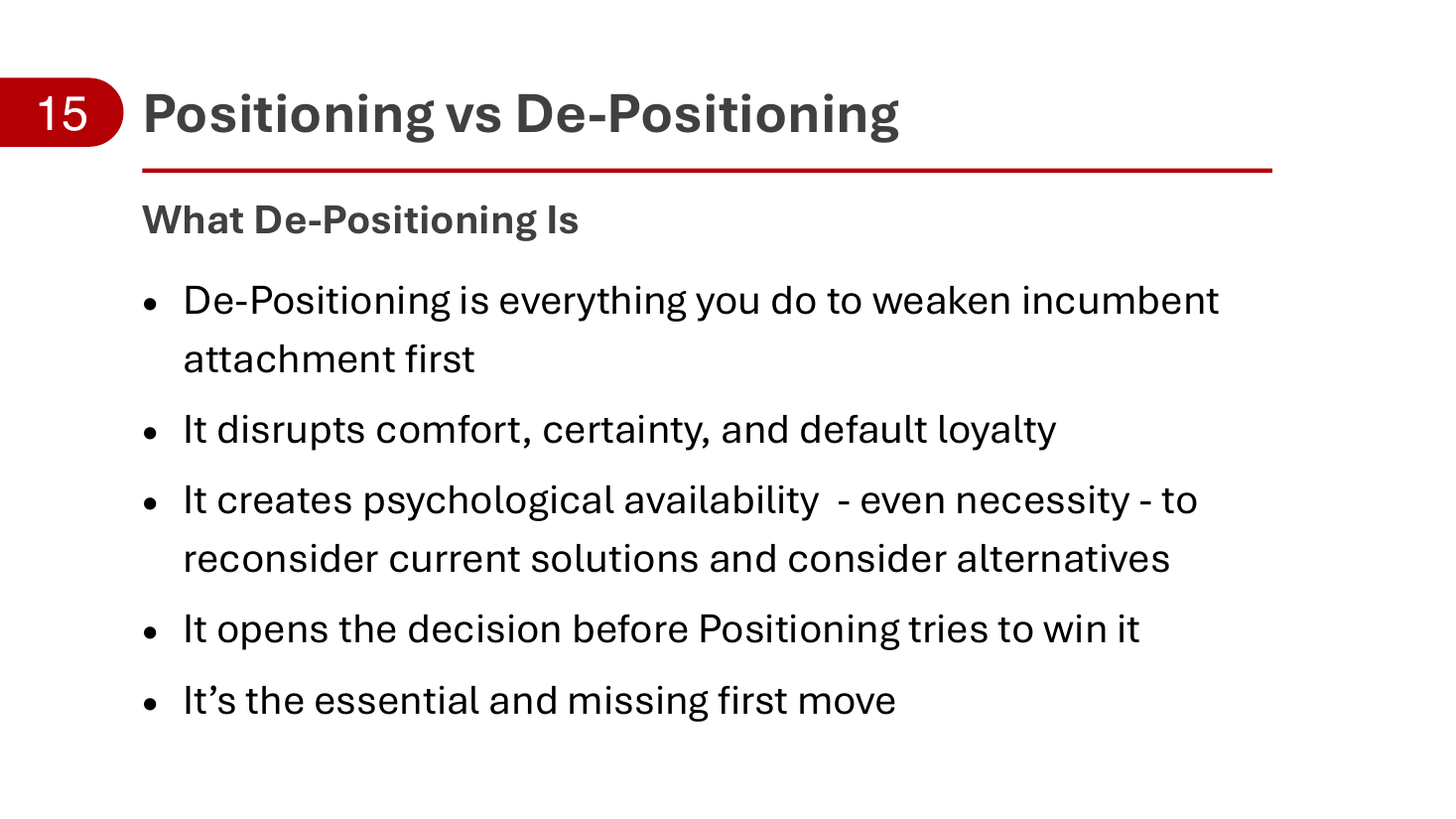
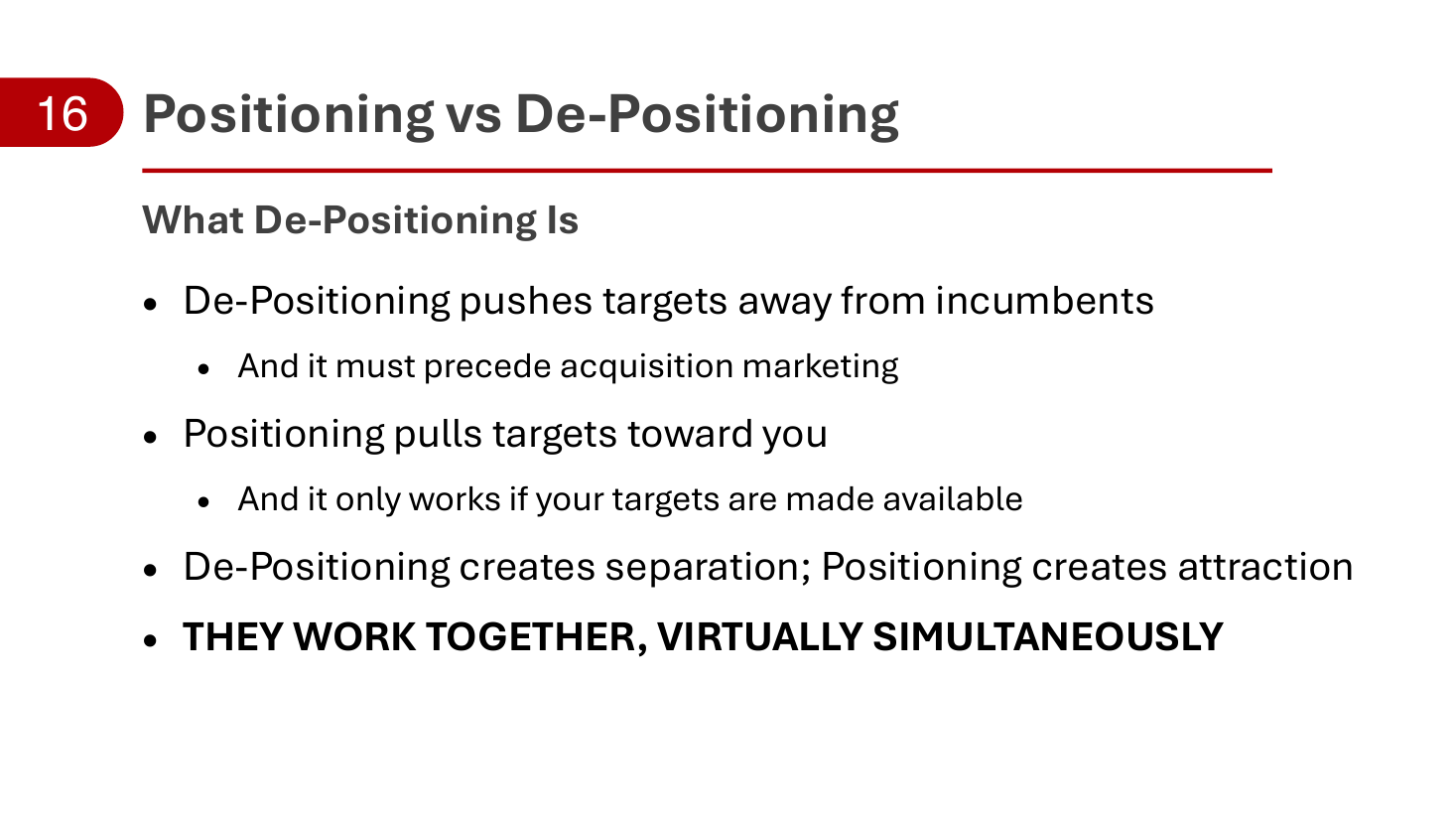
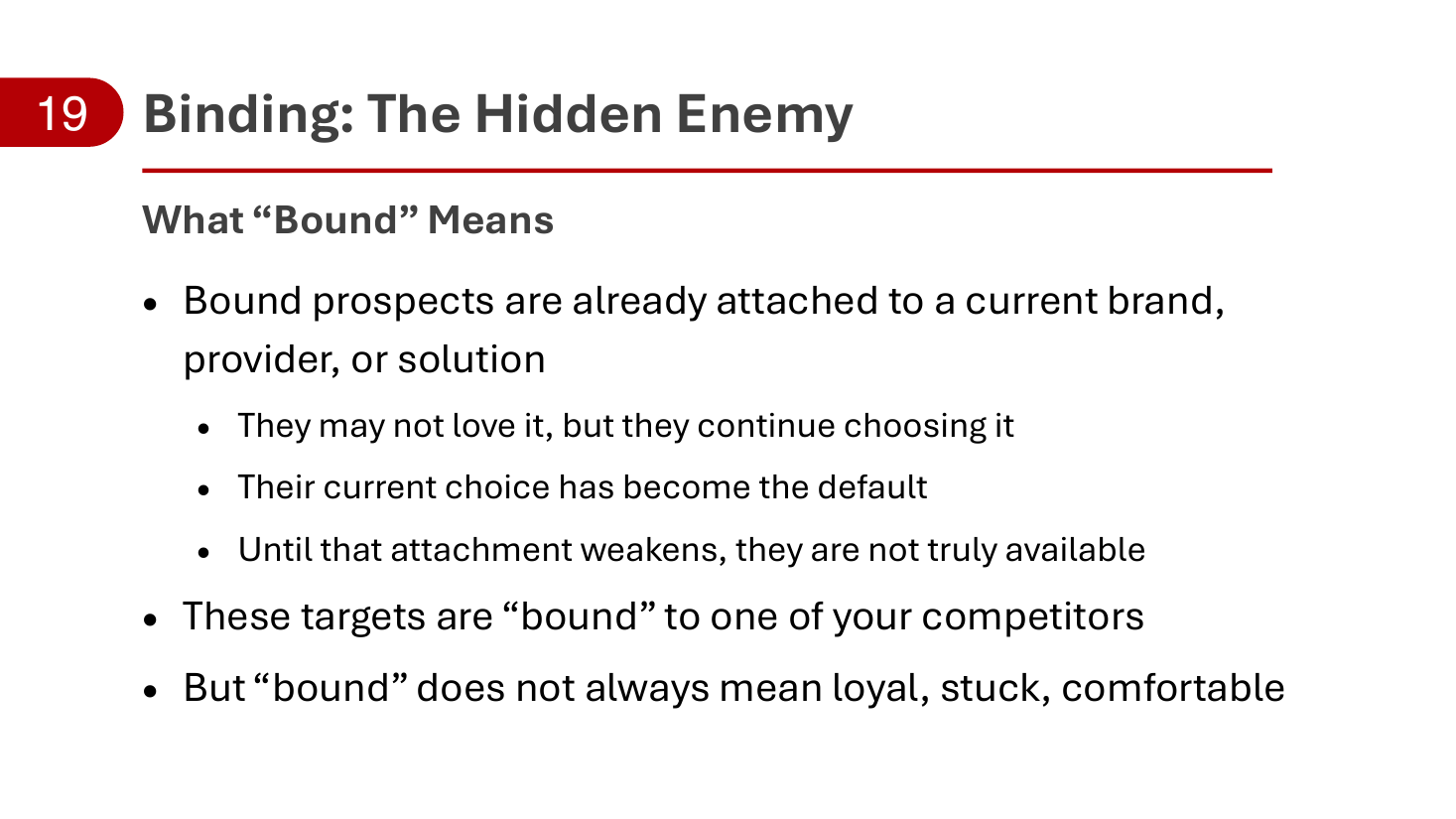
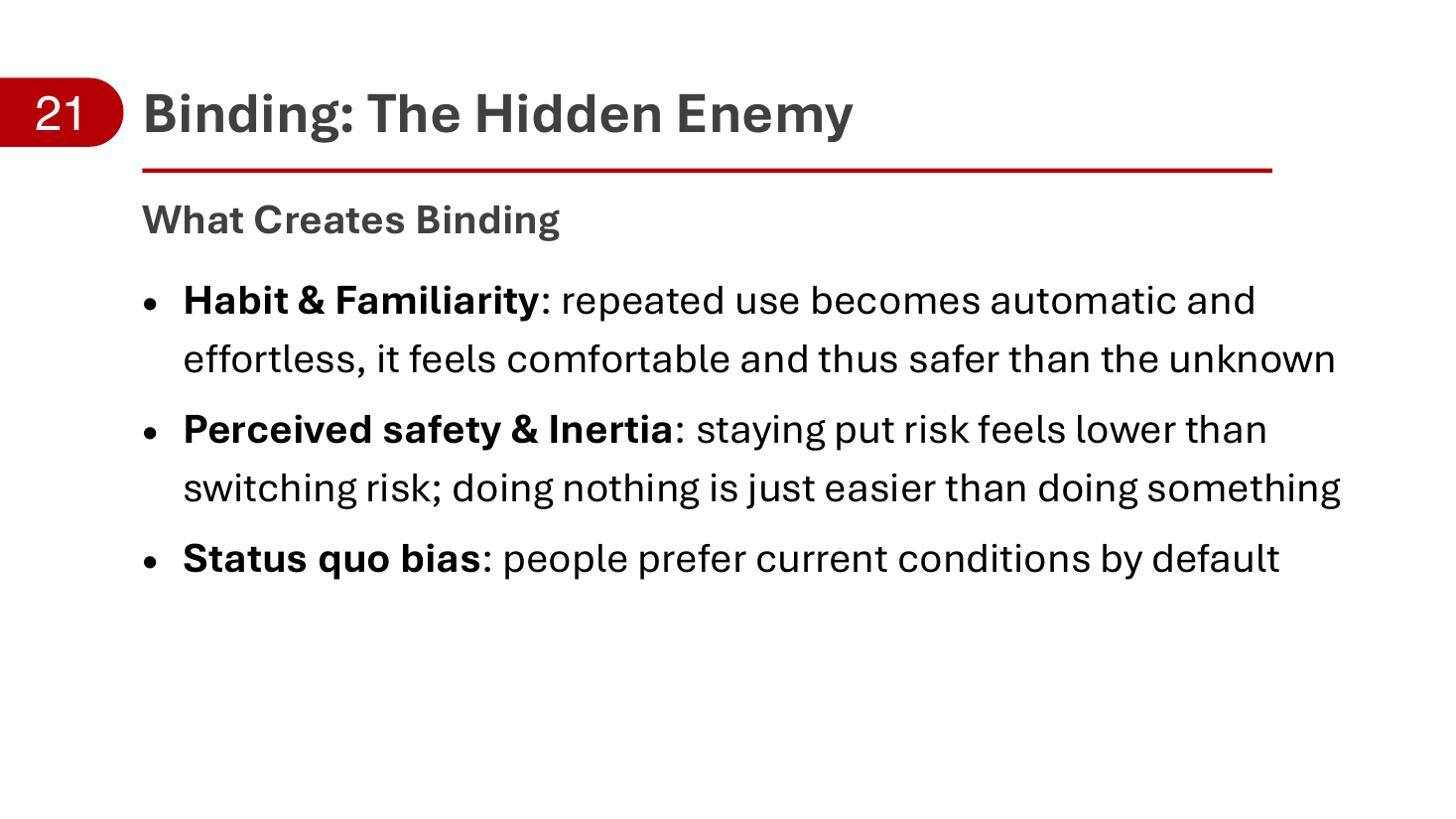
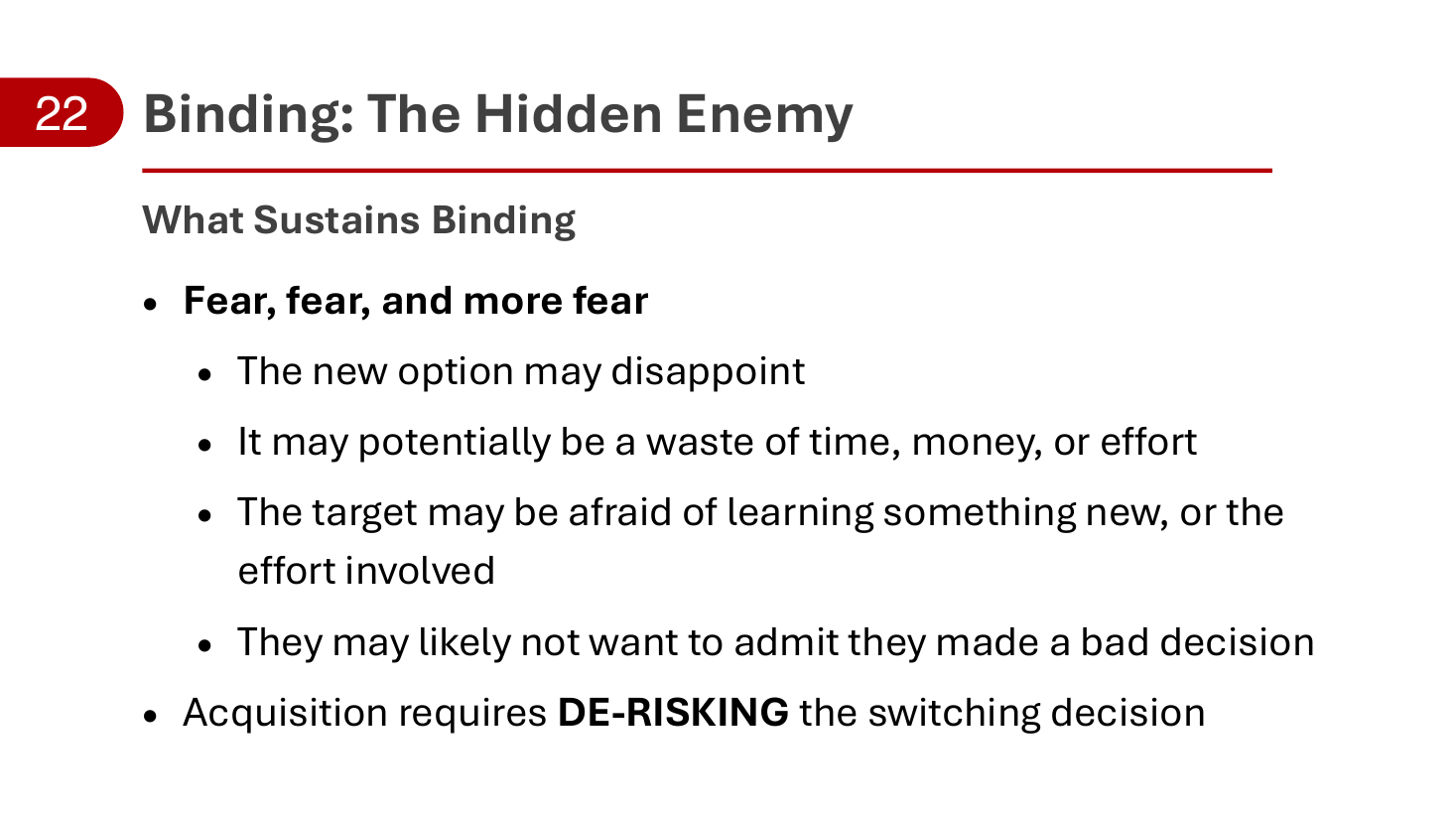
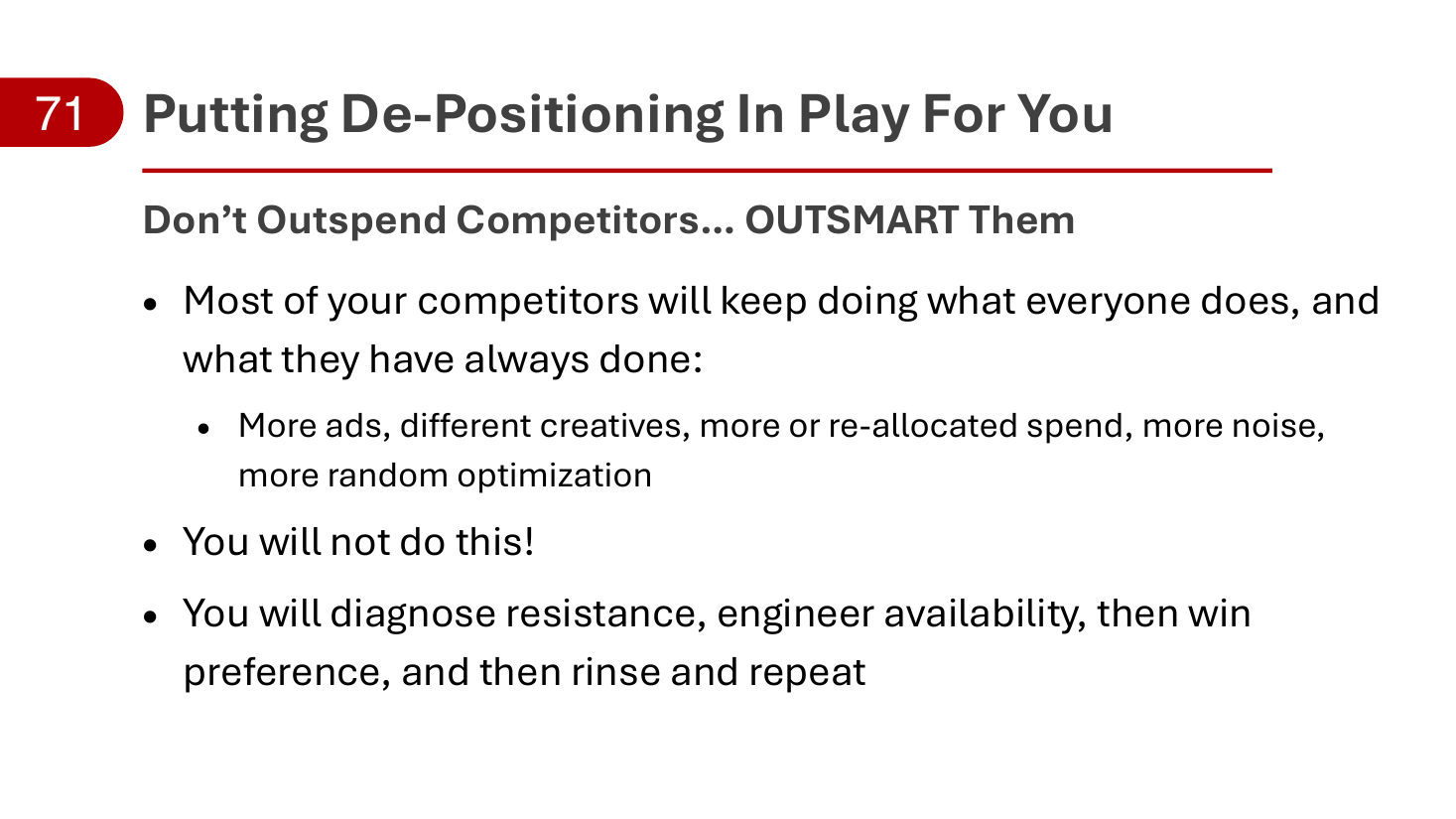
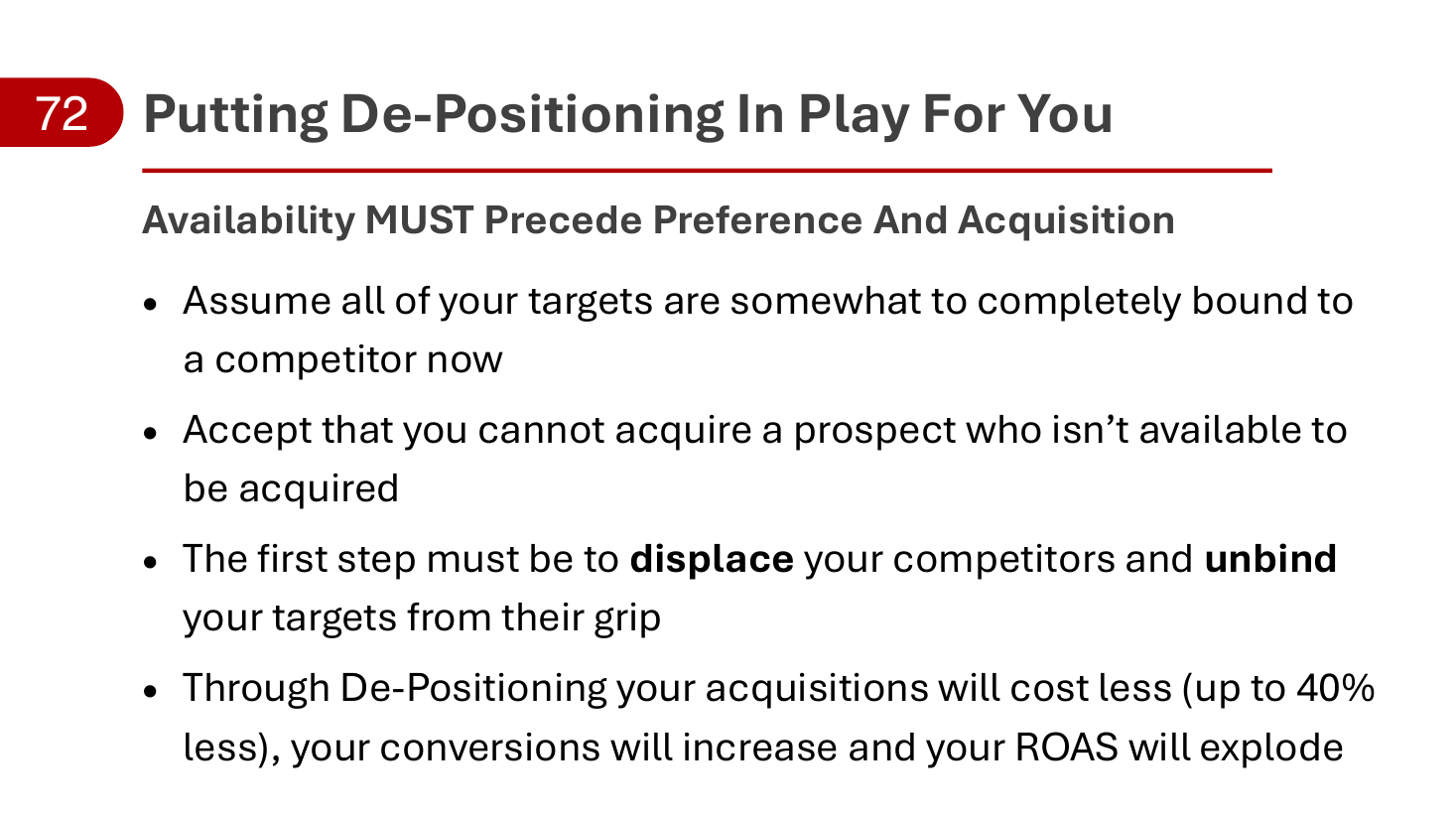
- Acquisition is displacement, not demand creation, so you must unbind targets from competitors first. Marion argues 95%+ of any competitive market is already buying from someone, so growth comes from share transfer. The first job is "activation": giving a bound prospect a reason to pause and reconsider before positioning tries to win them.
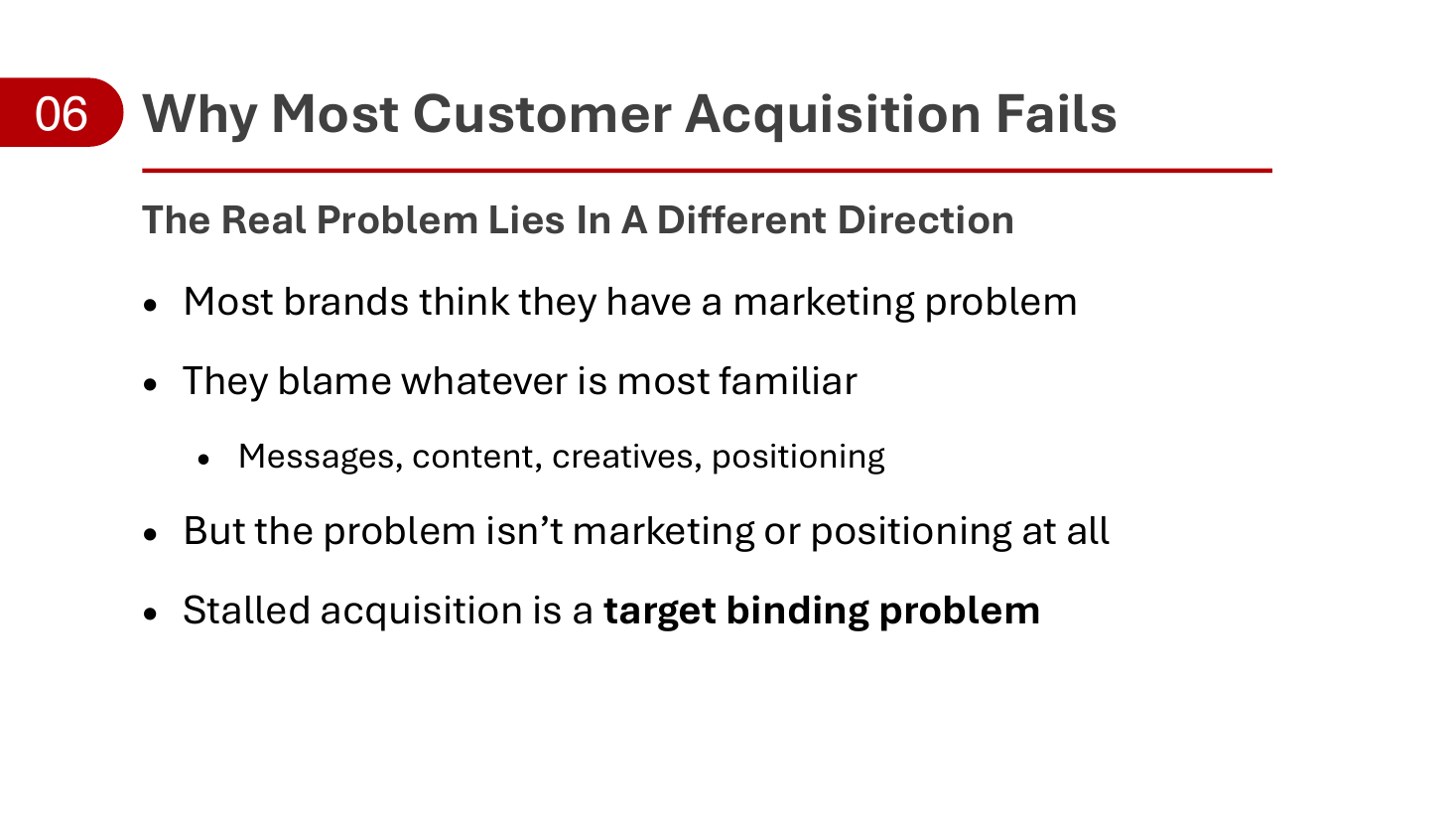
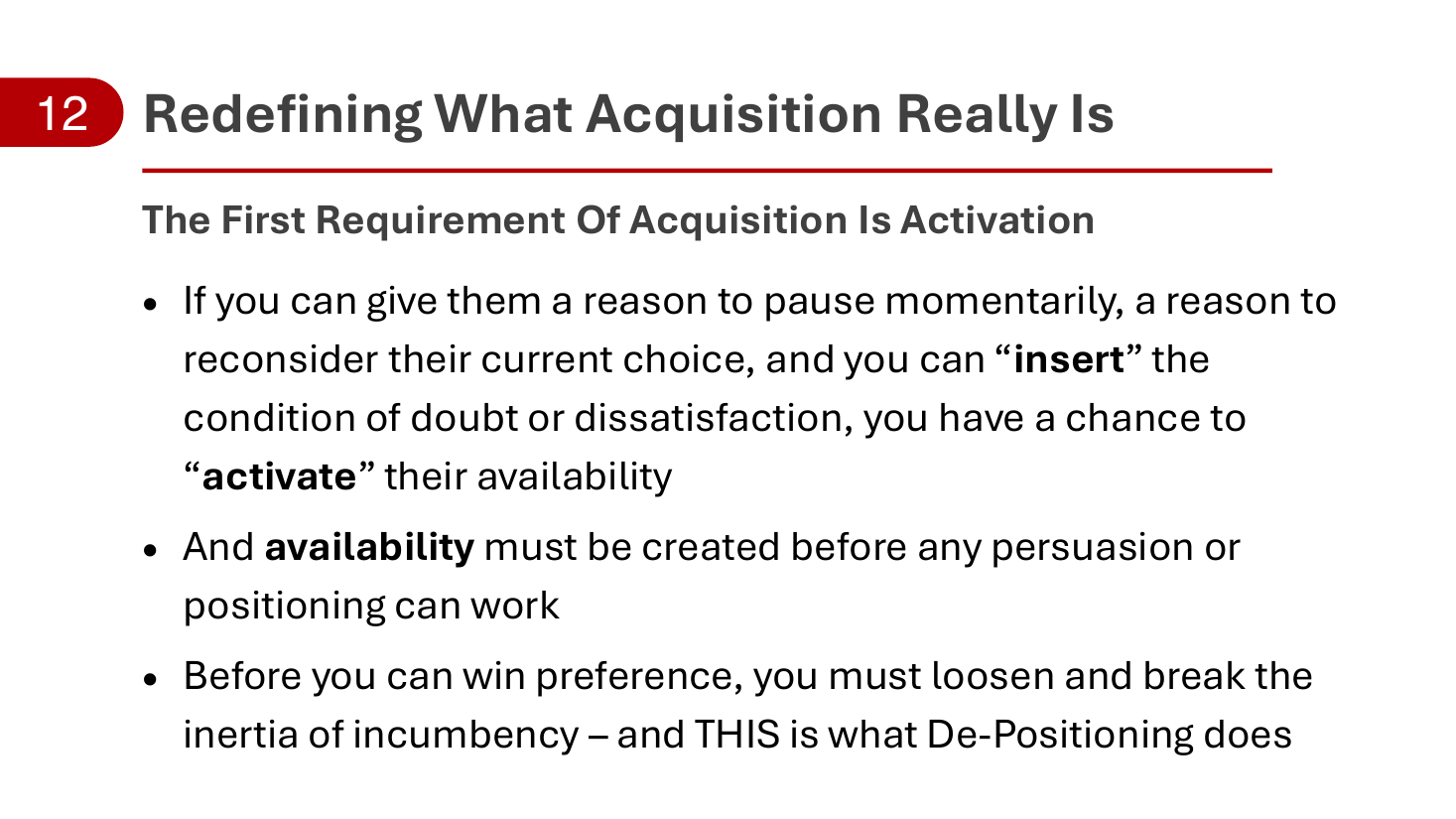
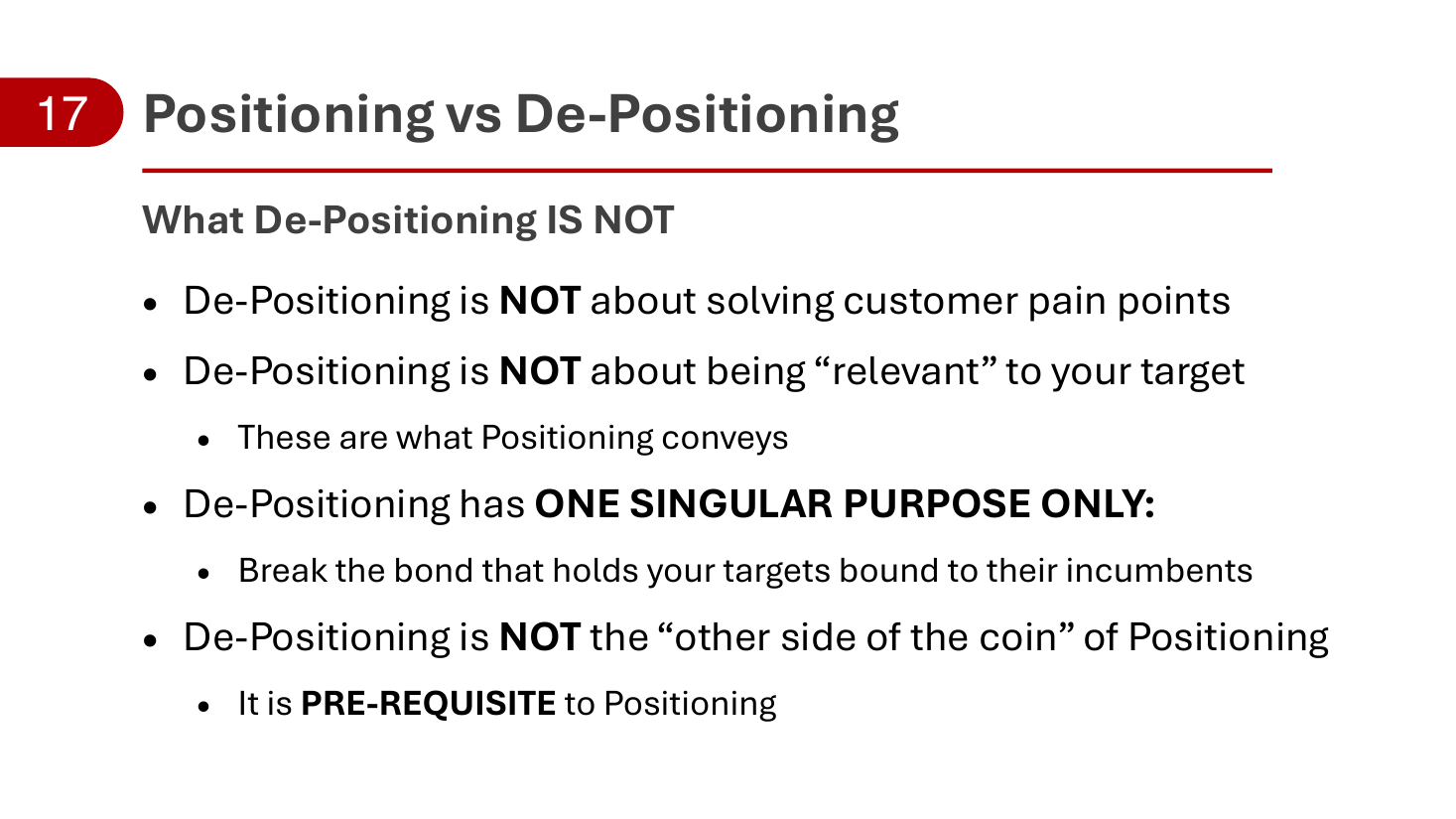
- De-positioning is a prerequisite to positioning, not its opposite. Positioning shapes how a target perceives you, but it fails if the target's mind is closed and committed to an incumbent. De-positioning has one purpose: break the bond holding the target to their current provider.
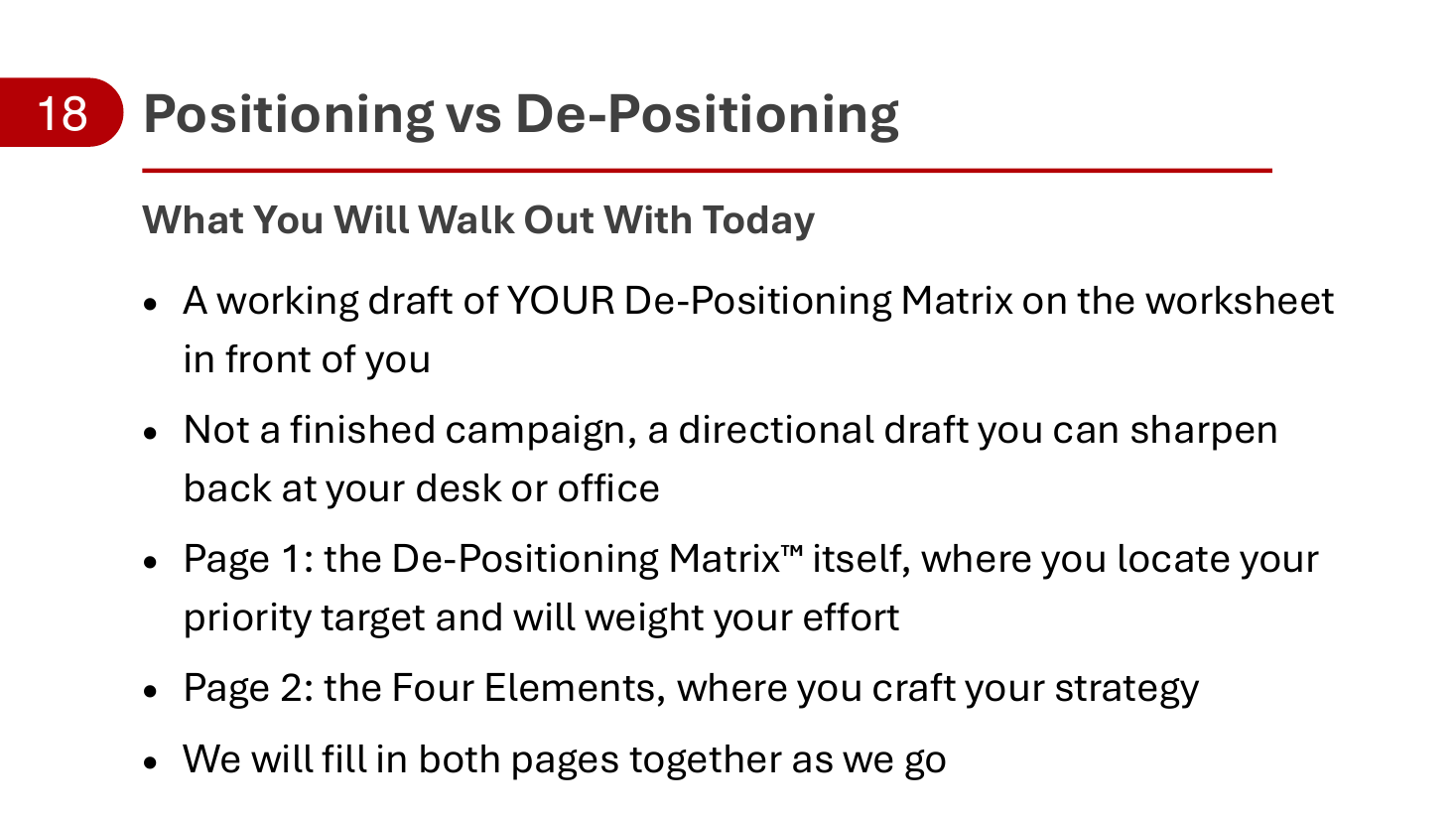
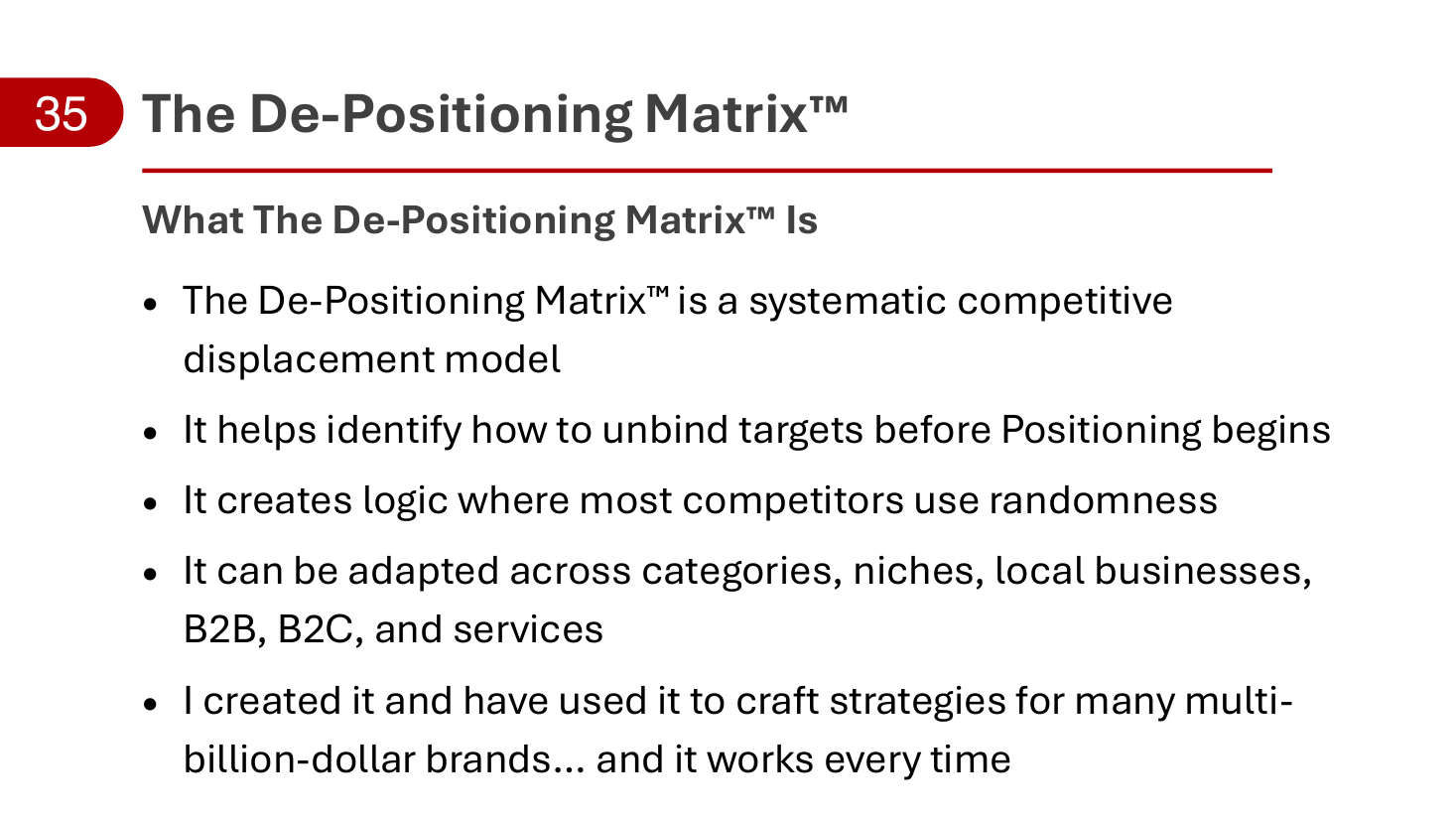
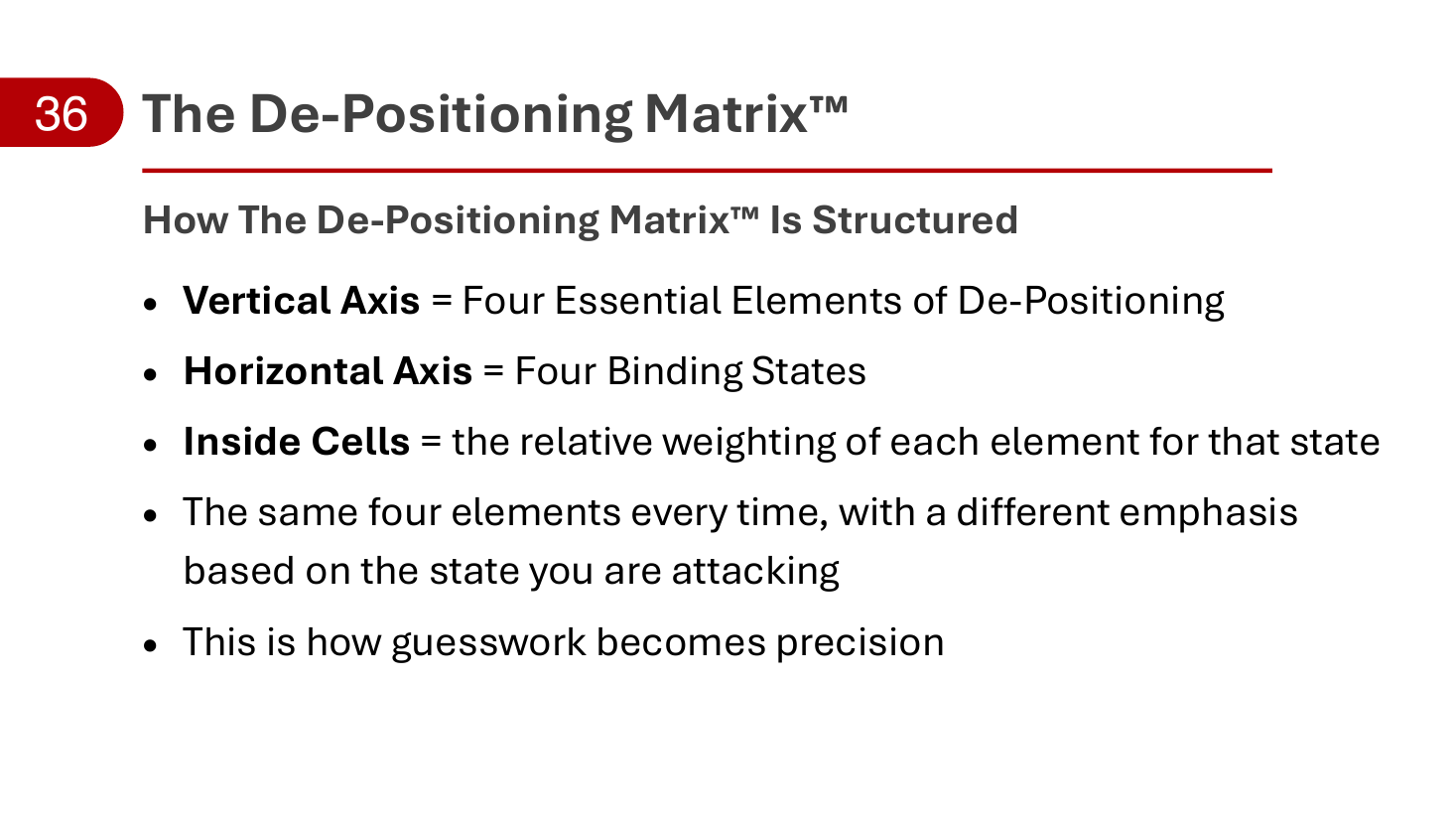
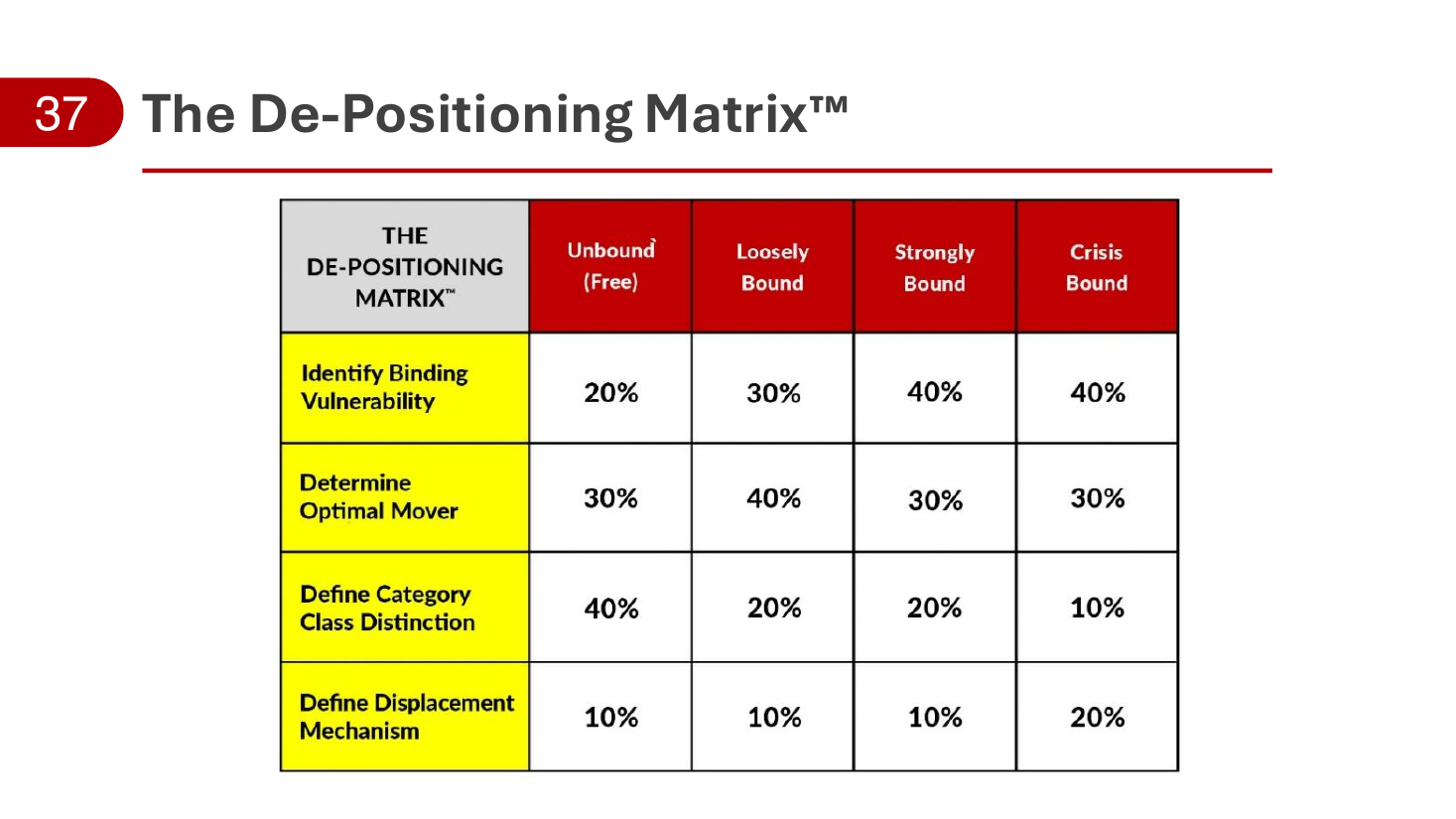
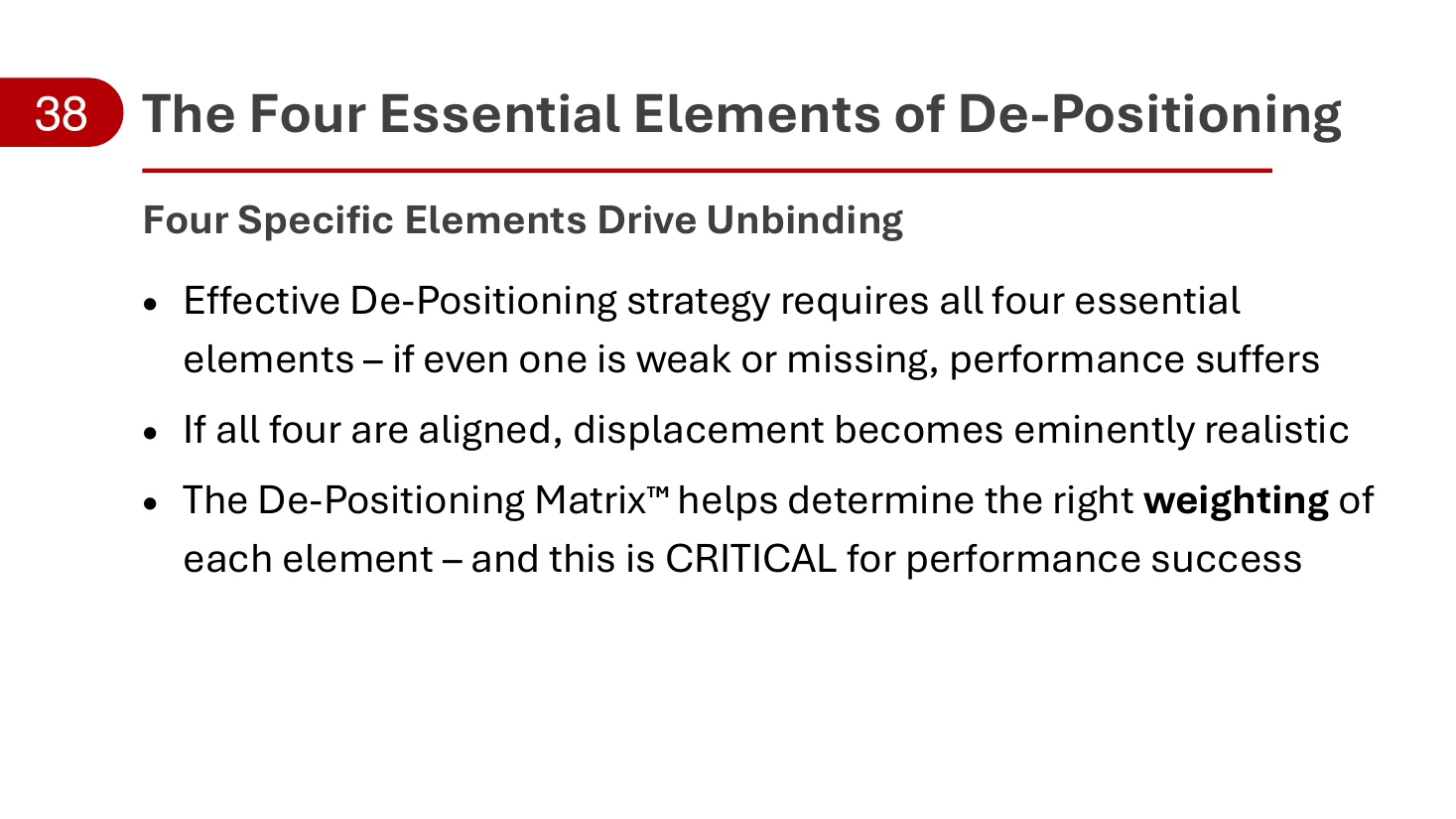
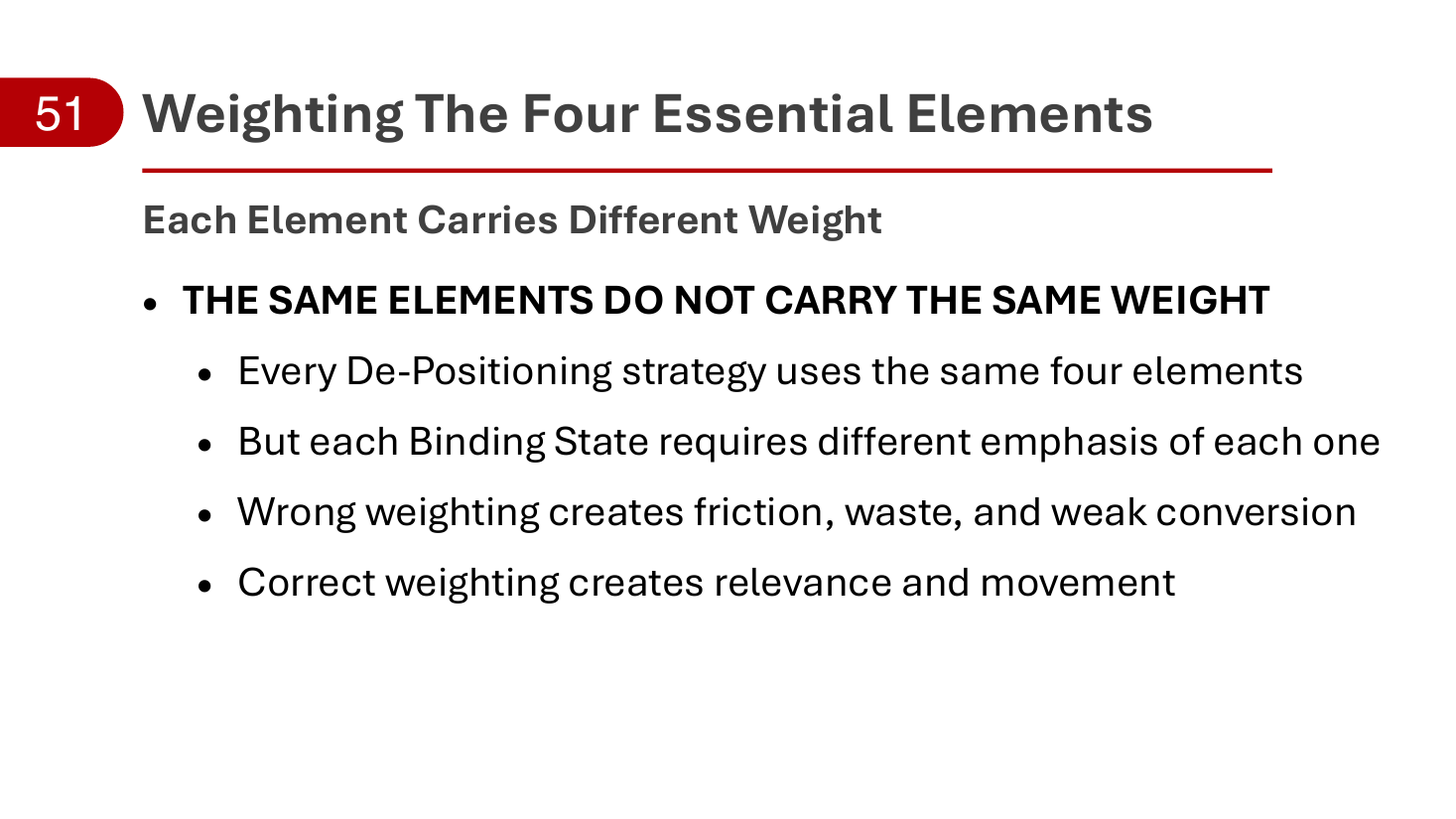
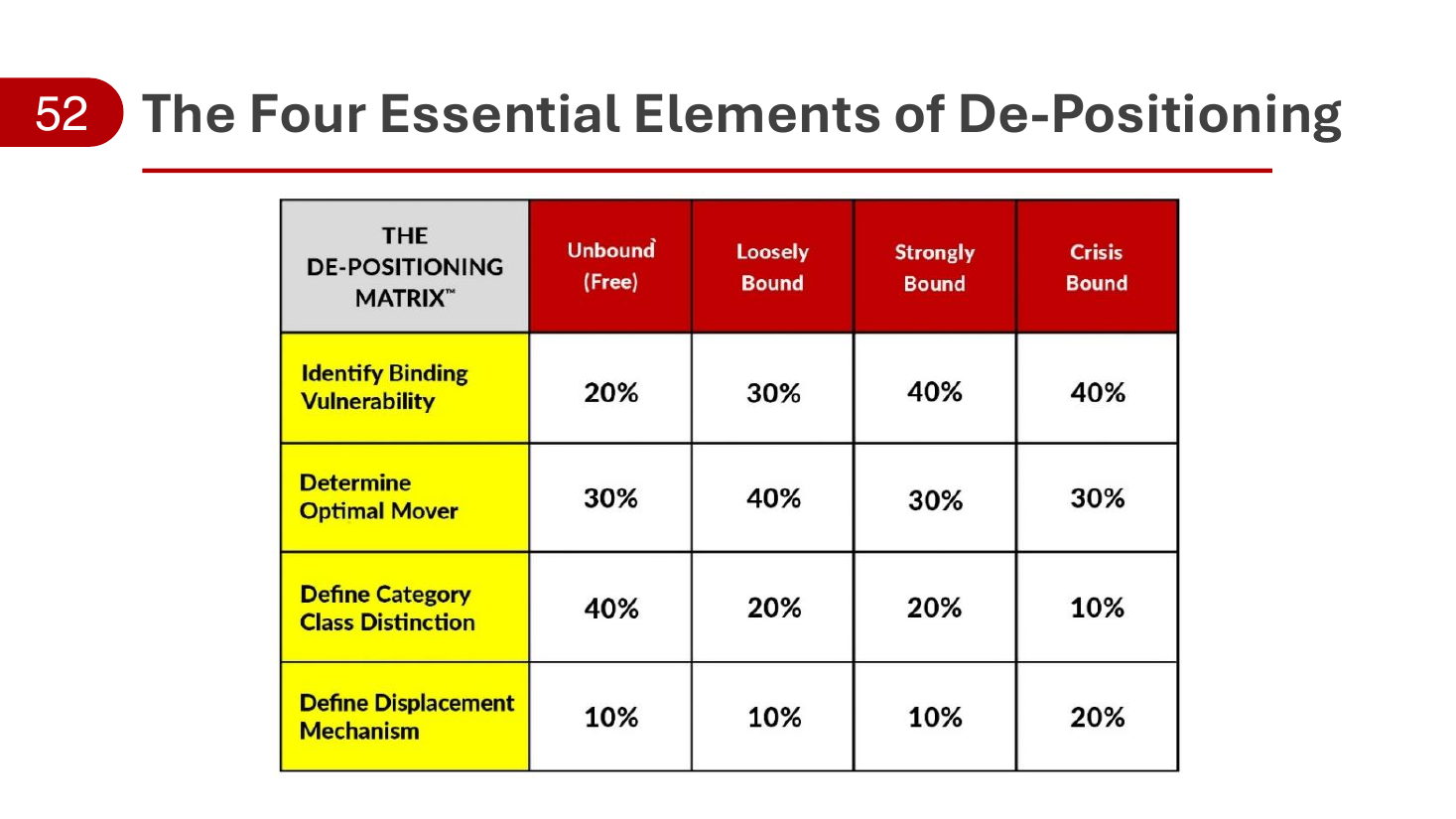
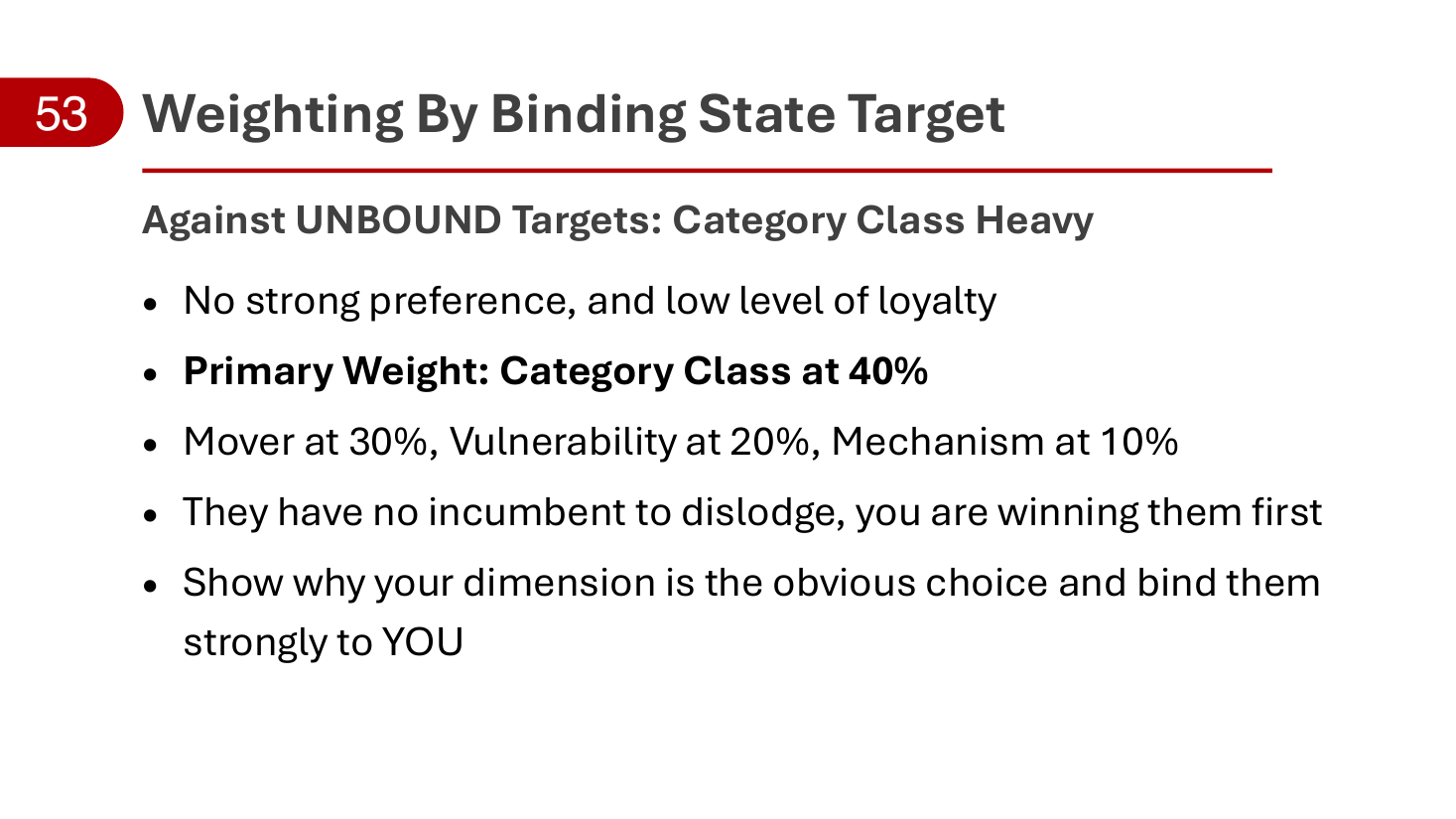
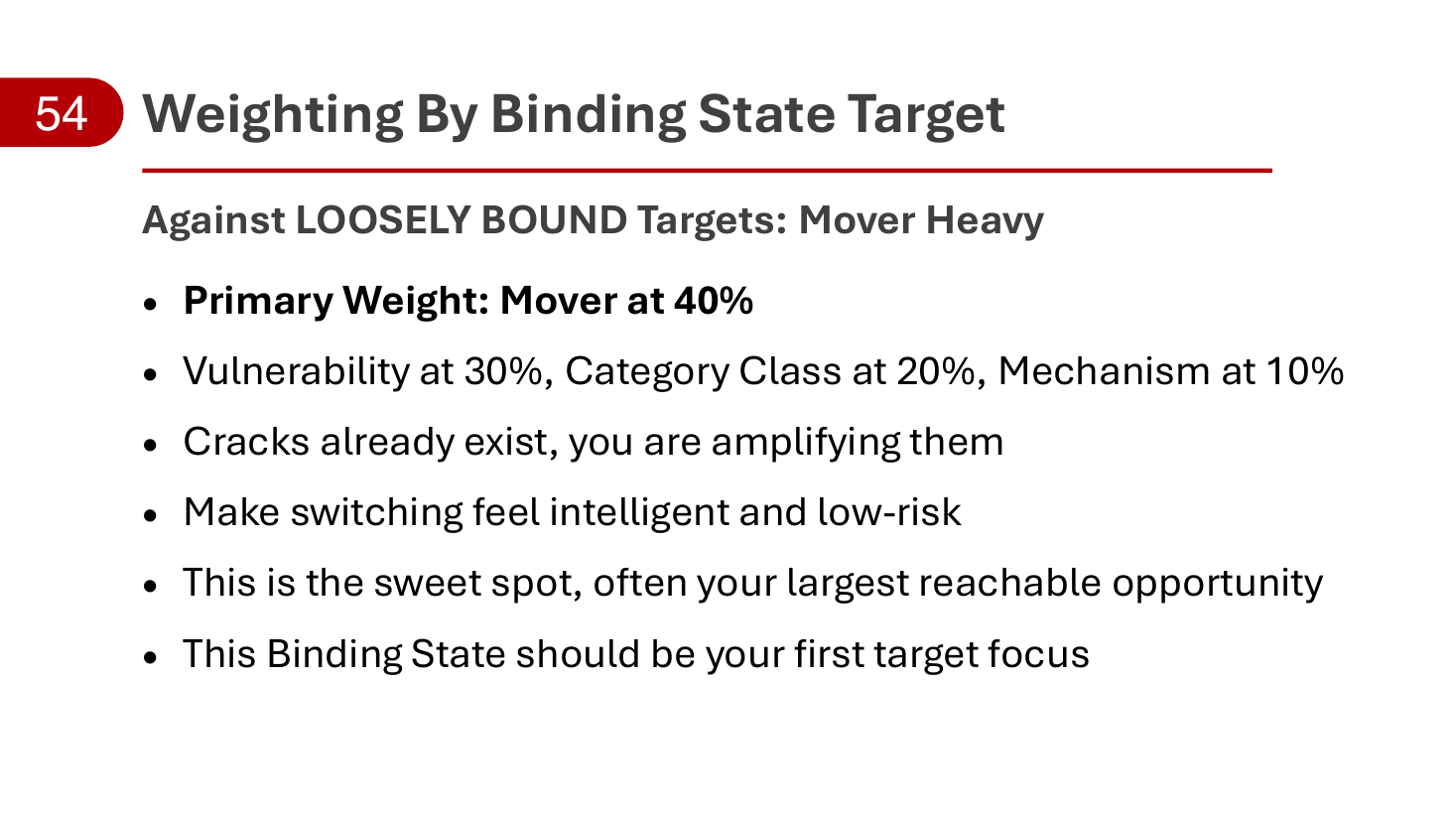
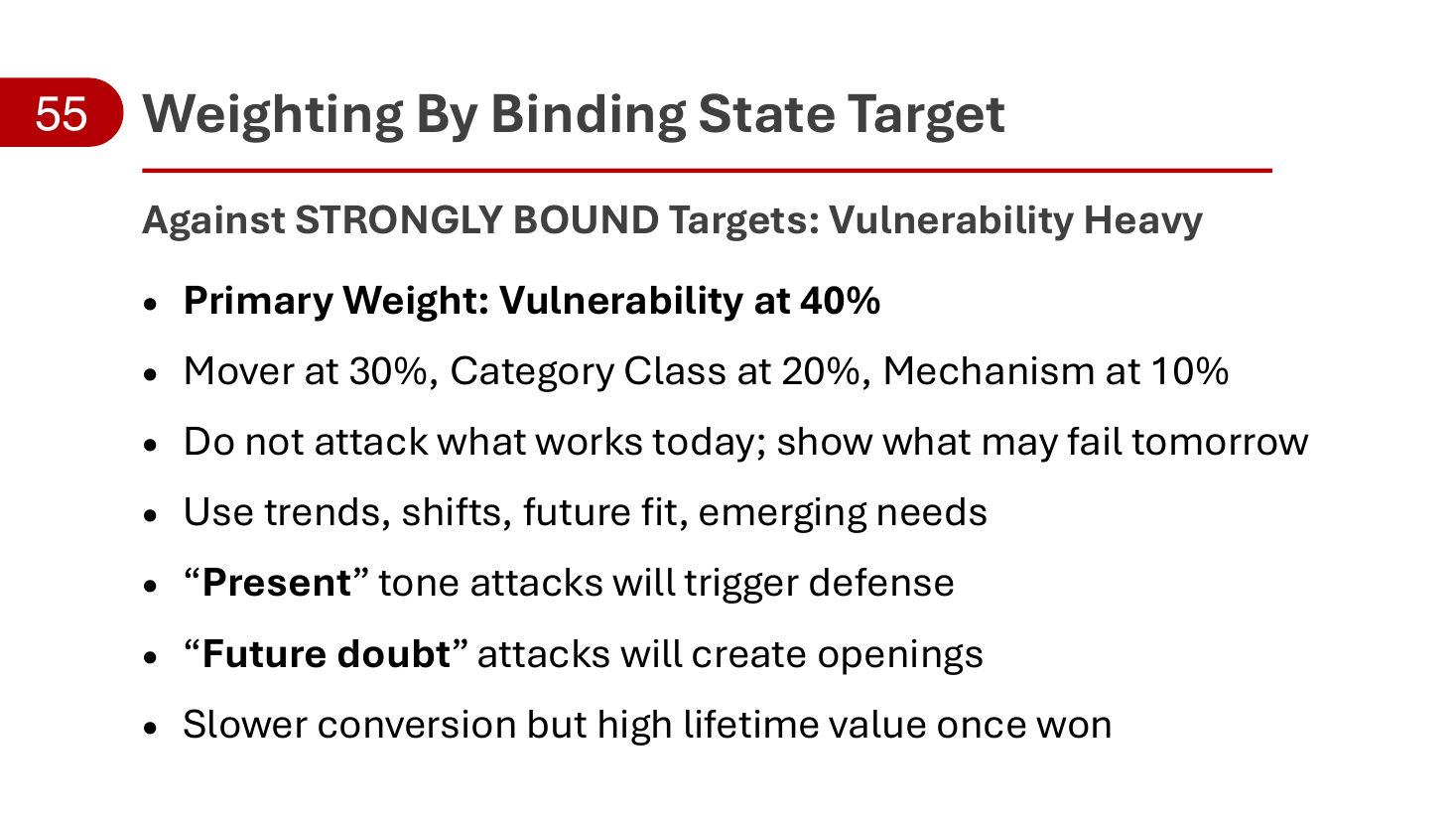
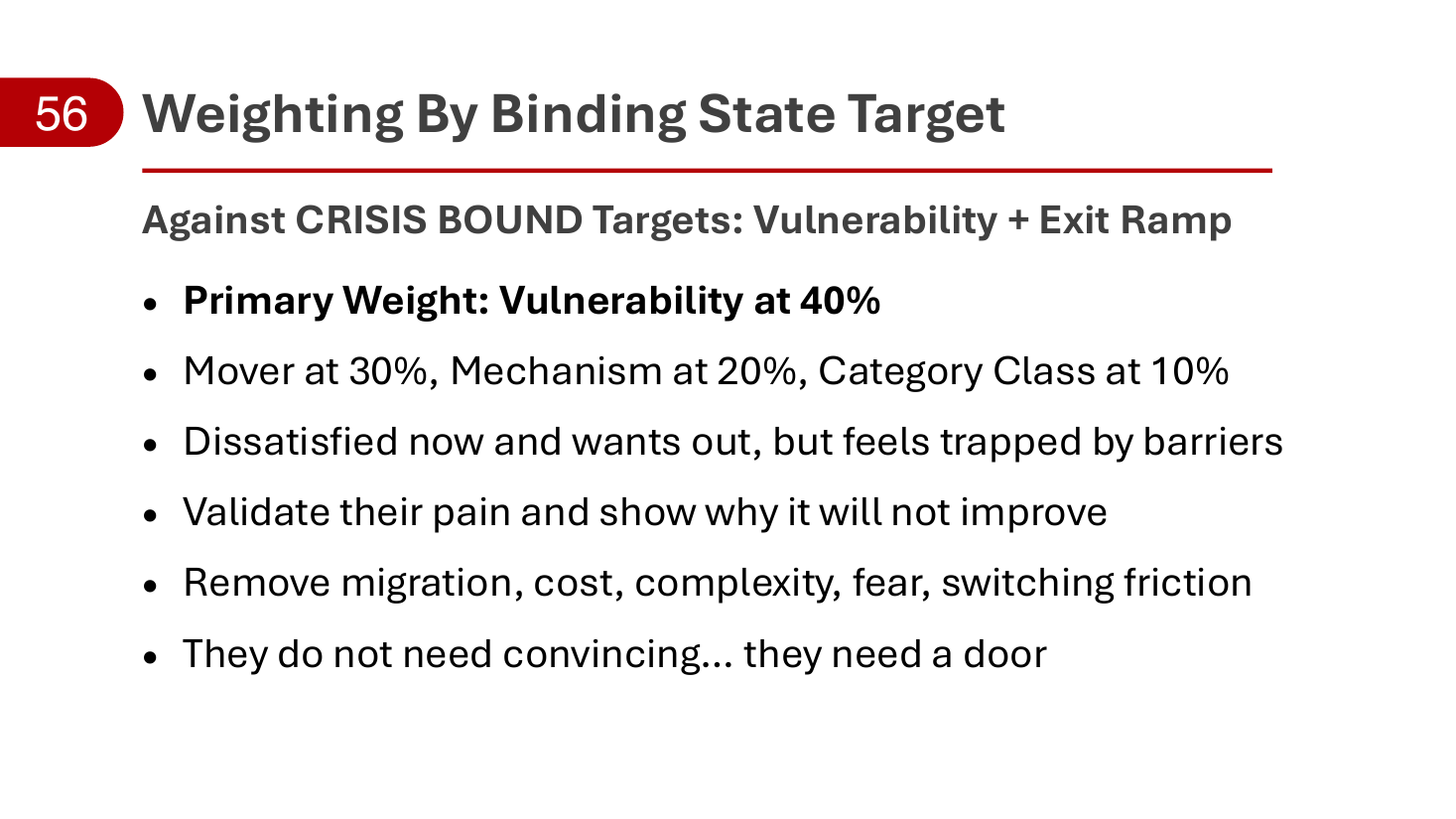
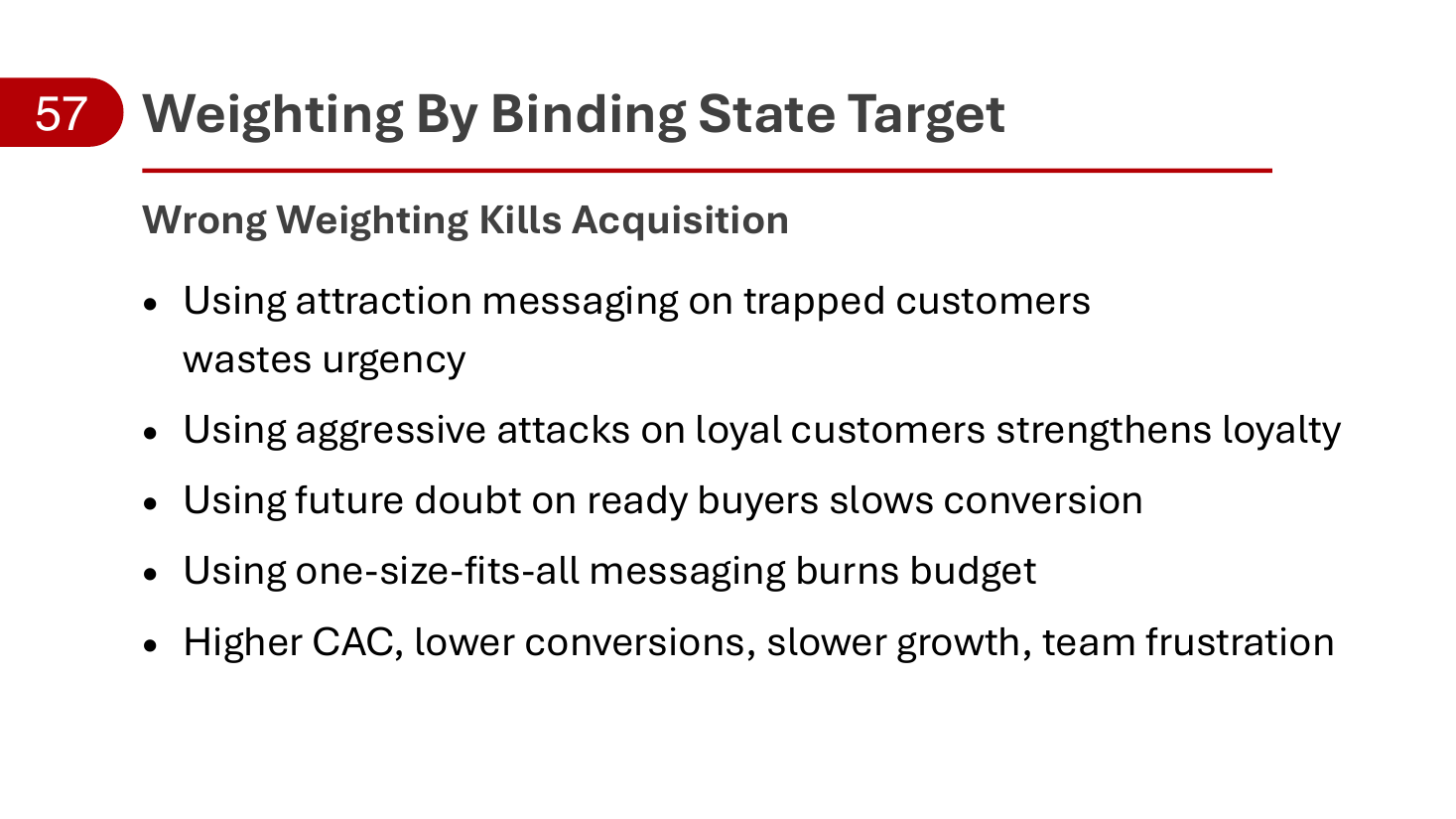
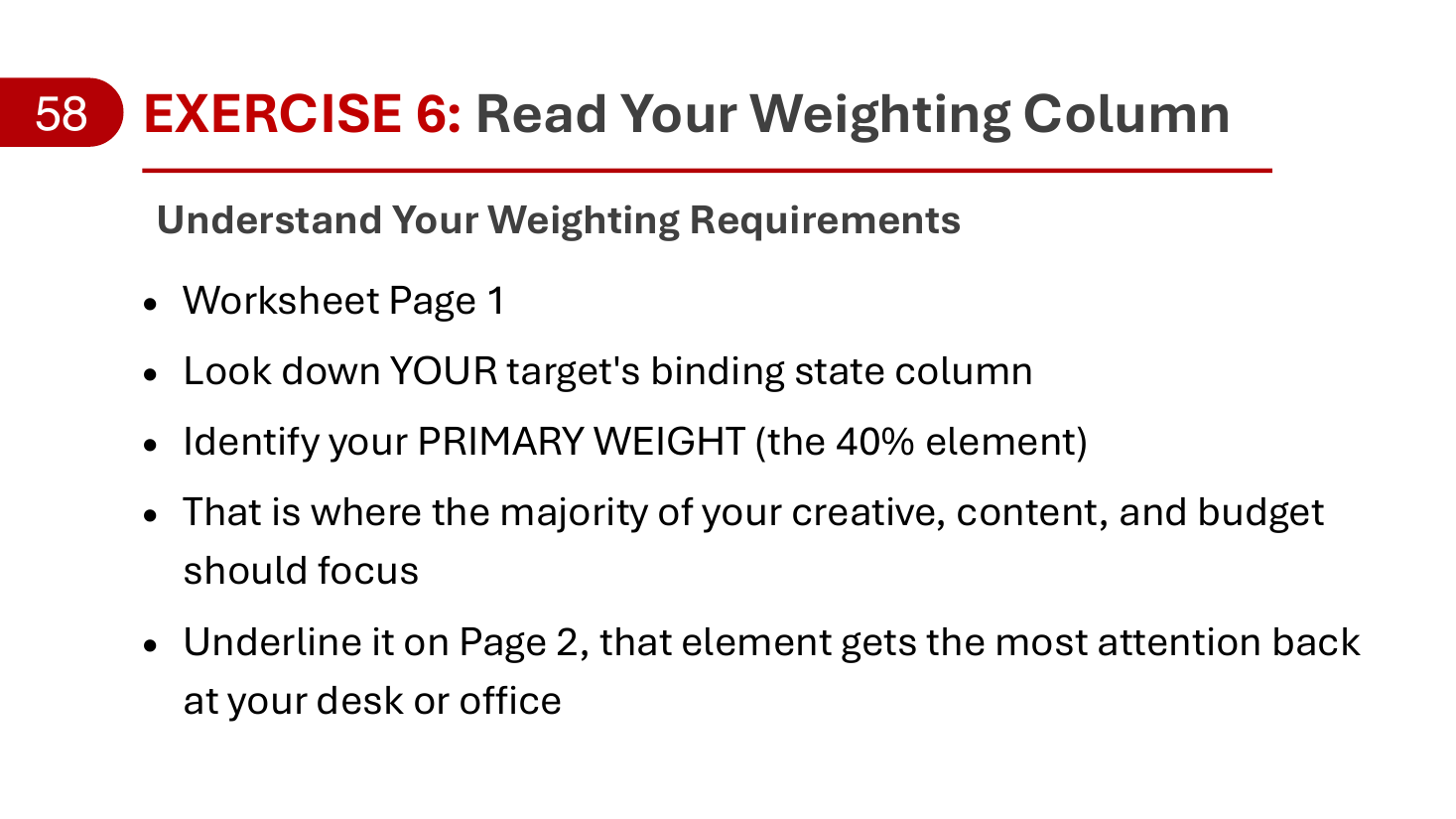
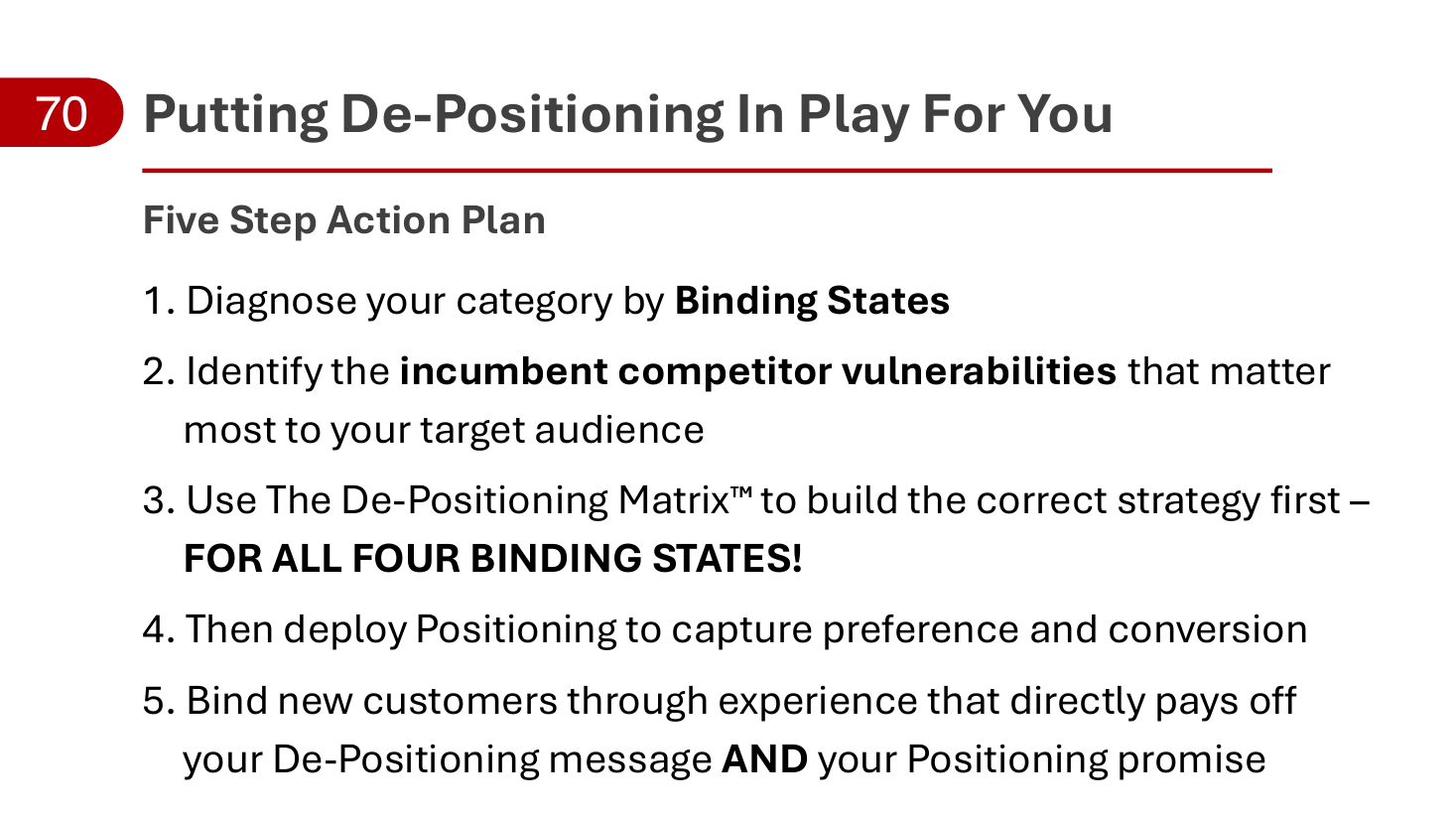
- The De-Positioning Matrix maps four binding states against four essential elements, with different weightings per state. Unbound, Loosely Bound, Strongly Bound, and Crisis Bound targets each require a different primary emphasis among Vulnerability, Mover, Category Class, and Displacement Mechanism. Wrong weighting wastes budget.
- Success is 90% mindset and 10% skillset, and the enemy is the "chimp brain" fight-or-flight response. Austin frames every new problem as a biological threat reaction that the logical brain must consciously override, trained through voluntary discomfort (he cold-plunges with the mantra "no negotiations").
- Problems sort into three types and two categories, which dictates the response. Normal and abnormal problems are "peacetime" (about 99% of life); extinction-level problems are "wartime." Identifying the type prevents over-reacting or under-reacting.
- Lead with solutions, not problems: the one-three-one rule enforces accountability. Borrowed from Dan Martell's "Buy Back Your Time," team members must bring one well-stated problem, three solutions, and one recommendation they are accountable for.
- Keyword density math still beats unguided AI content, and links still work. Roof's "where the sidewalk ends" testing (no-results SERPs as a clean lab) and his Rhinoplasty Plano lorem ipsum experiment show Google ranks on mathematical keyword and contextual-term factors. LLMs score poorly on those terms out of the box and strip terms when asked to optimize.
Key points
Marty Marion (de-positioning)
Speaker framing:
- Self-described former Madison Avenue strategist (senior director / VP of strategic planning for three of "the world's largest advertising agencies"); calls himself one of "the mad men."
- Says he opened SEO Spring Training in 2019 (its first year) and has opened it every year since; spoke on "Tech Day" the day before.
- Claims his de-positioning technique is responsible for "over three hundred and fifty billion dollars of incremental revenue" for already-global category leaders (speaker claim, unverified).
- Says the USPTO granted him registered trademark status for the De-Positioning Matrix that week.
- Website: masterpositioning.com. Email: marty@masterpositioning.com. Book: "Advanced Brand Positioning and The De-Positioning Matrix," 350 pages.
Core claims and numbers:
- "Sixty to seventy percent of everybody who enrolls in any kind of loyalty or retention program attrites that program in less than seven months" (and the number rises over a year).
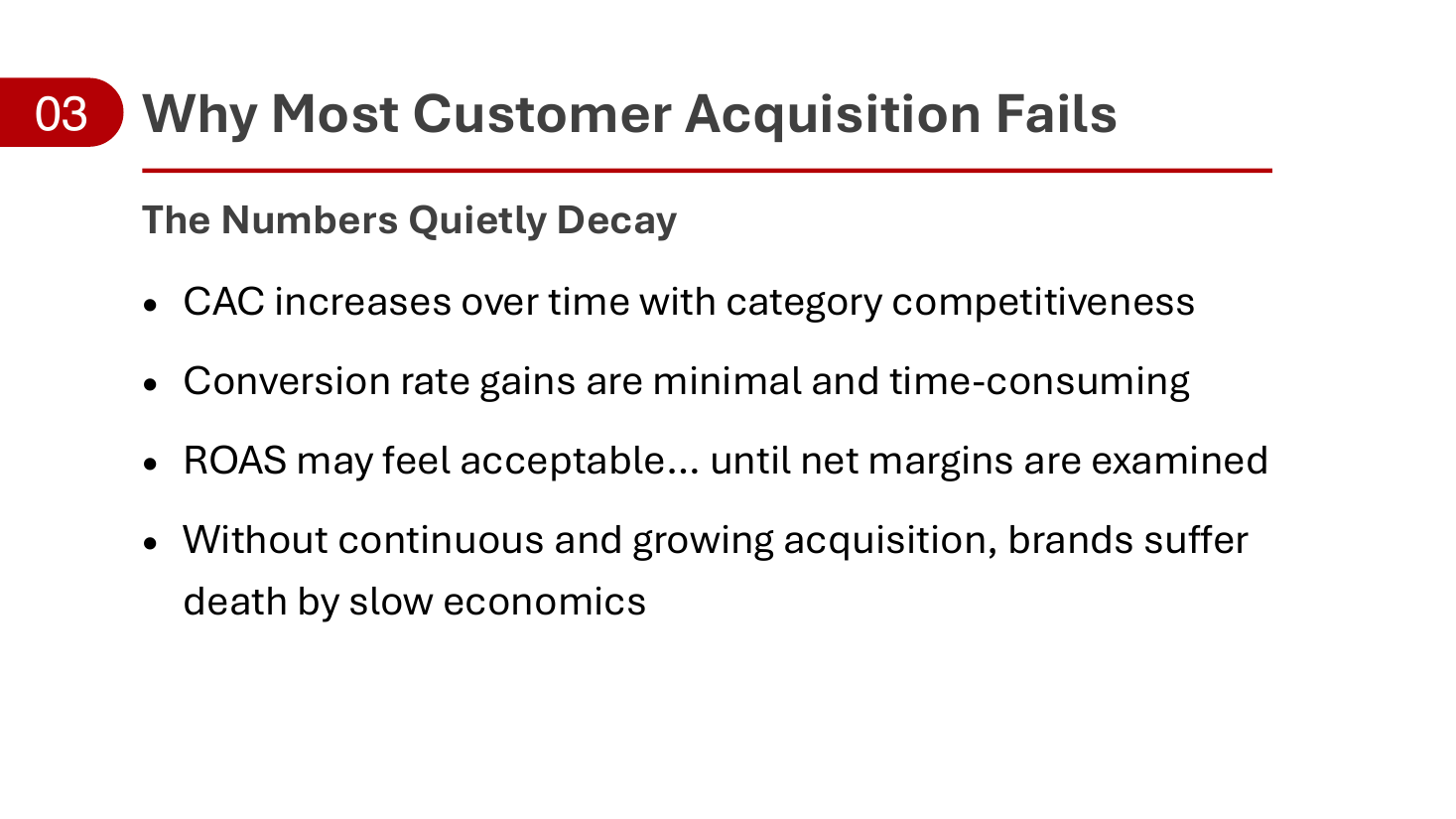
- "If your rate of new customer and client acquisition does not exceed your rate of attrition... your business is going out of business, you just don't know it yet."
- "95%+ of your targets are already buying" from someone else; acquisition begins in an already-occupied market.
- Acquisition is a zero-sum game: "For you to win a customer, another brand must lose one."
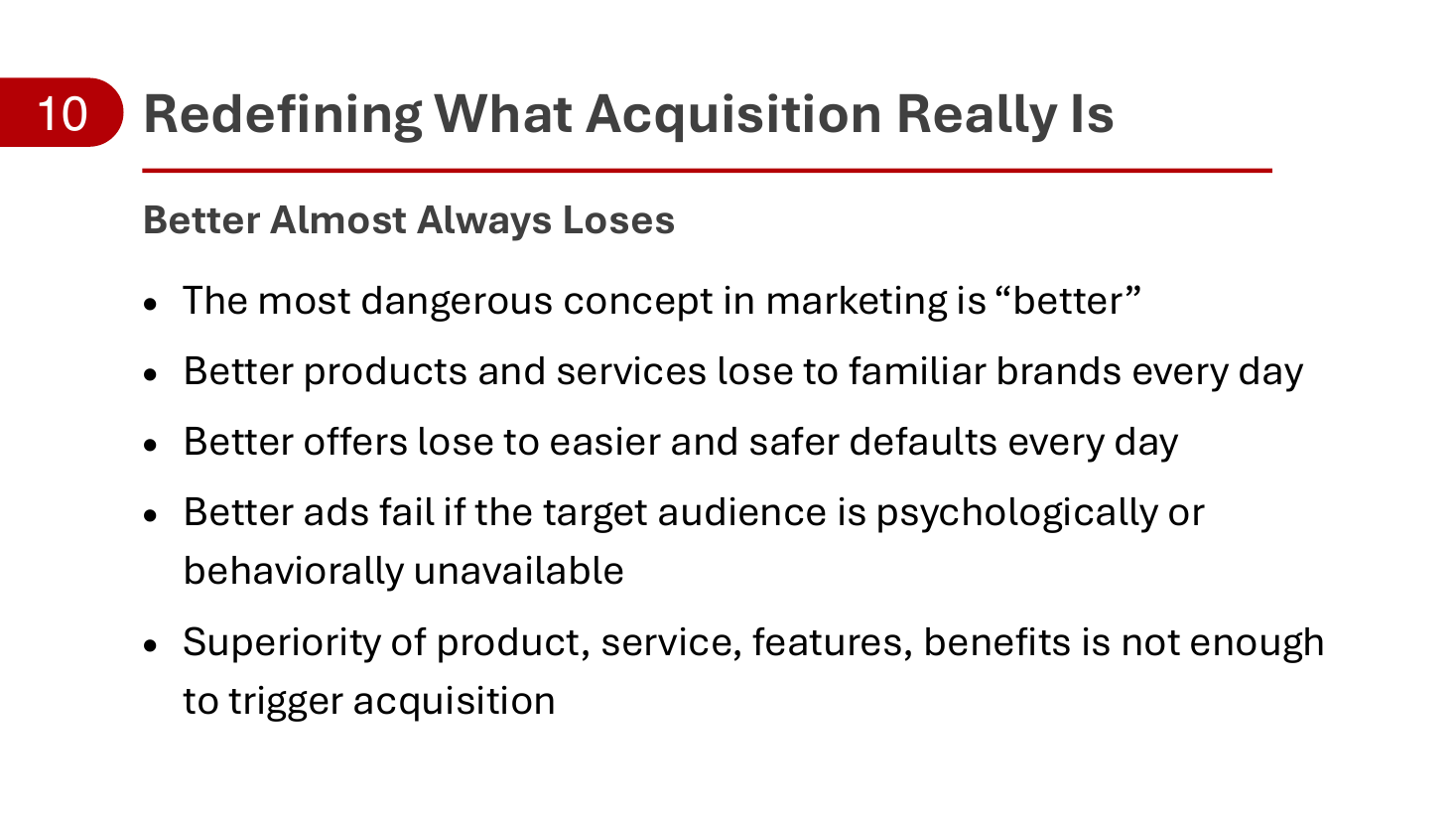
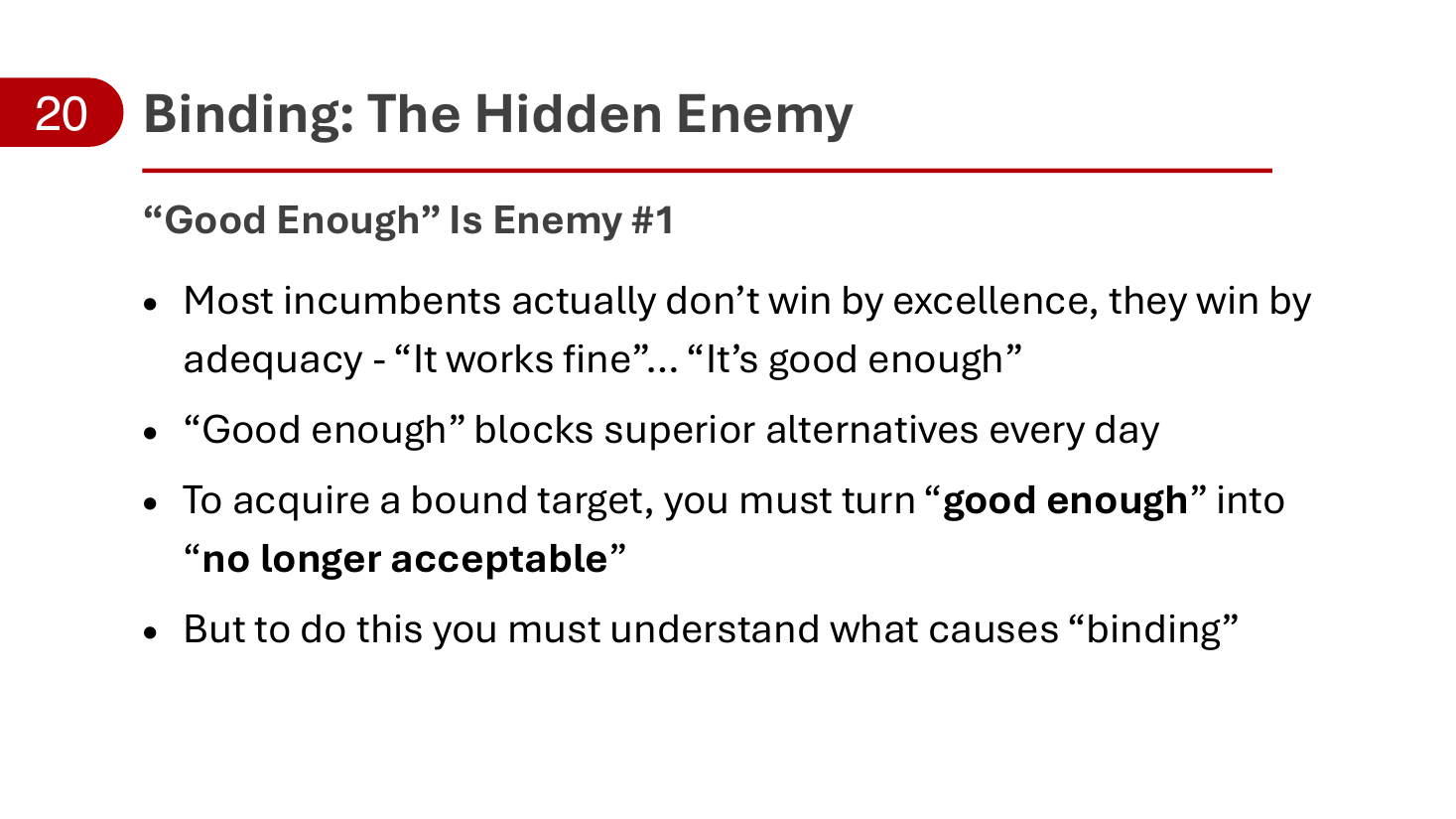
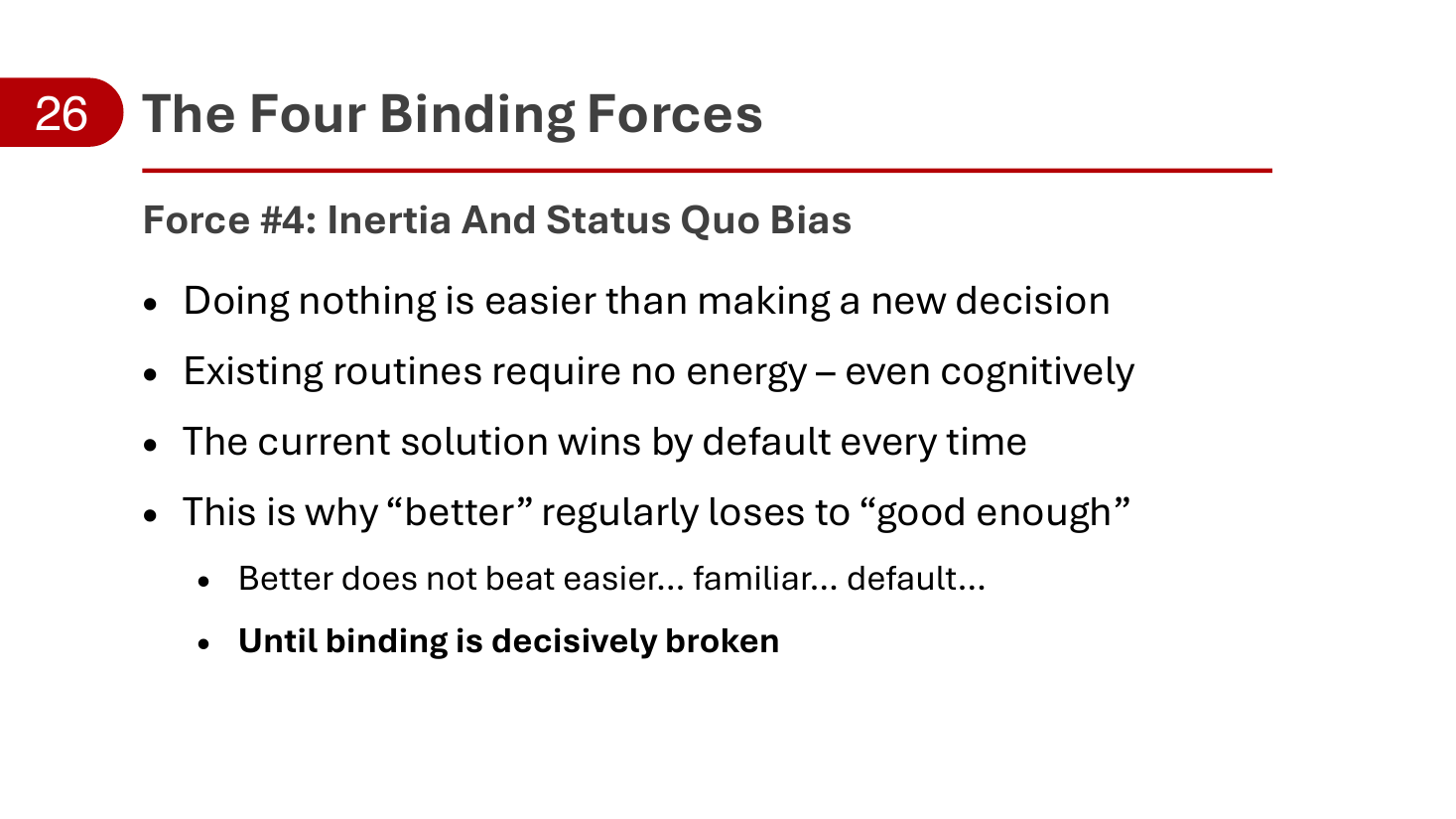
- "The most dangerous word in all of marketing is just better." Better loses to familiar, easier, safer defaults.
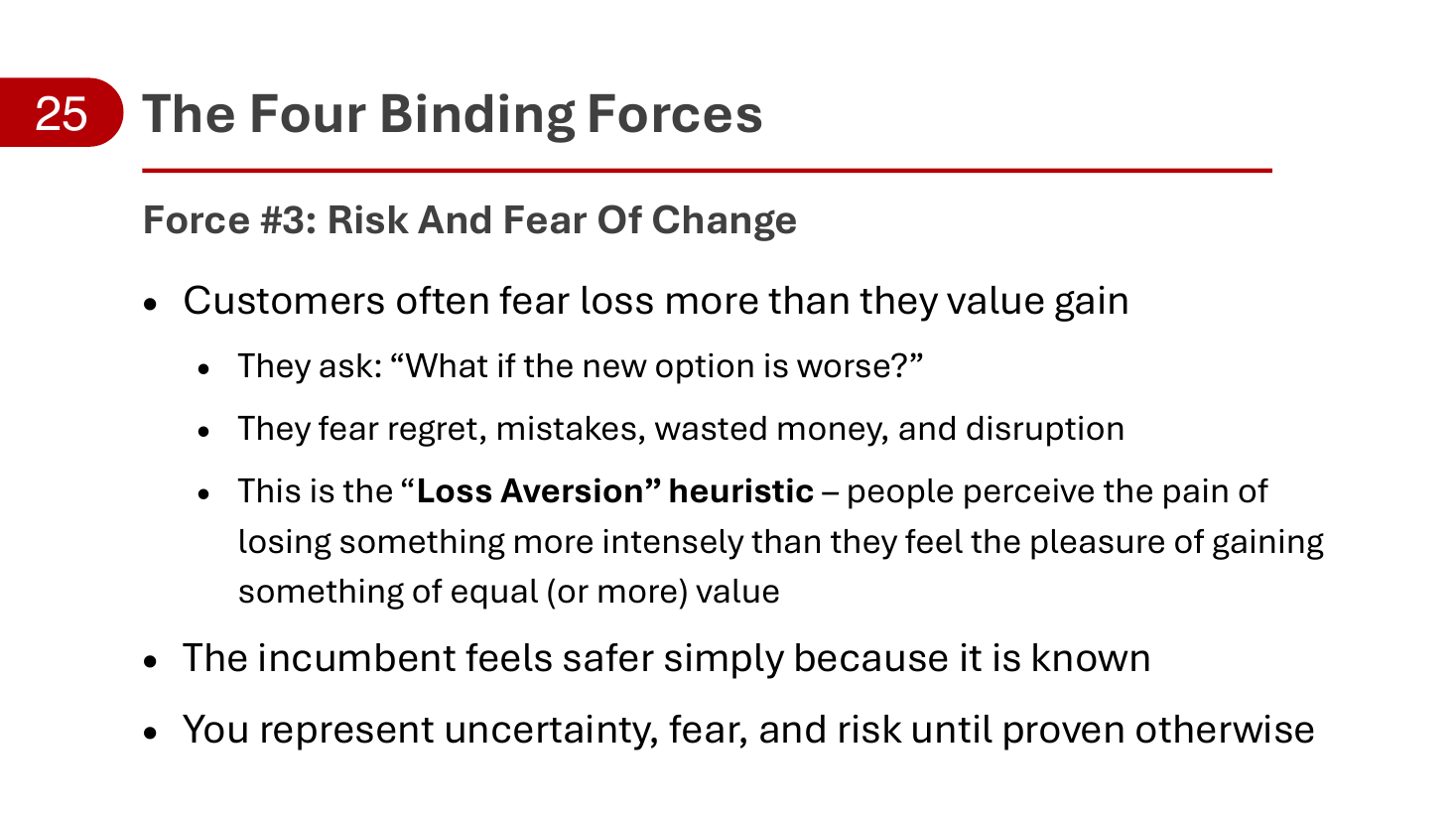
- Loss aversion: people fear losing something "three to four times more intensely" than they value an equal or greater gain (the deck states "loss aversion" without the multiplier).
- Through de-positioning, "your acquisitions will cost less (up to 40% less)" (deck slide 72).
- References Trout and Ries, "Positioning: The Battle for Your Mind" (1970s) as the origin of positioning theory, and the Zeigarnik effect (people are compelled to answer unanswered questions) as the hook behind open-question displacement.
The Four Binding Forces (what creates and sustains binding):
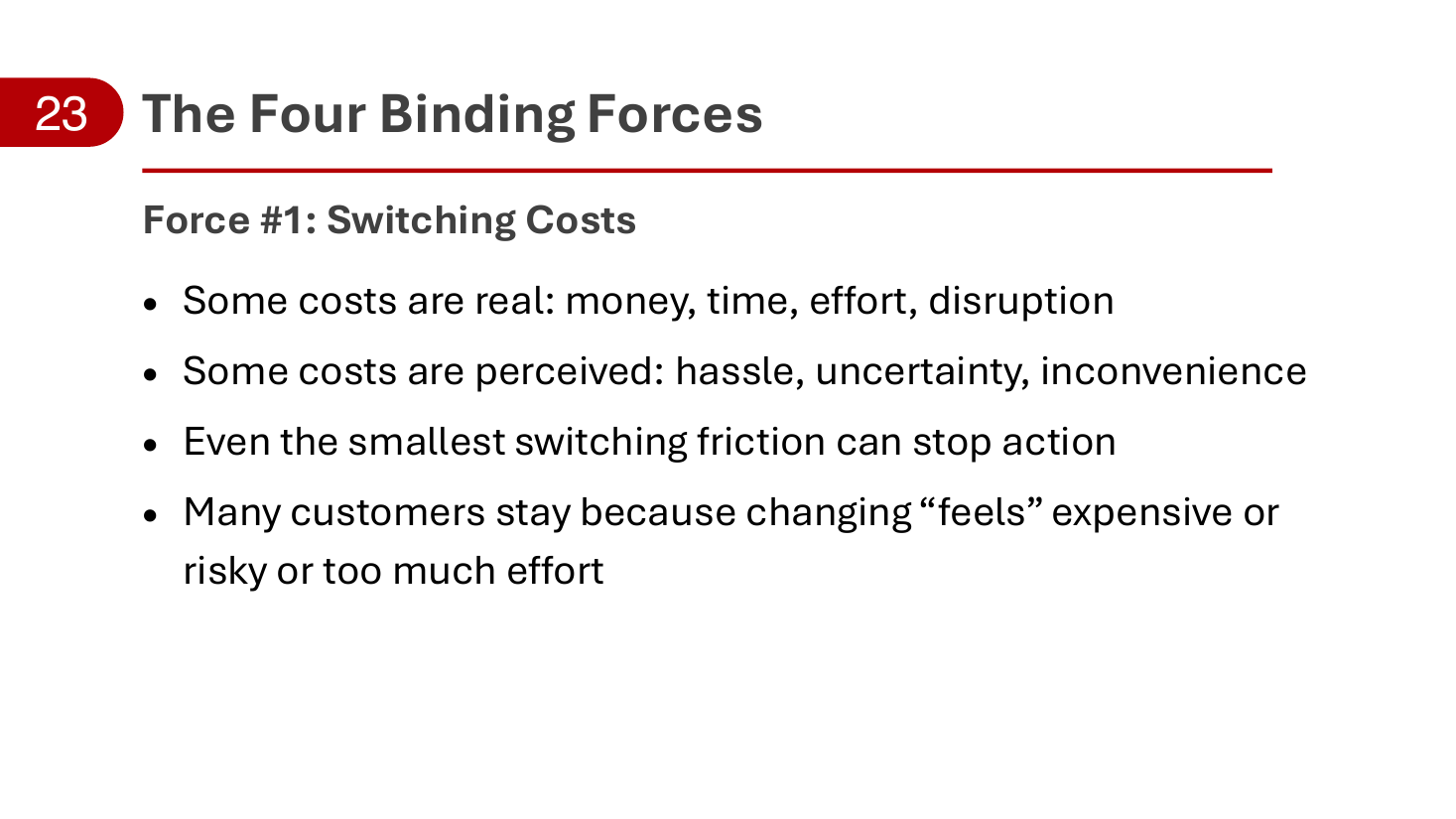
- Switching Costs (real: money, time, effort, disruption; perceived: hassle, uncertainty).
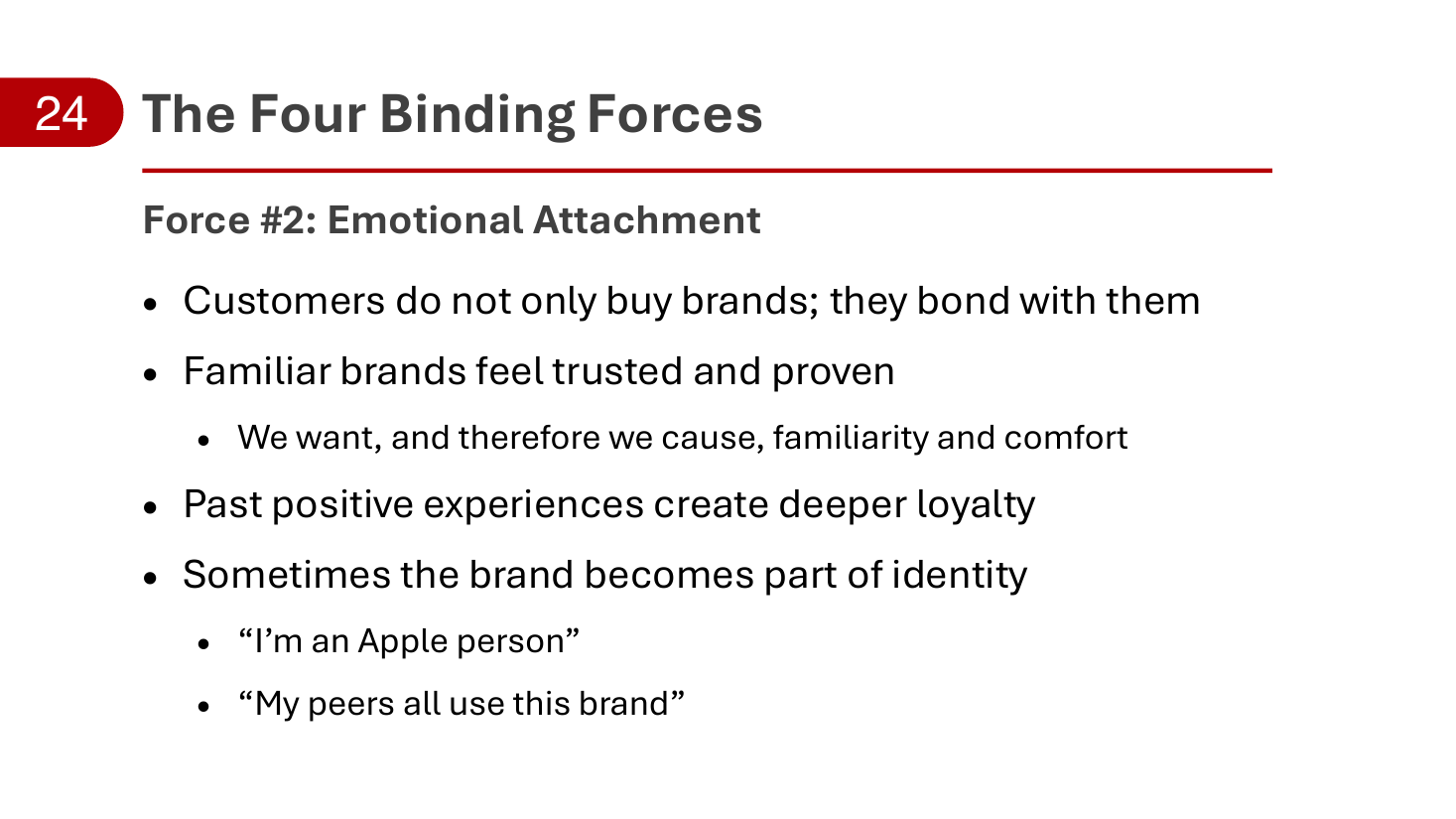
- Emotional Attachment (identity: "I'm an Apple person").
- Risk and Fear of Change (loss aversion).
- Inertia and Status Quo Bias ("better" loses to "good enough").
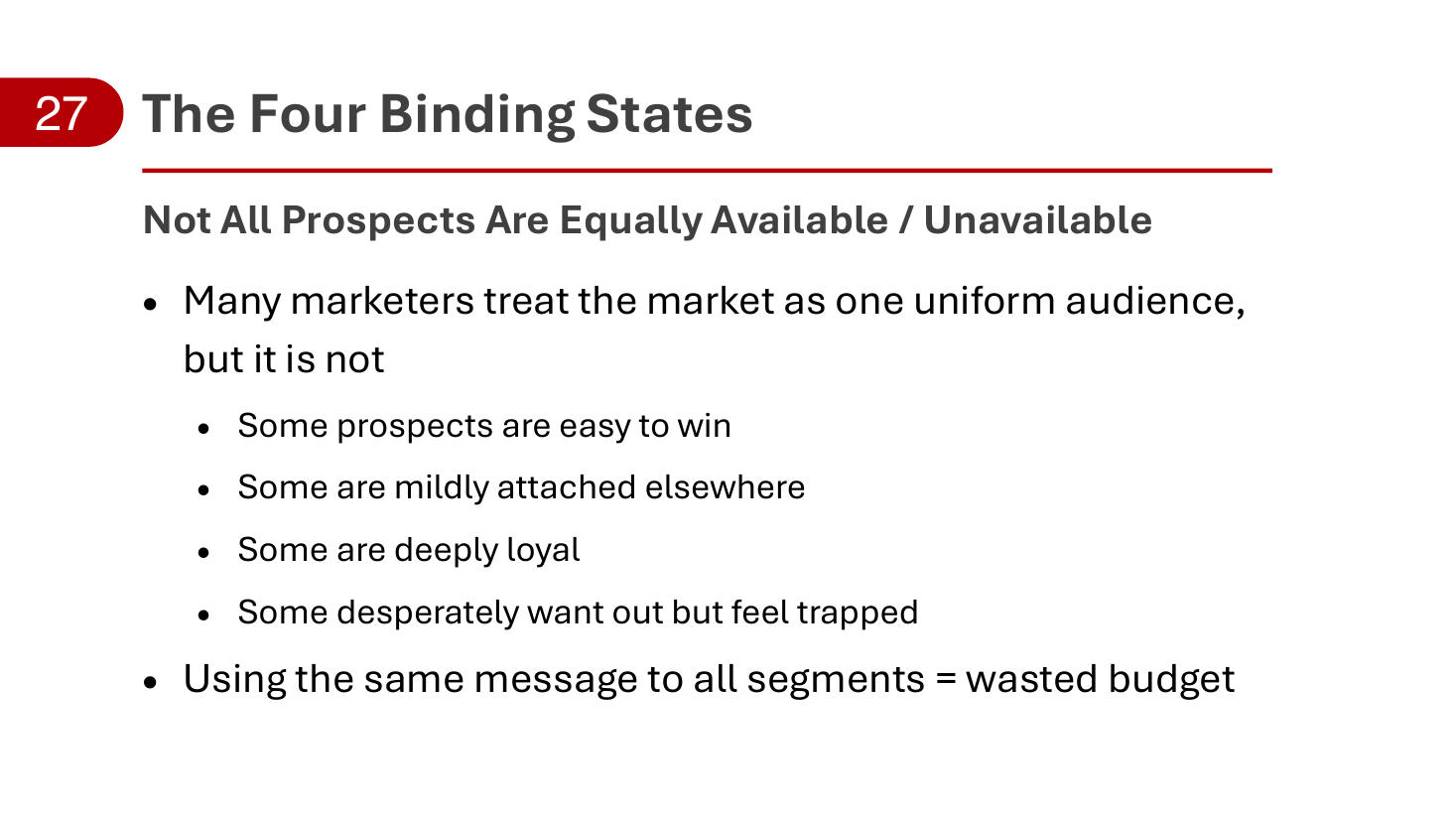
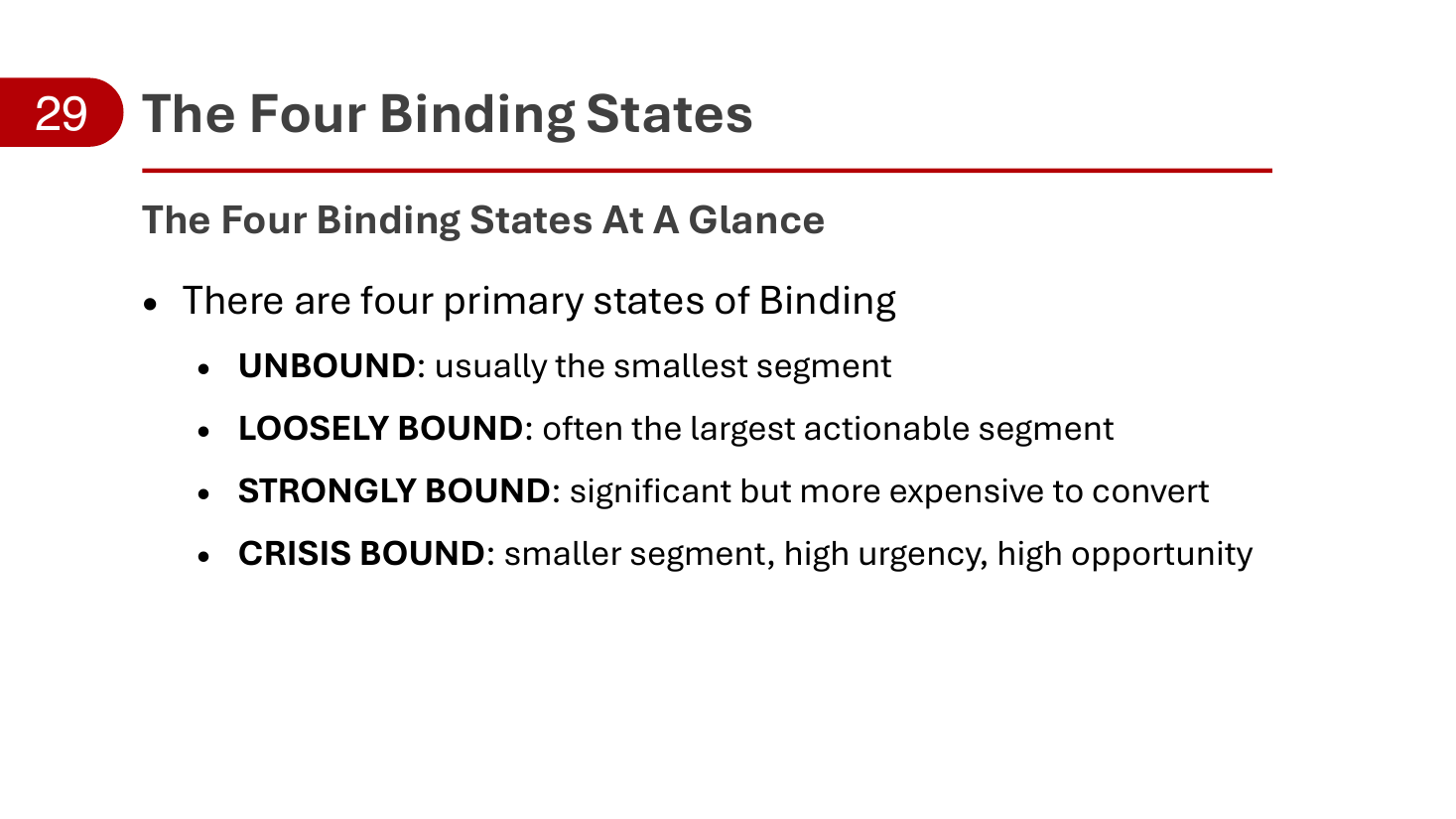
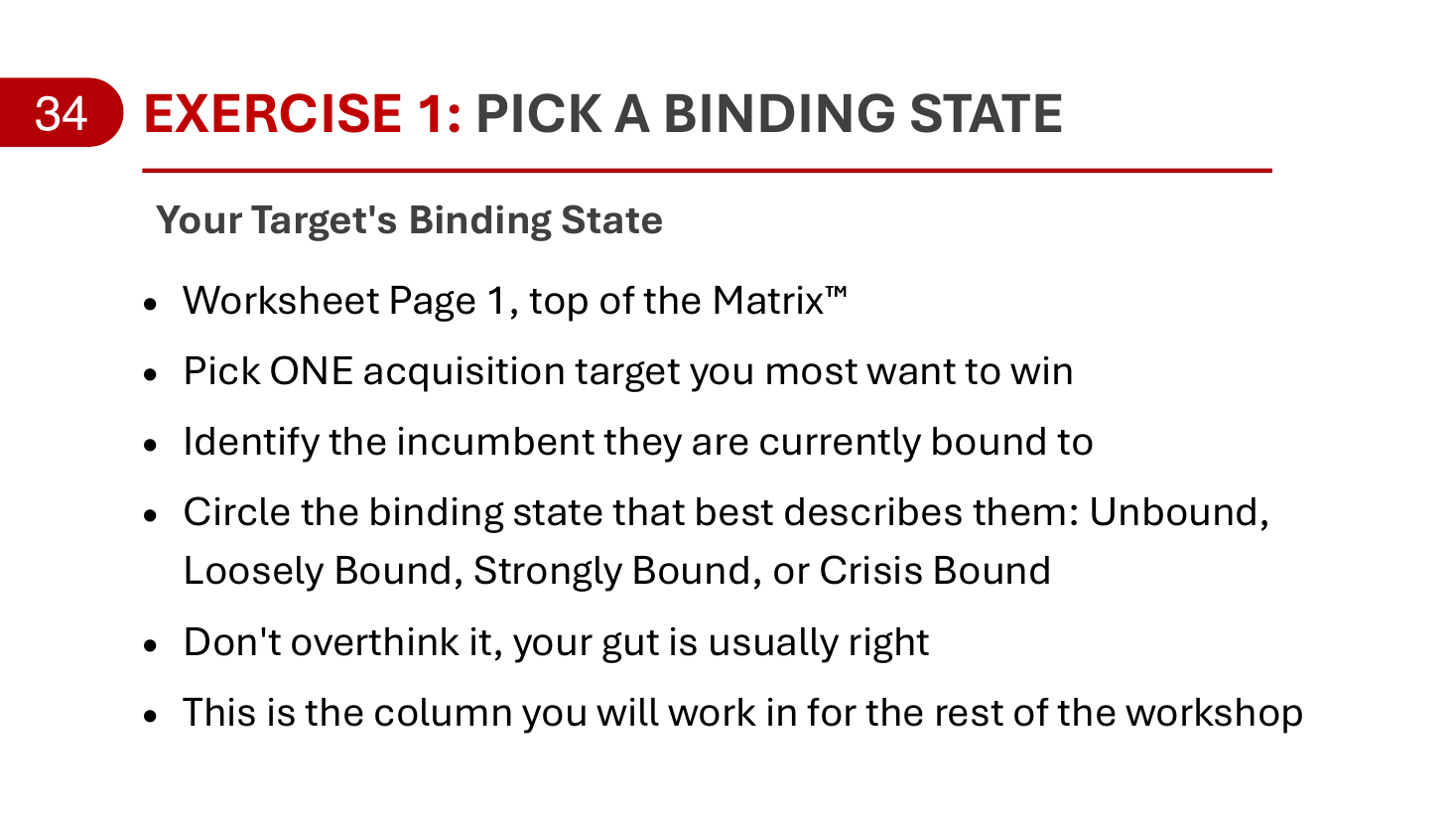
The Four Binding States:
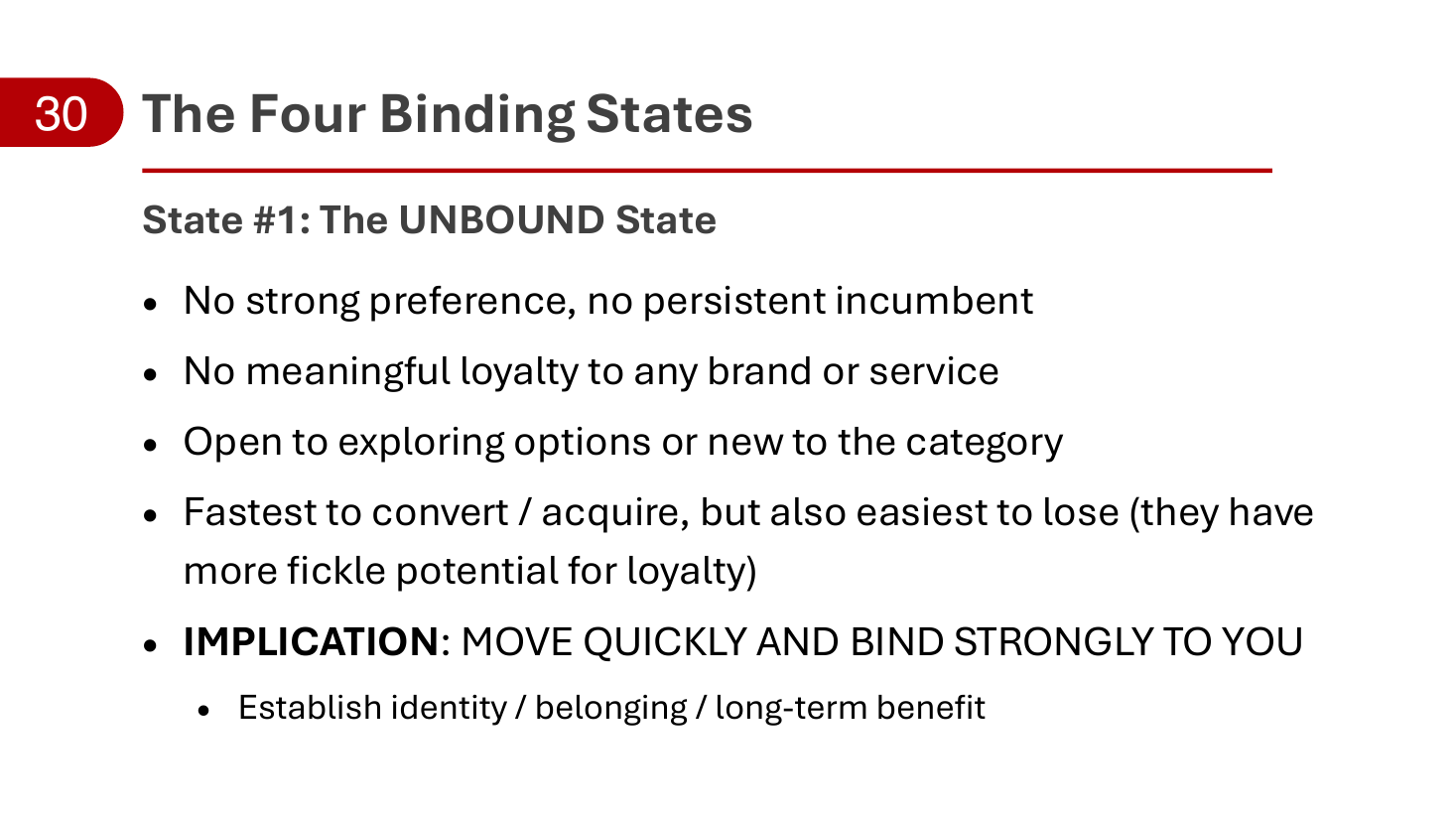
- UNBOUND: usually the smallest segment; no incumbent; fastest to convert but easiest to lose.
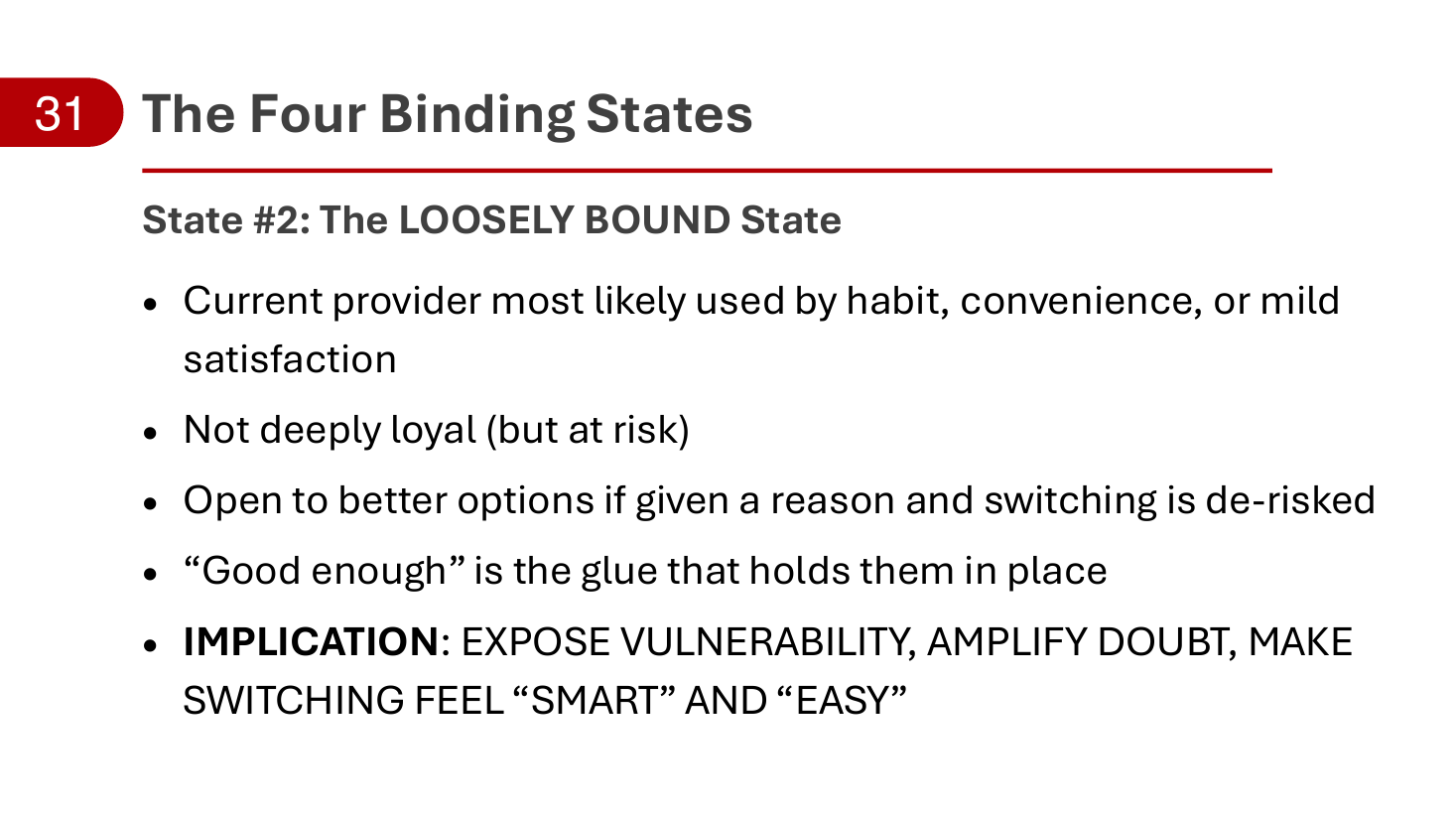
- LOOSELY BOUND: often the largest actionable segment; held by "good enough"; the "sweet spot" and recommended first target.
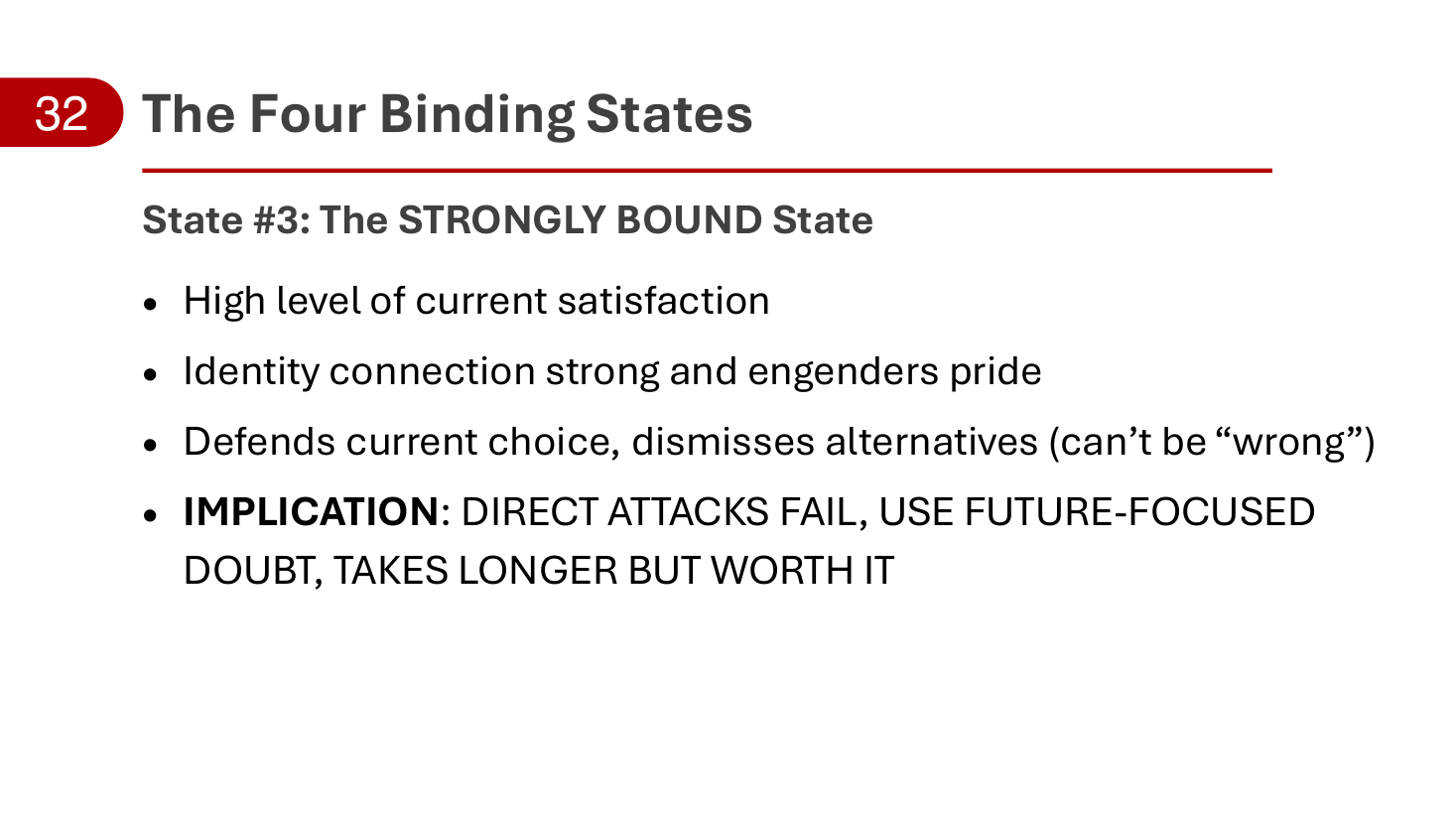
- STRONGLY BOUND: high satisfaction and identity connection; direct attacks fail; use future-focused doubt.
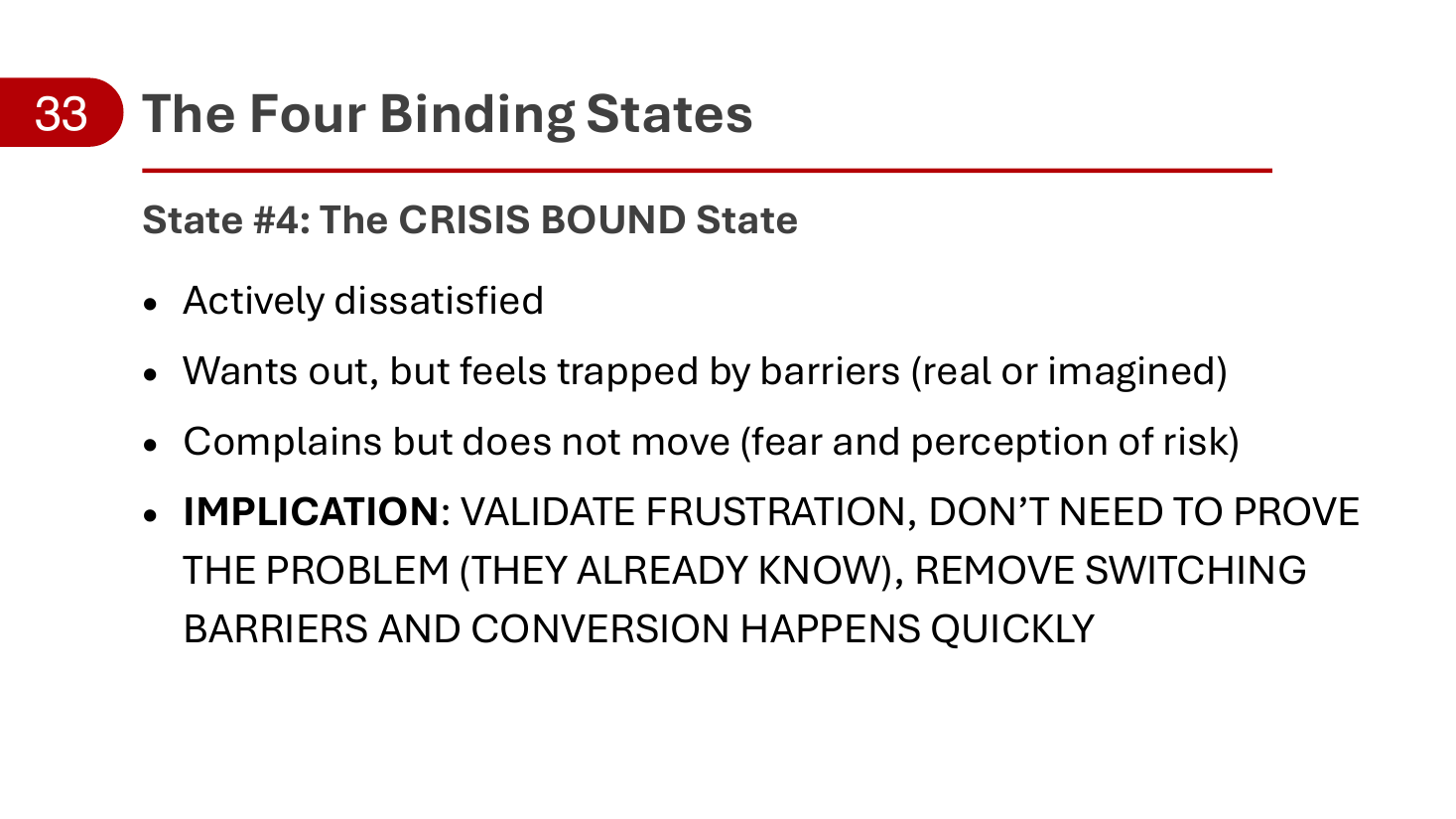
- CRISIS BOUND: actively dissatisfied, wants out, feels trapped; validate frustration and remove switching barriers; "they need a door."
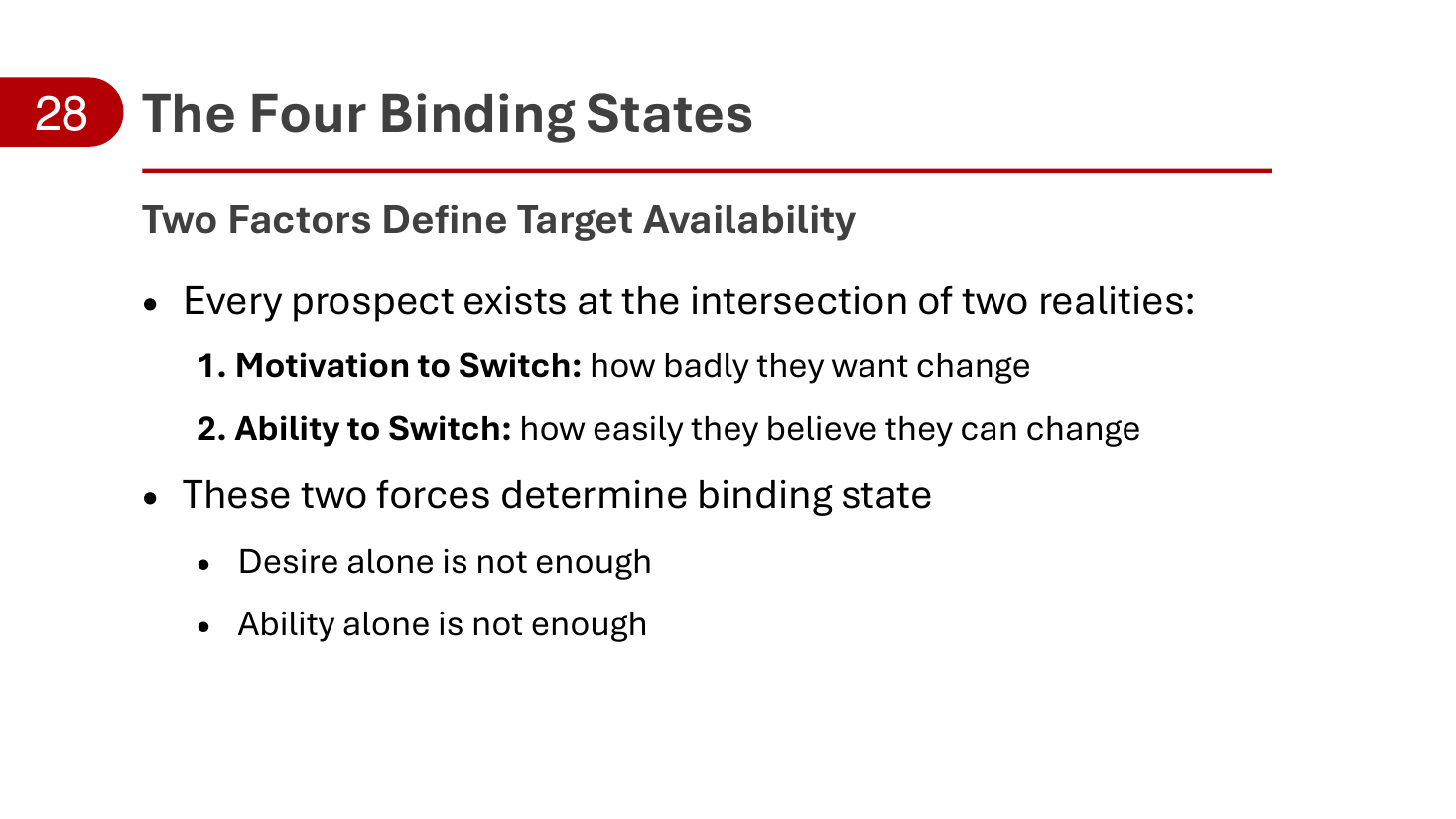
- Two factors define availability: Motivation to Switch and Ability to Switch.
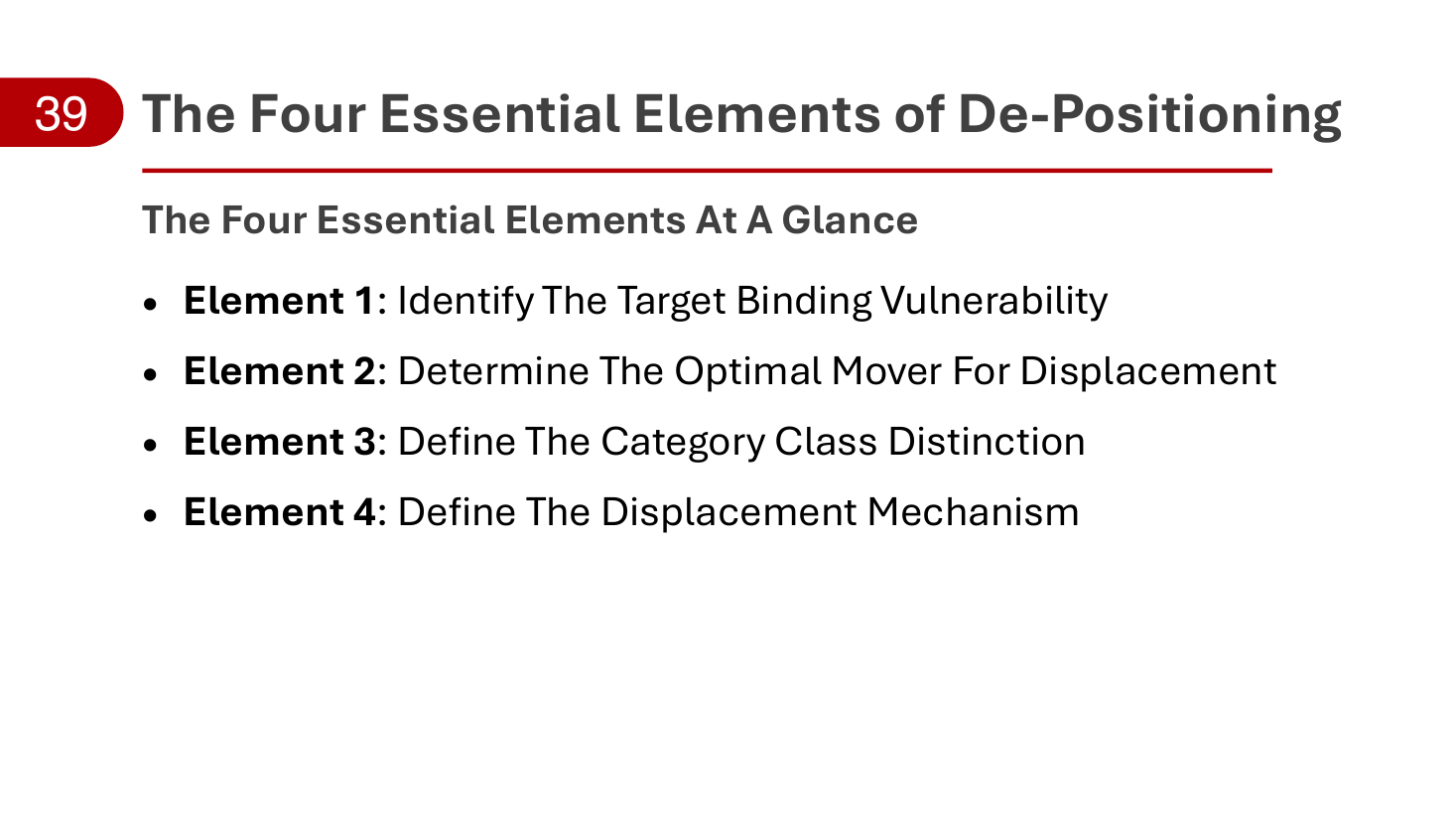
The Four Essential Elements of De-Positioning:
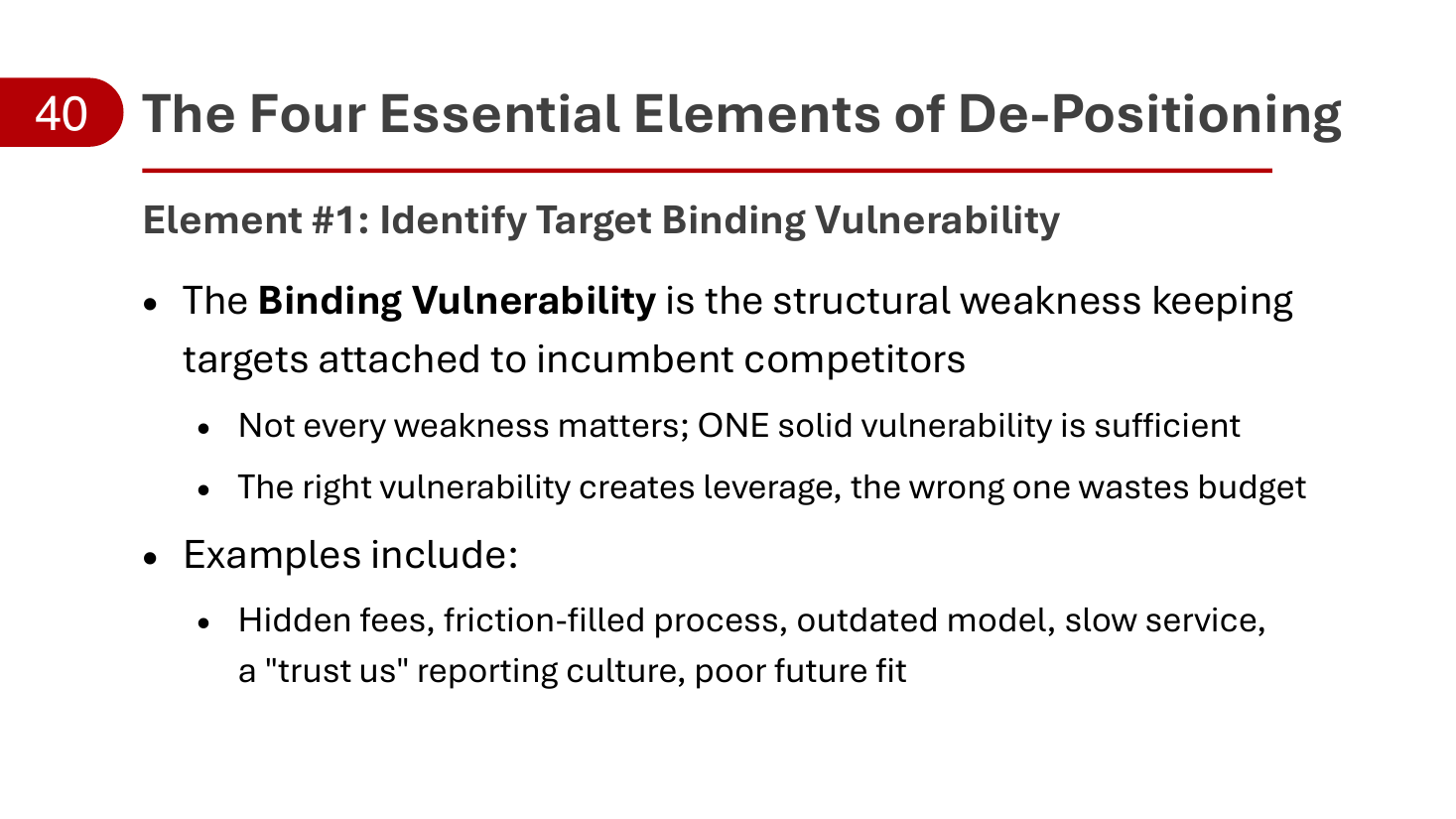
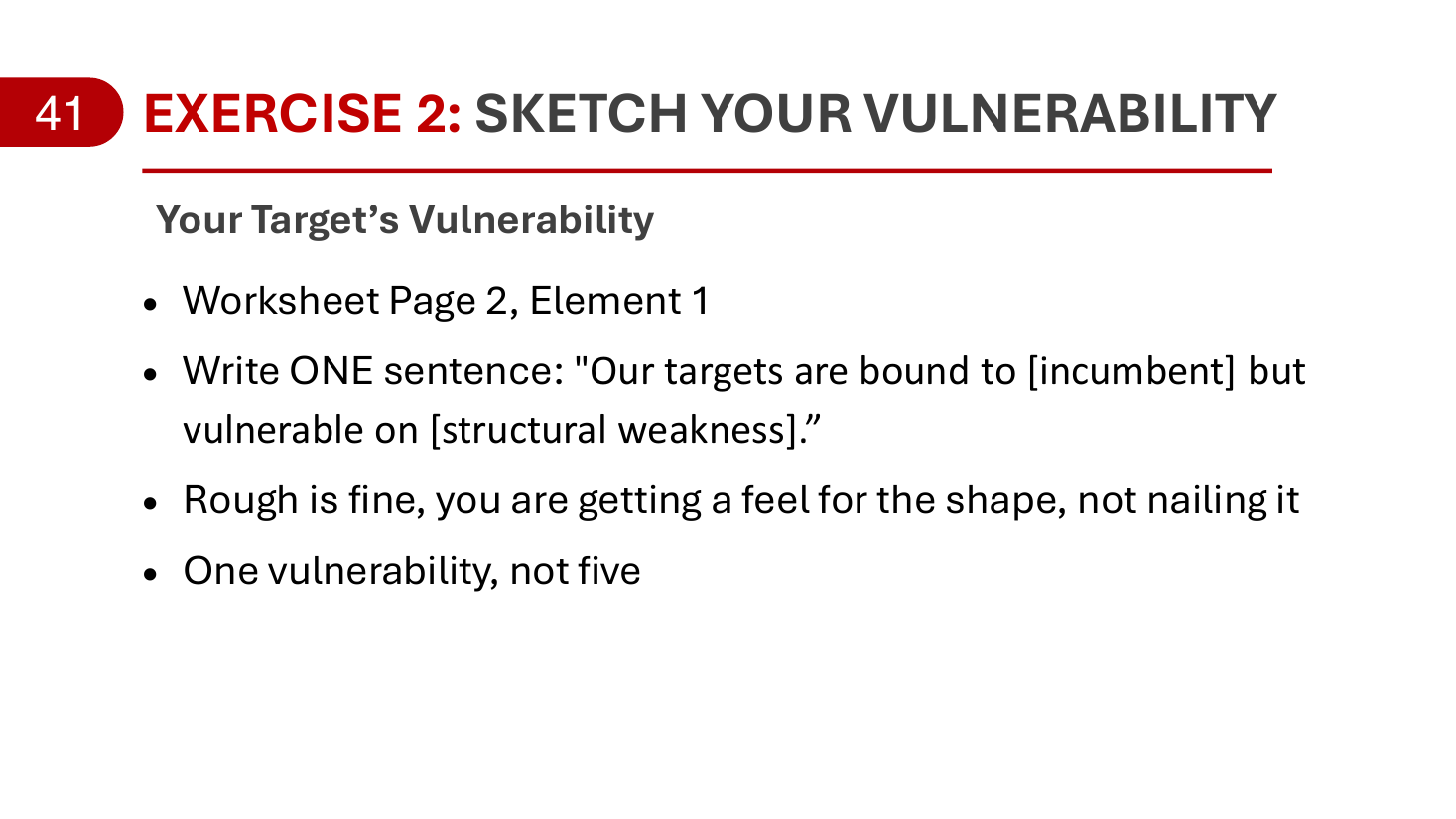
- Identify the Target Binding Vulnerability (ONE structural weakness is enough; e.g. hidden fees, a "trust us" reporting culture, poor future fit).
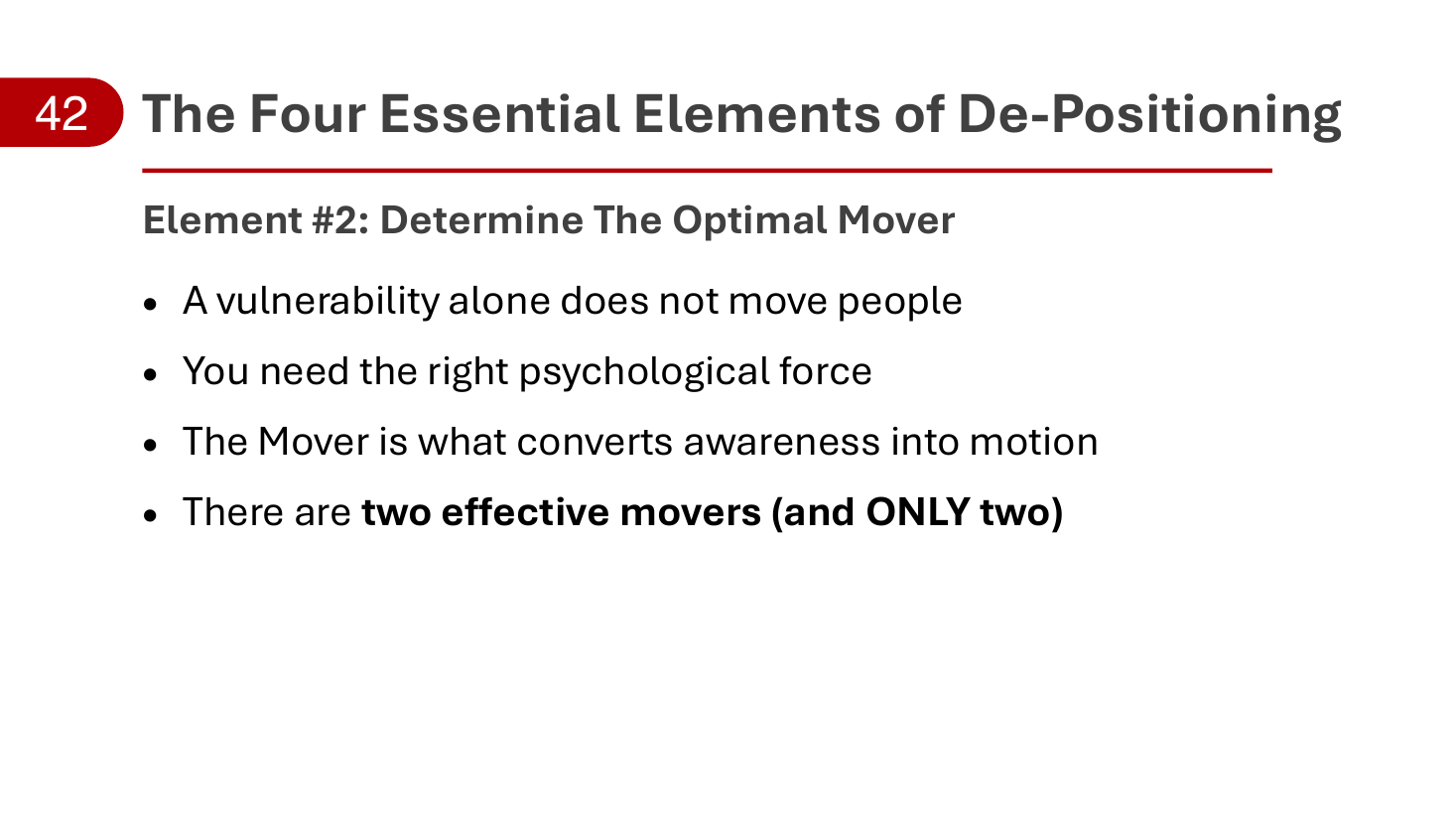
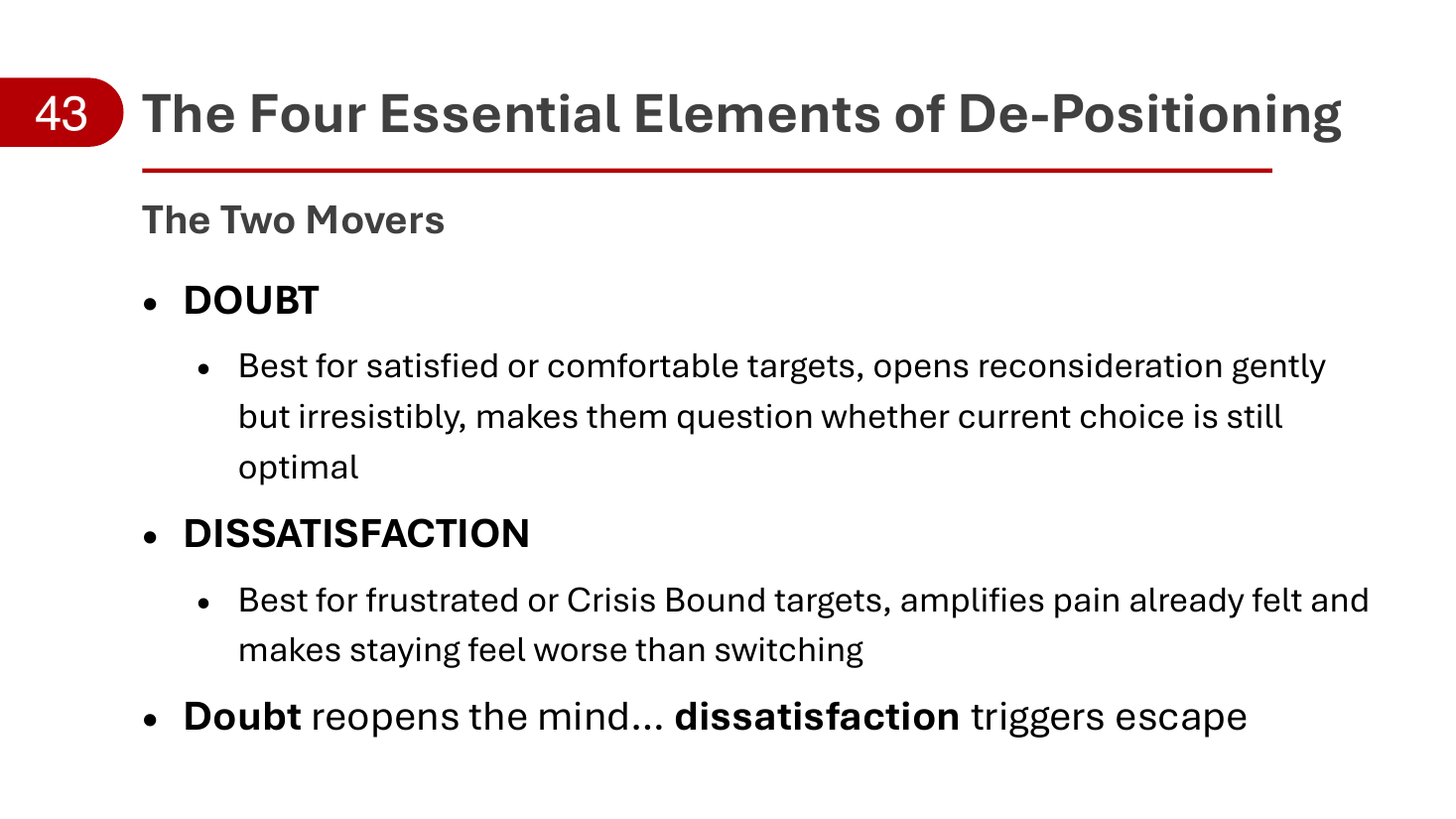
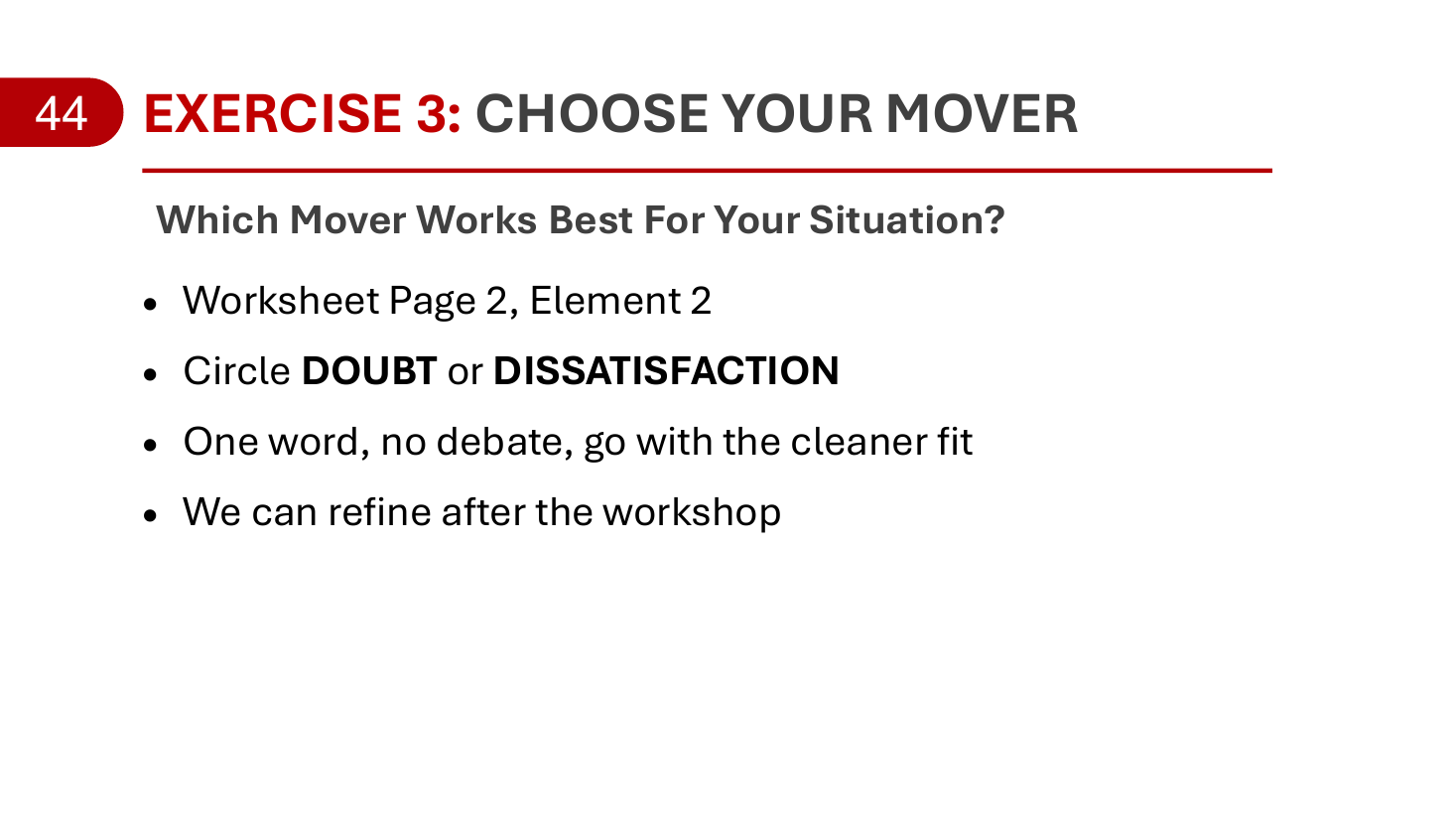
- Determine the Optimal Mover. Only TWO movers exist: DOUBT (for satisfied/comfortable targets) and DISSATISFACTION (for frustrated/Crisis Bound targets). "Doubt reopens the mind; dissatisfaction triggers escape."
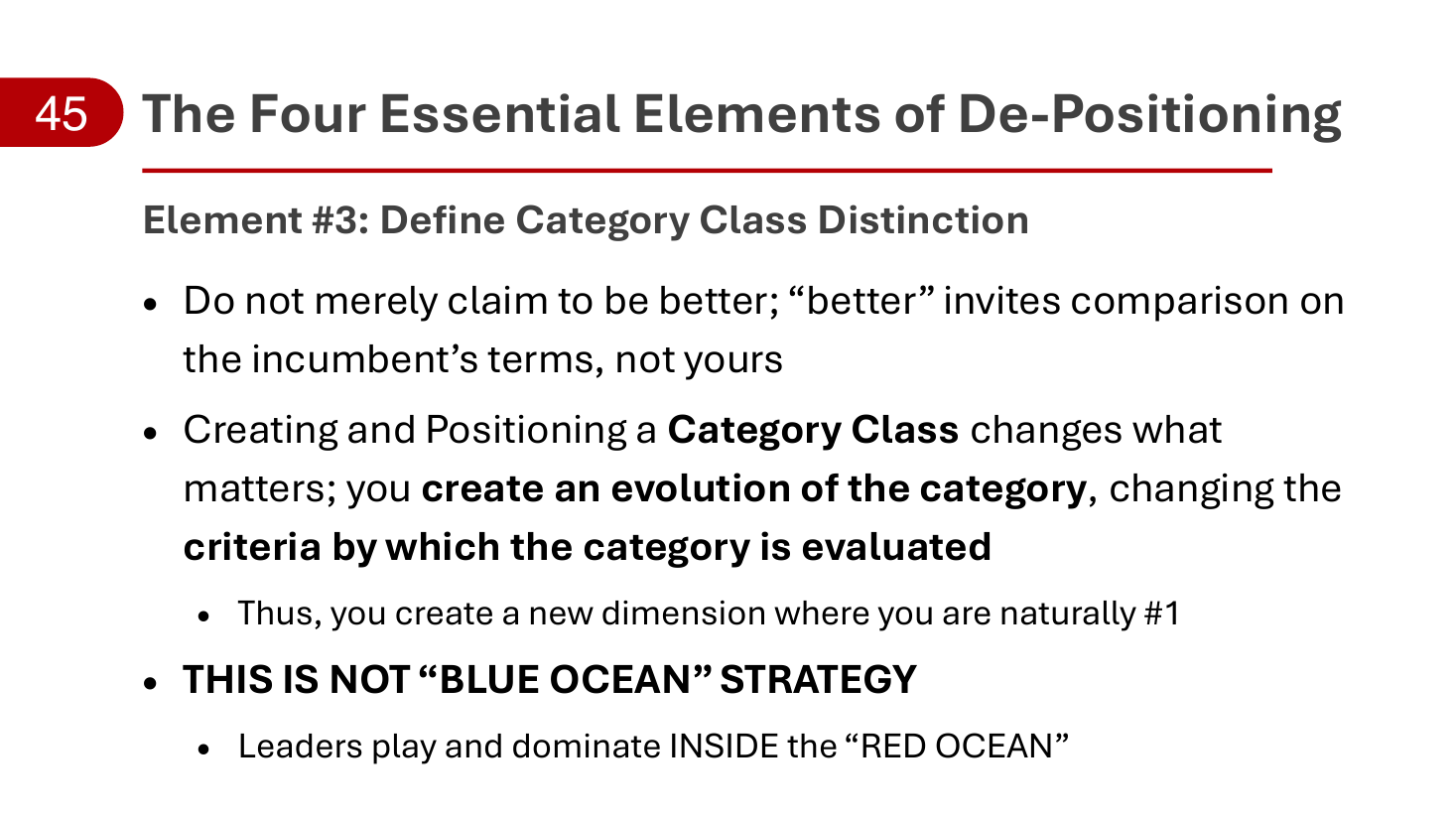
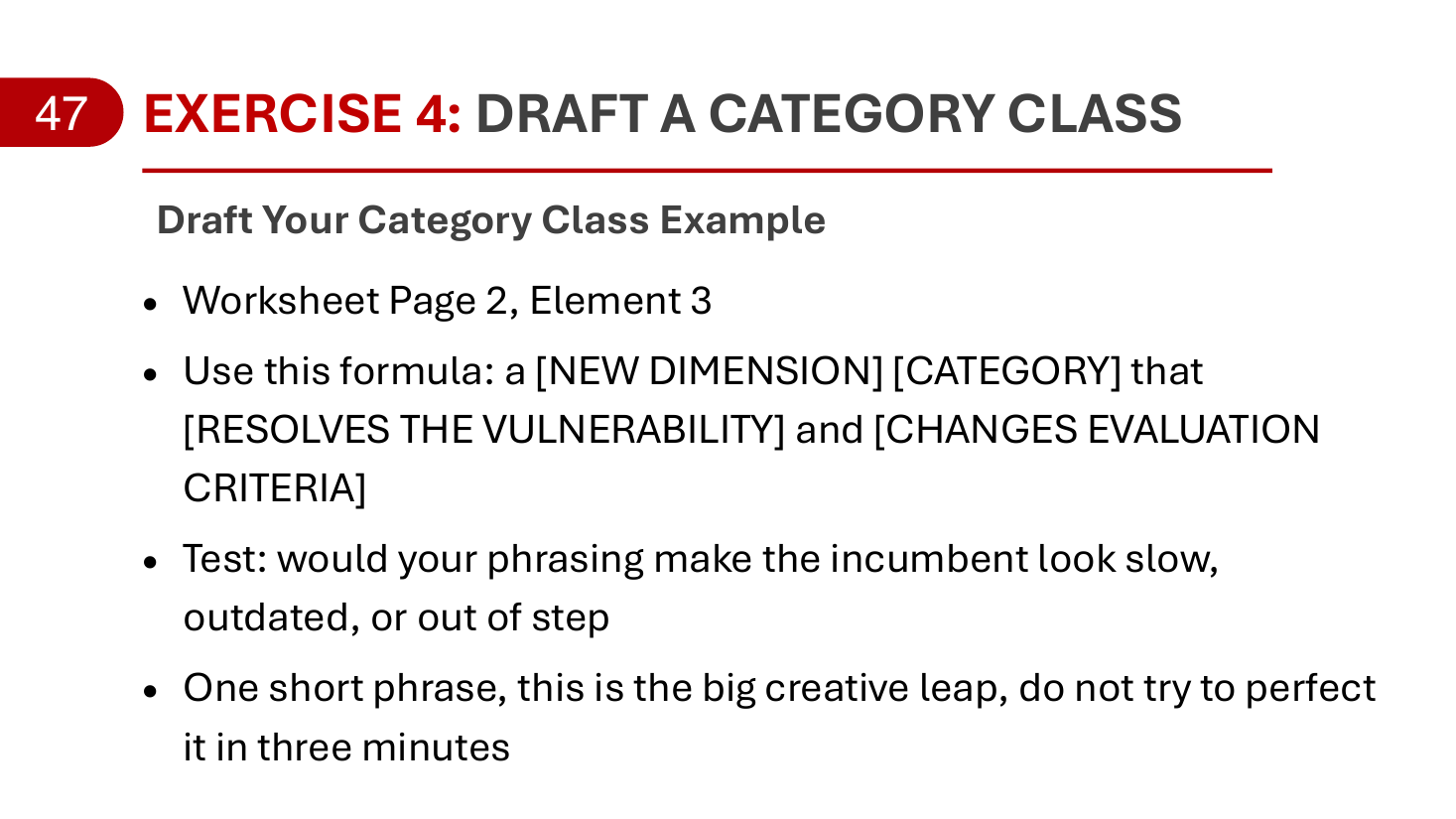
- Define the Category Class Distinction (change the evaluation criteria so you are naturally #1; explicitly NOT Blue Ocean, since leaders dominate inside the "Red Ocean").
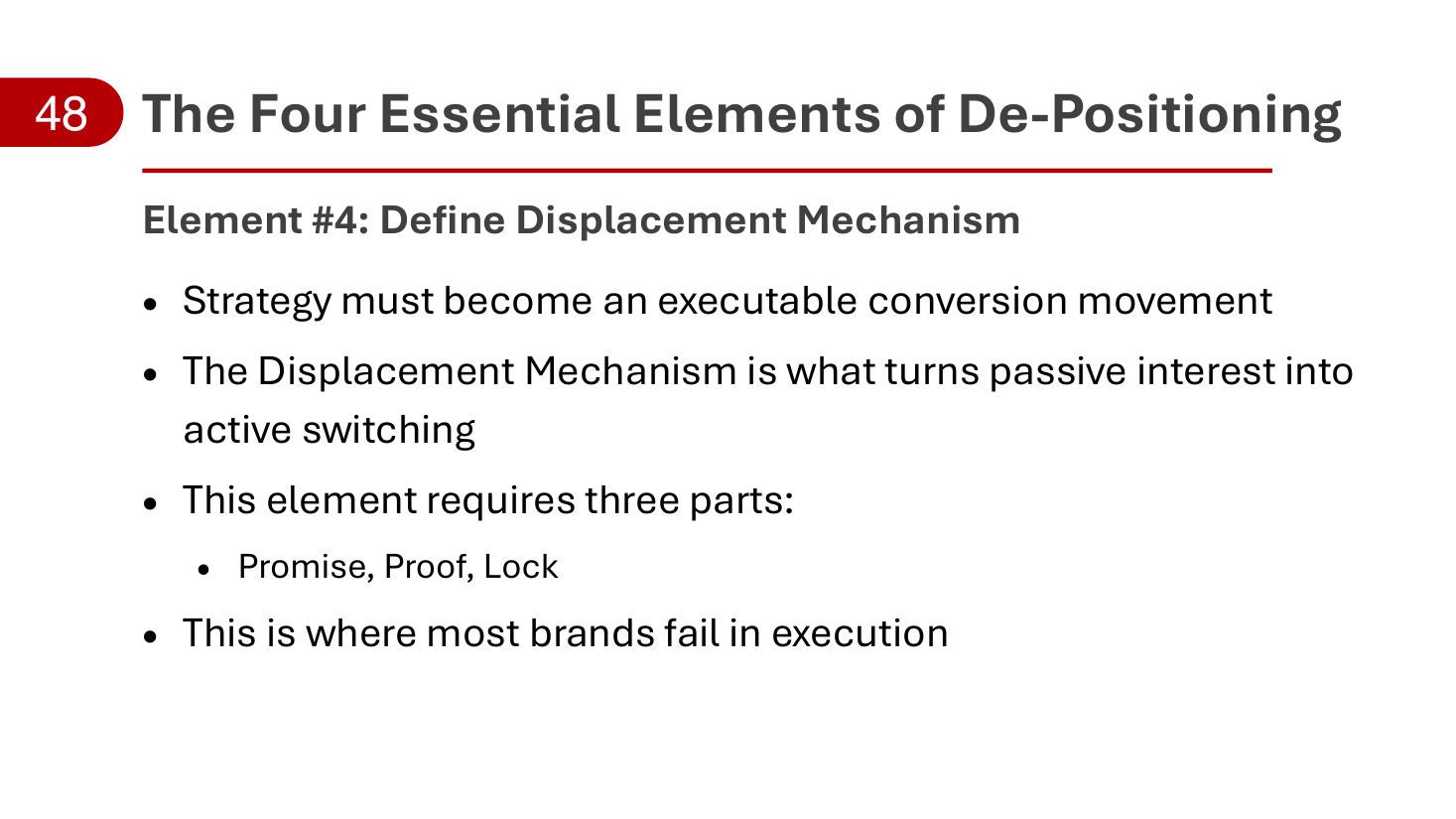
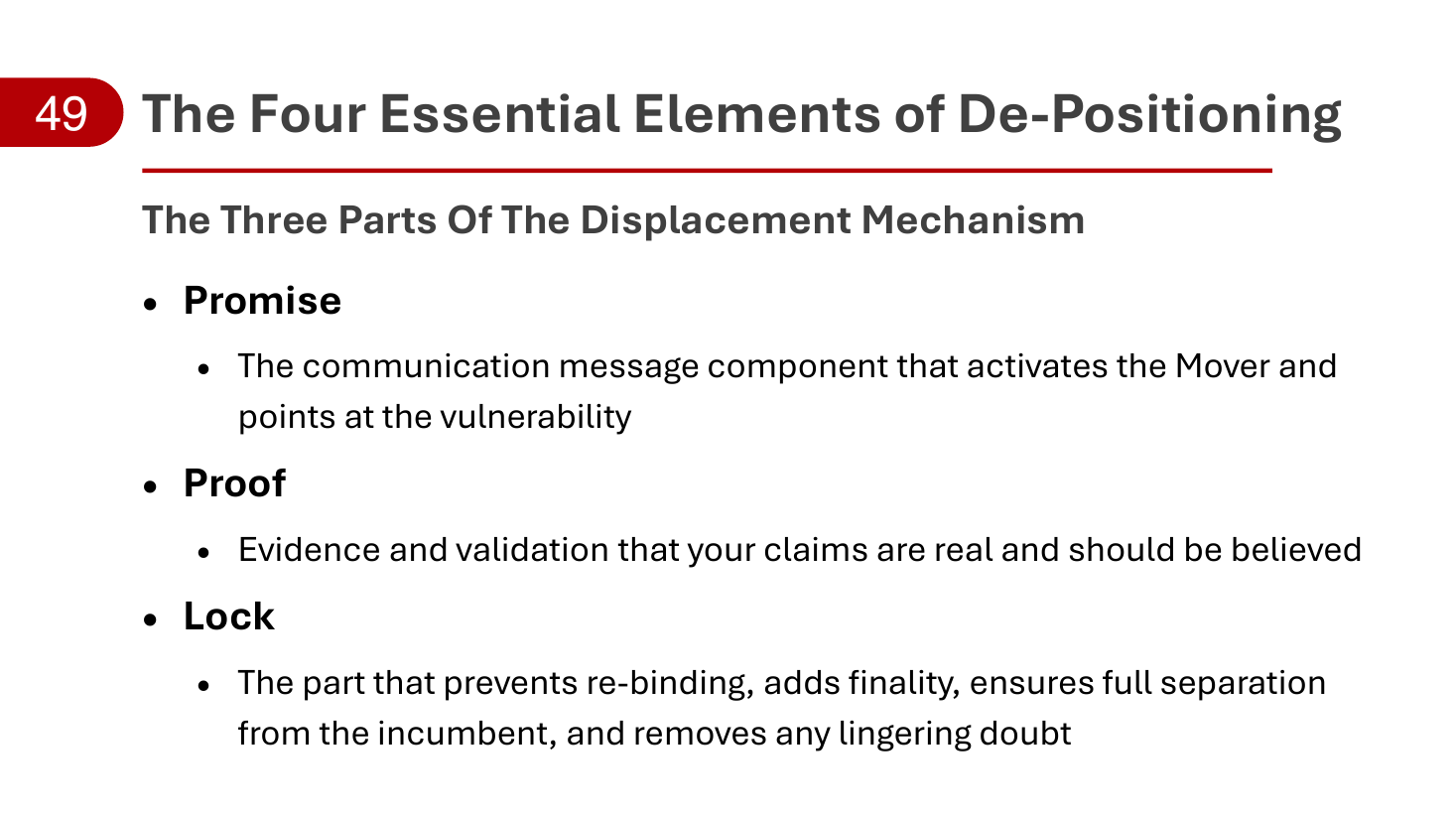
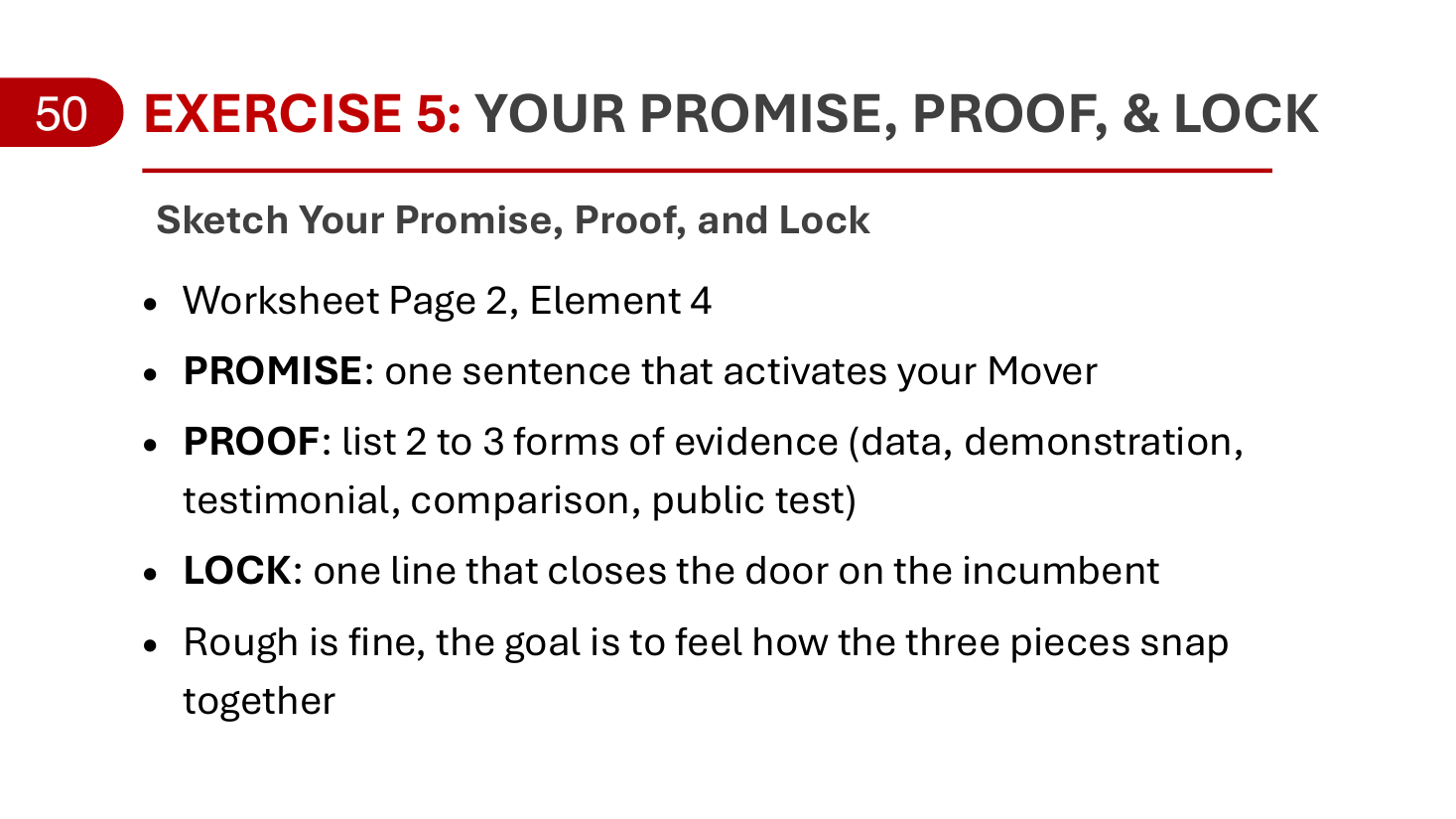
- Define the Displacement Mechanism, with three parts: Promise, Proof, Lock.
Matrix weightings (primary element per state):
- UNBOUND: Category Class 40%, Mover 30%, Vulnerability 20%, Mechanism 10%.
- LOOSELY BOUND: Mover 40%, Vulnerability 30%, Category Class 20%, Mechanism 10%.
- STRONGLY BOUND: Vulnerability 40%, Mover 30%, Category Class 20%, Mechanism 10%.
- CRISIS BOUND: Vulnerability 40%, Mover 30%, Mechanism 20%, Category Class 10%.
Real-world examples:
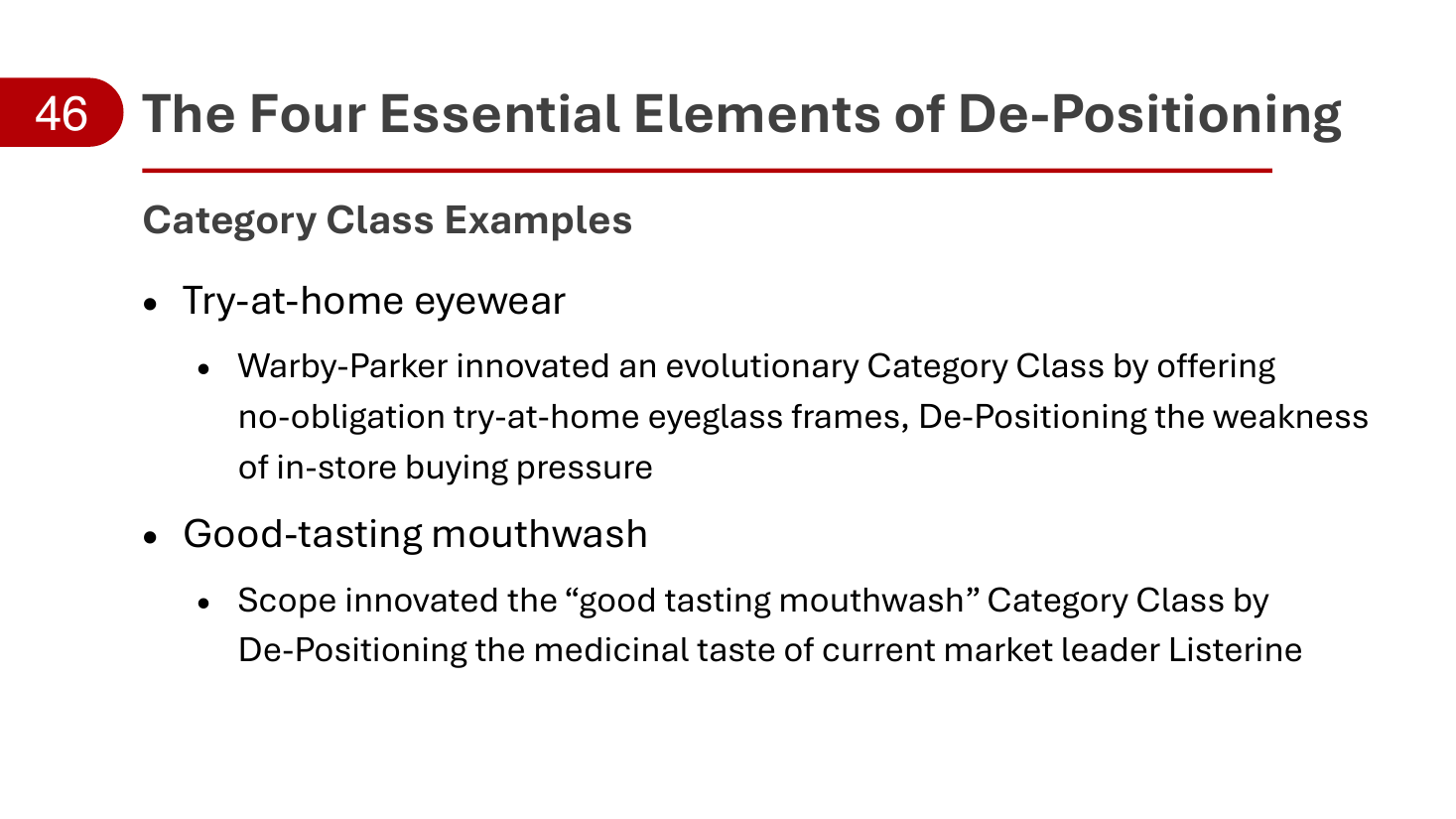
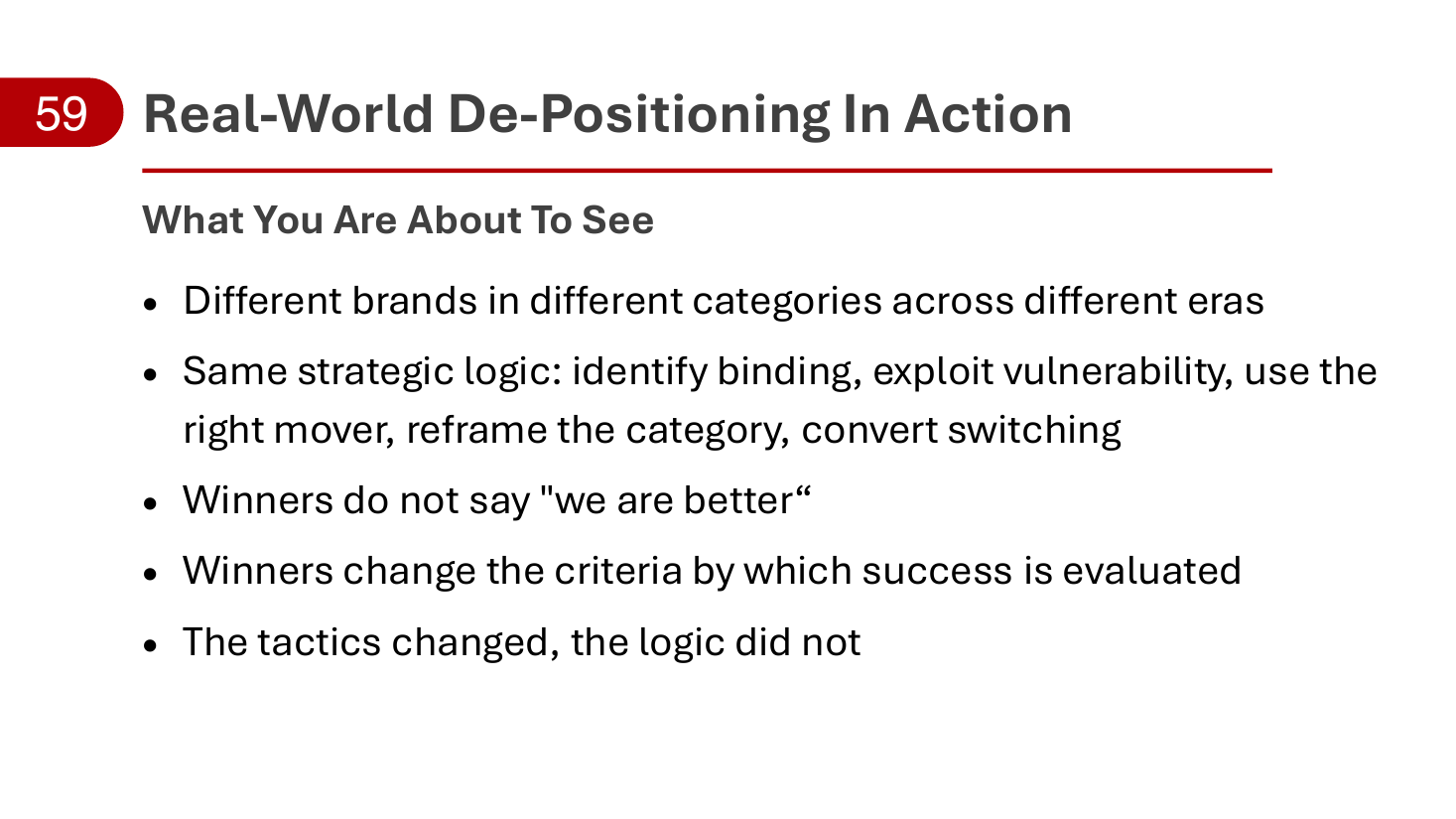
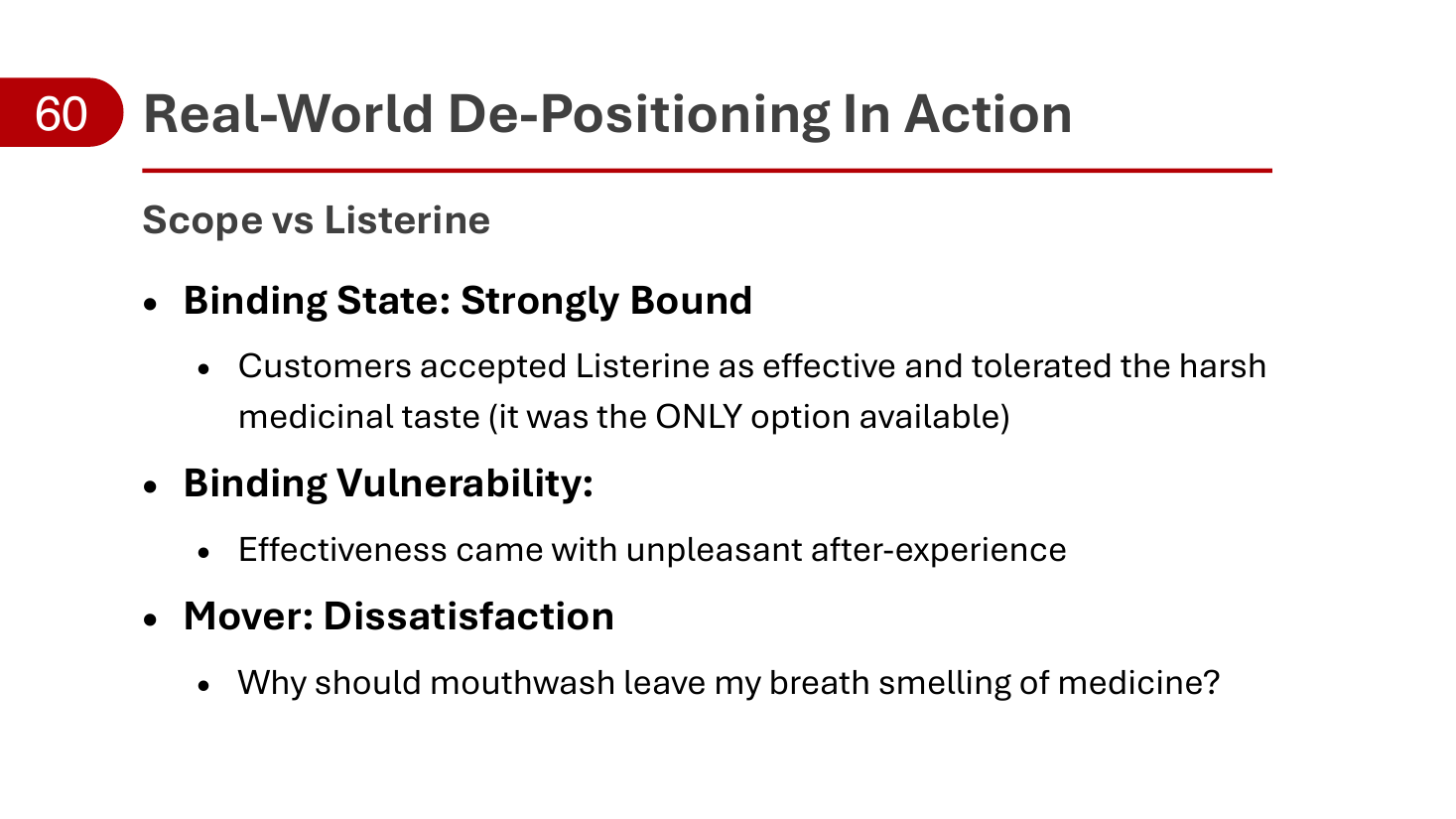
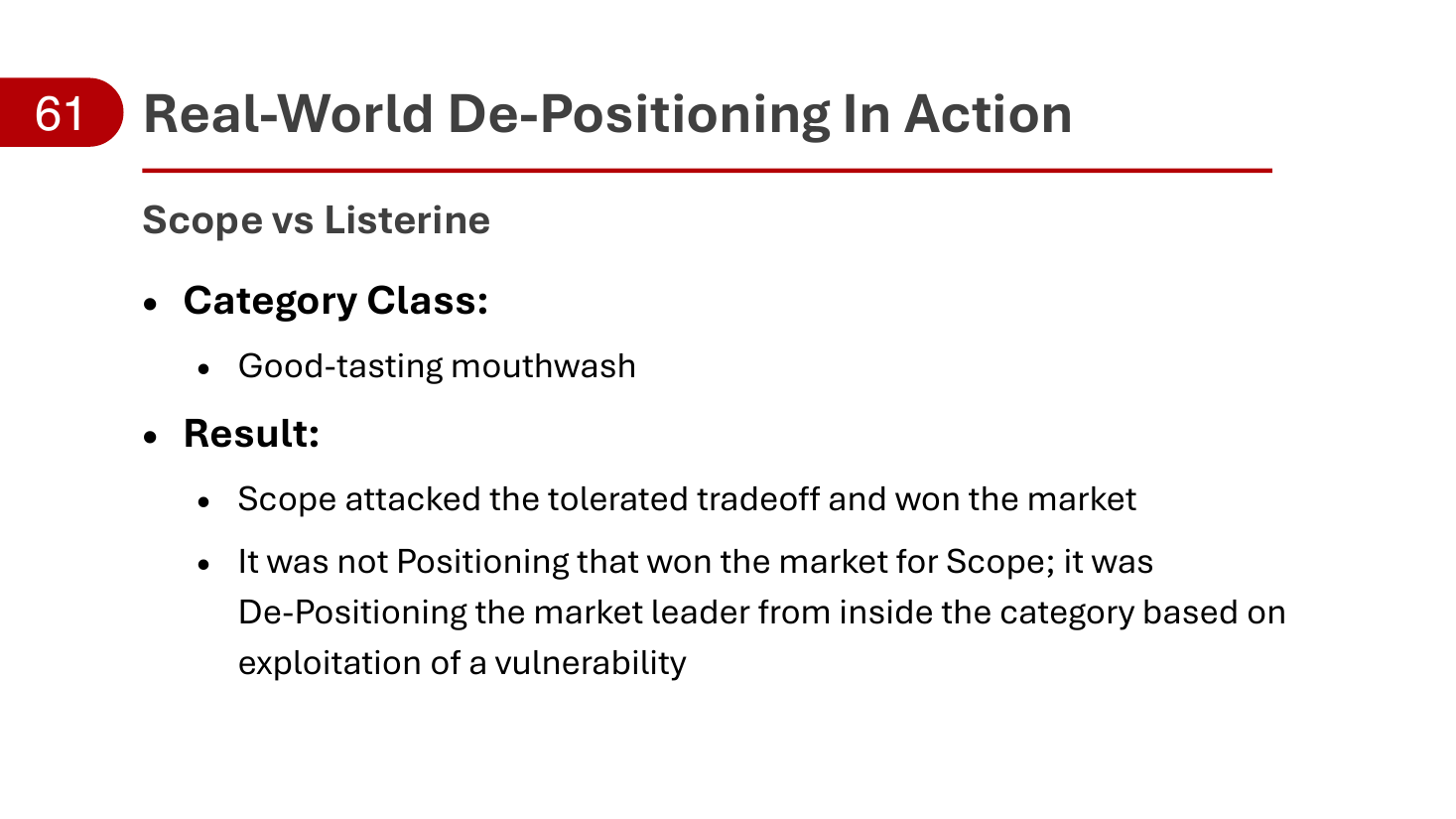
- Scope vs Listerine: Strongly Bound; vulnerability = harsh medicinal taste; mover = dissatisfaction; category class = "good-tasting mouthwash."
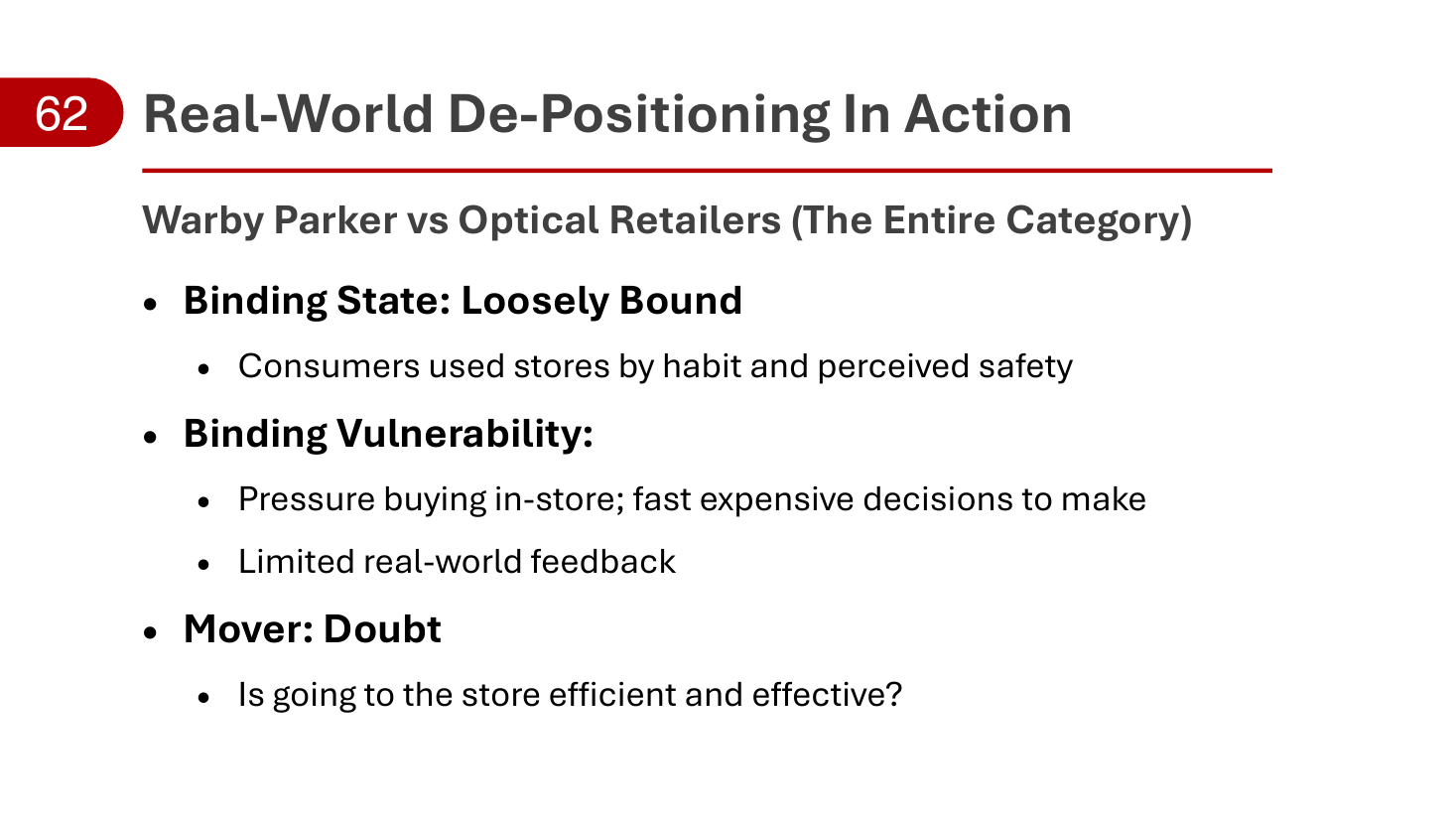
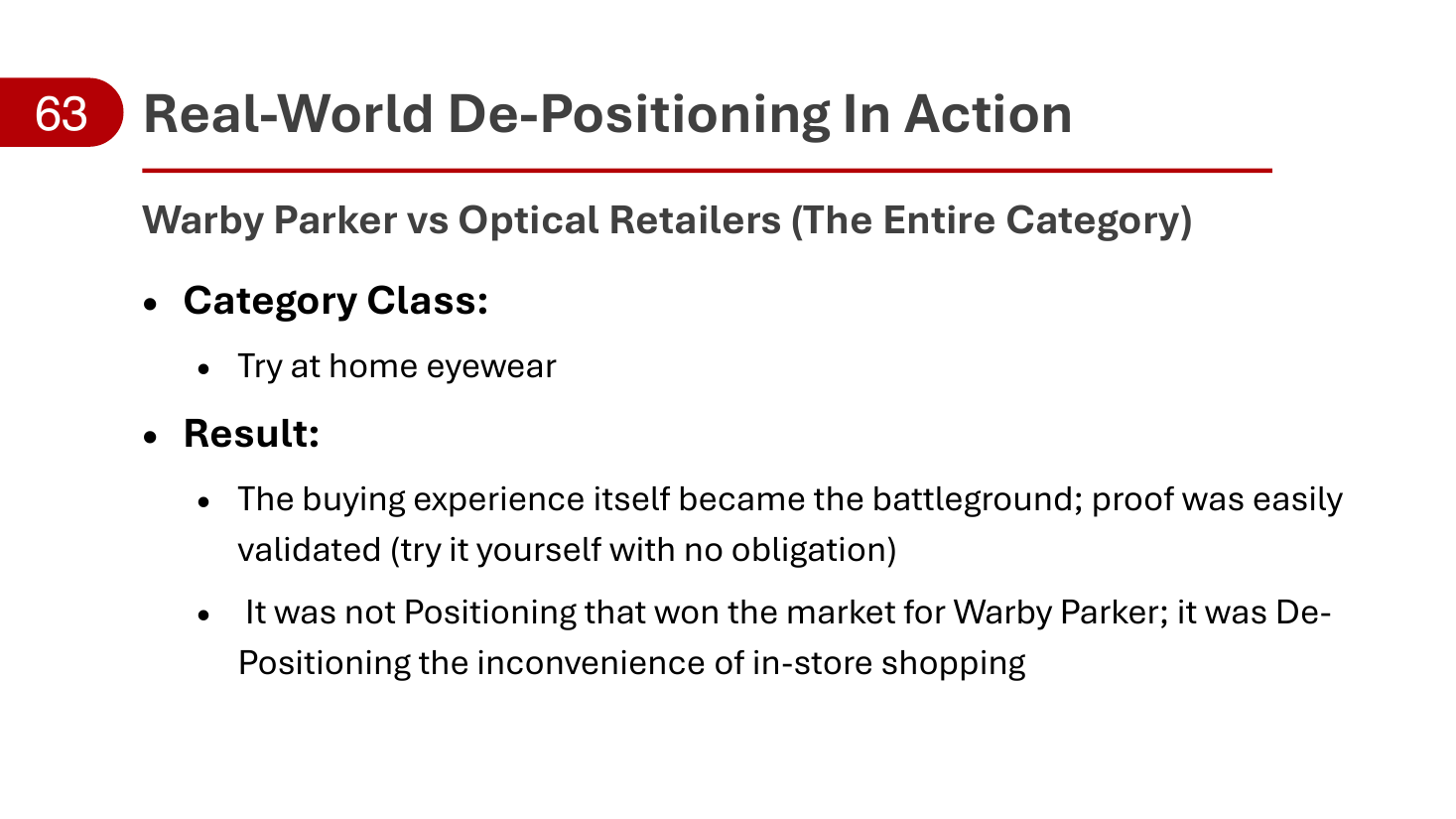
- Warby Parker vs optical retailers: Loosely Bound; vulnerability = in-store buying pressure and limited real-world feedback; mover = doubt; category class = "try-at-home eyewear."
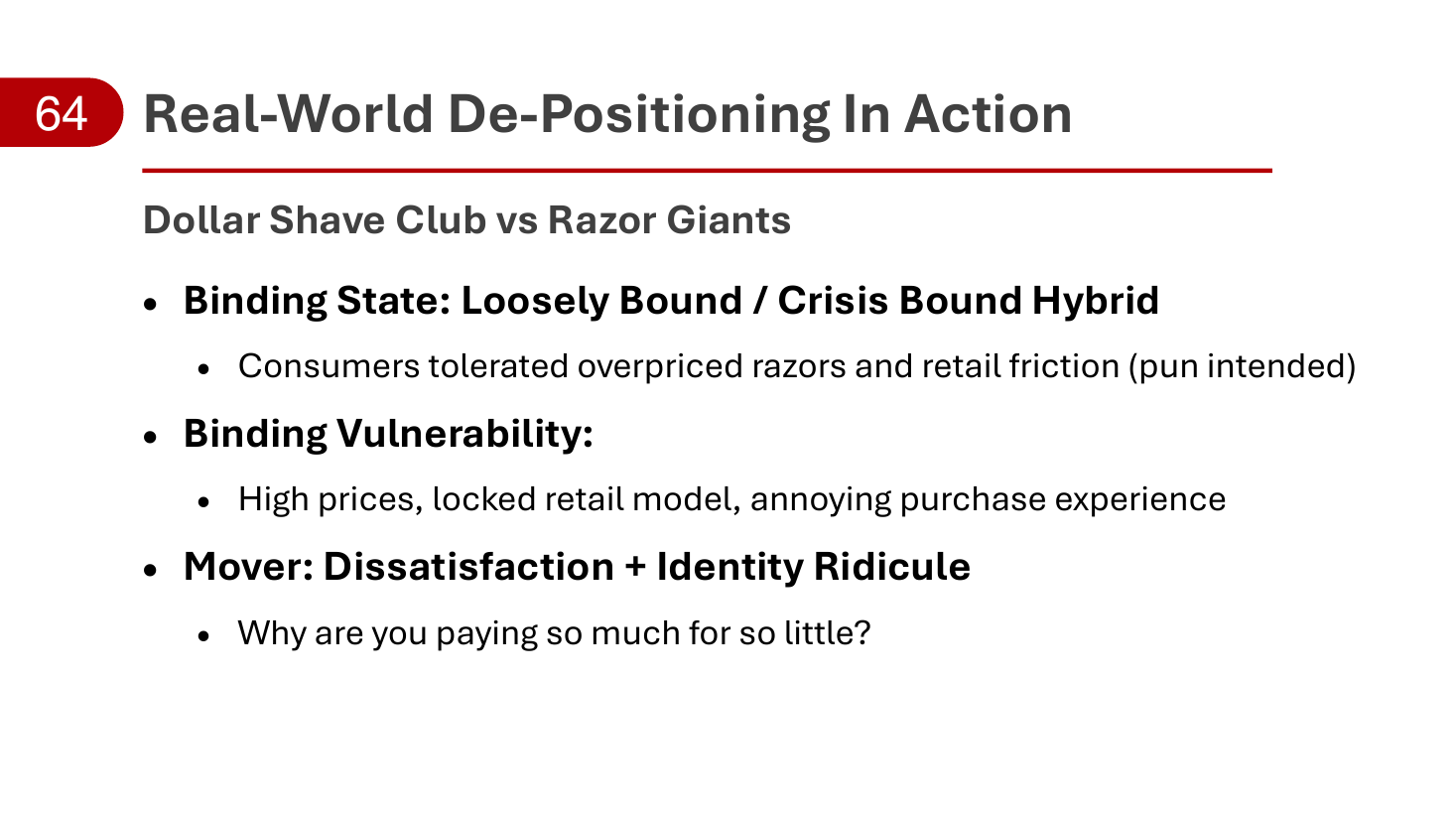
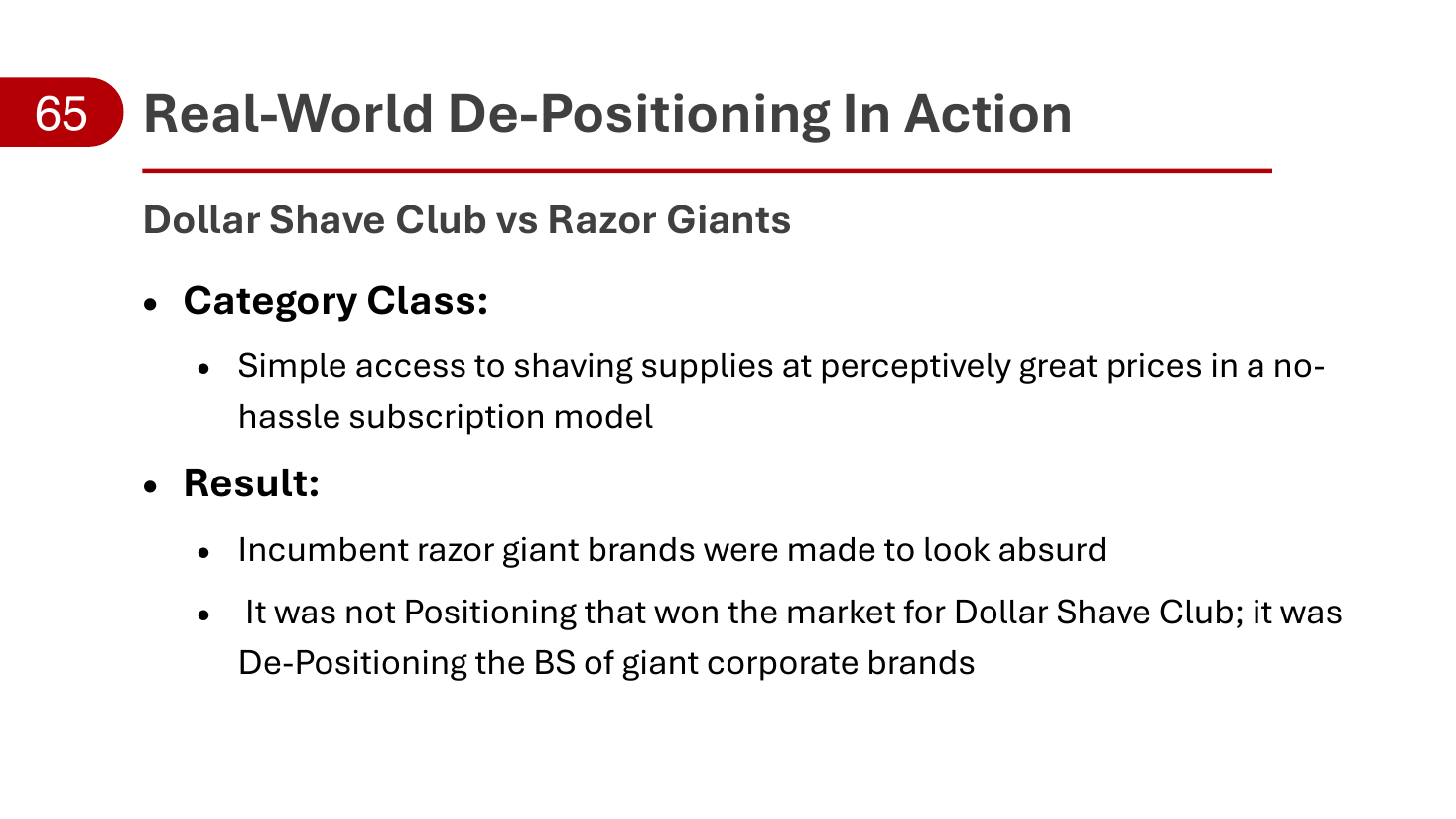
- Dollar Shave Club vs razor giants: Loosely/Crisis Bound hybrid; vulnerability = high prices, locked retail model, annoying purchase; mover = dissatisfaction plus identity ridicule ("Why are you paying so much for so little?"); category class = no-hassle subscription shaving supplies.
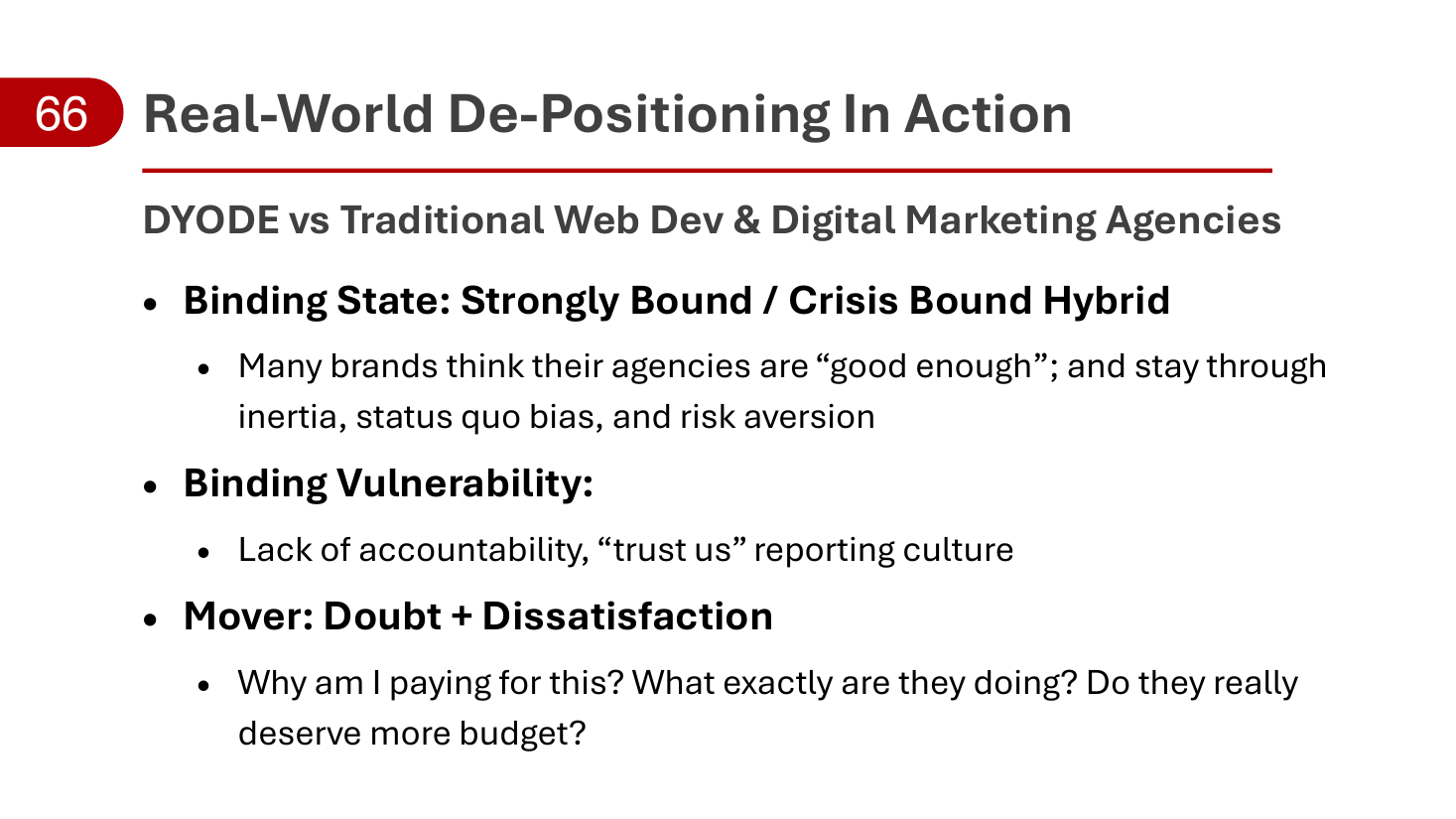
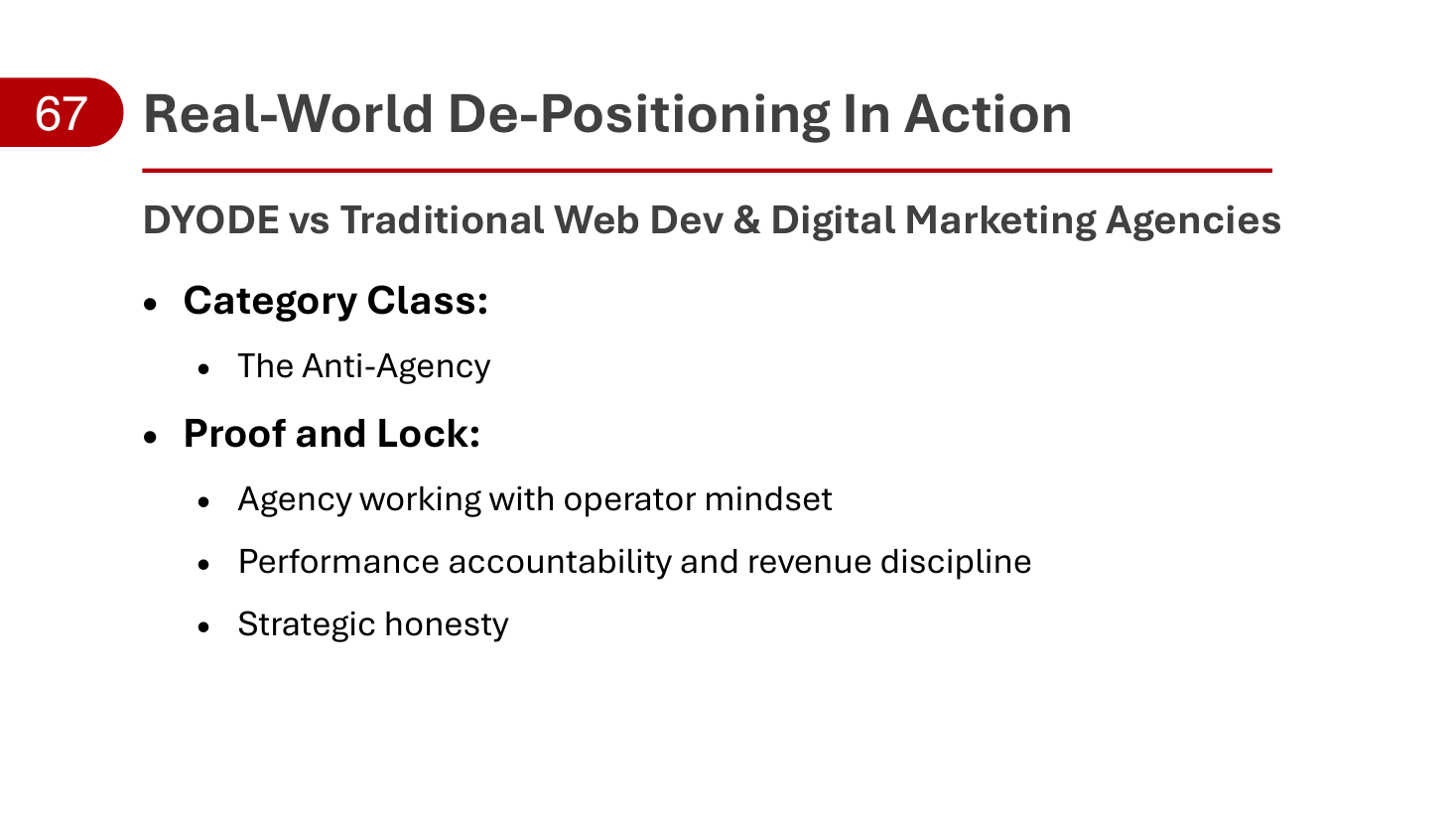
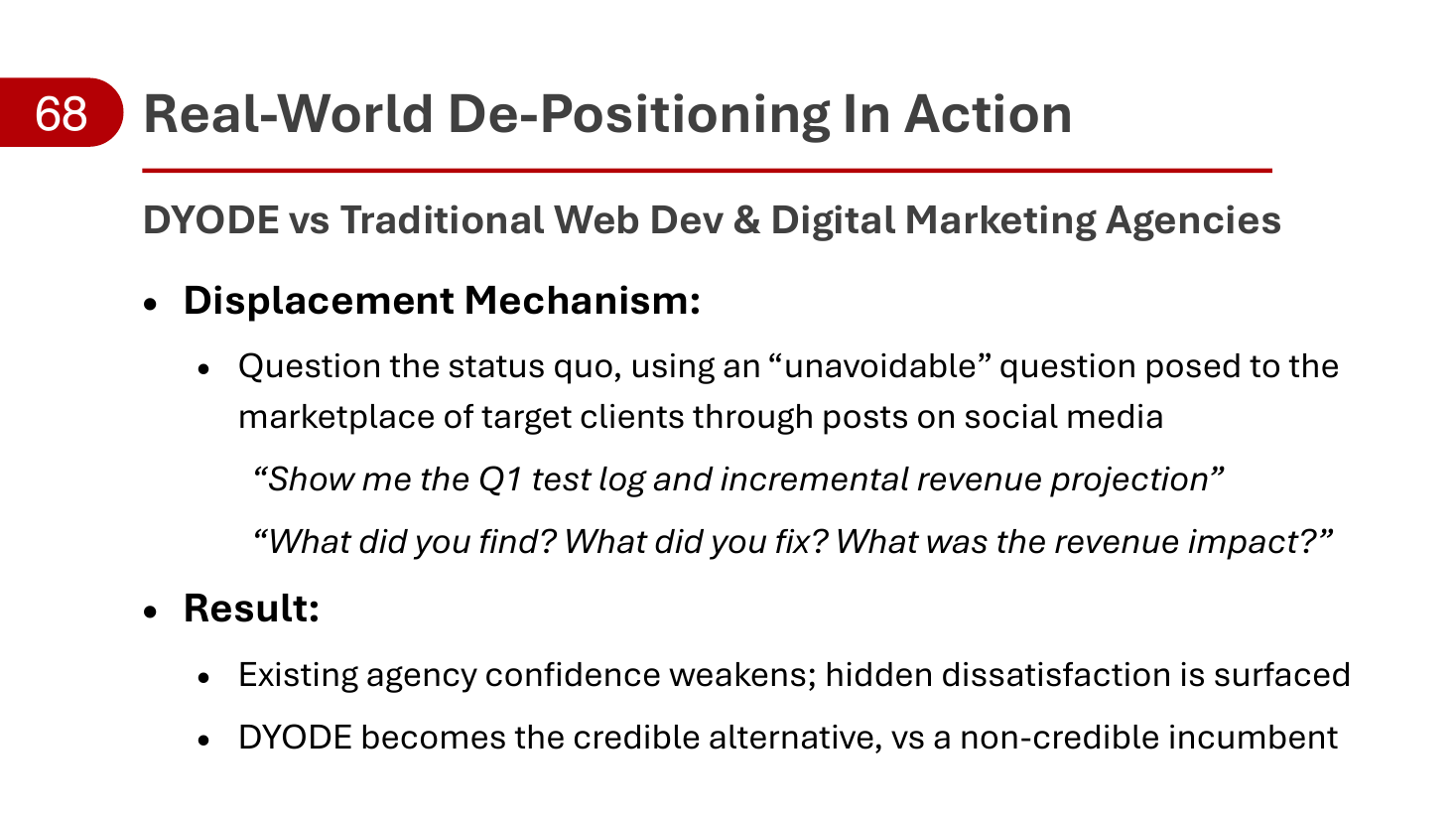
- DYODE vs traditional agencies (the deck spells it "DYODE"; Marion pronounces it "Diode"; an e-commerce migration agency): Strongly/Crisis Bound hybrid; vulnerability = lack of accountability, "trust us" reporting culture; mover = doubt plus dissatisfaction; category class = "the Anti-Agency." Displacement mechanism = arm clients with an unavoidable question for their current agency: "Show me the test logs... point out every mistake you found, how you fixed it, and what the revenue impact was."
- Shampoo illustration: an extreme de-positioning example where a hypothetical report tying sodium lauryl sulfate to brain cancer flips "good enough" to "no longer acceptable." Marion presents this as an extreme illustration, not a recommended tactic.
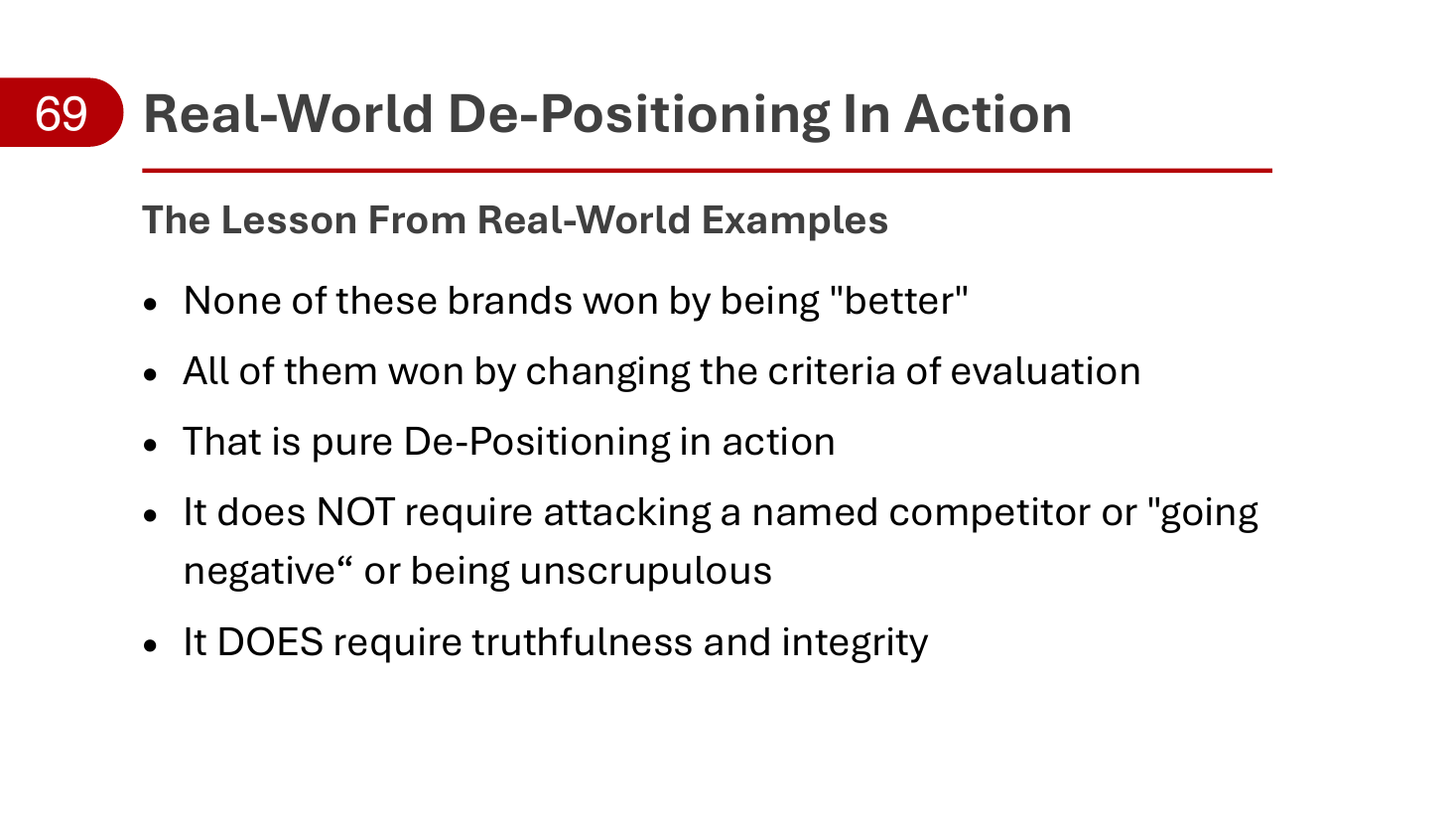
- Repeated ethics caveat: de-positioning does NOT require attacking a named competitor or "going negative"; it requires truthfulness and integrity.
Austin (mindset and problem-solving, last name not given)
Personal story (the spine of the talk):
- Diagnosed with a 1.5 cm brain tumor on the brain stem next to the auditory nerve on his 34th birthday, March 28, 2022.
- Pivotal moment: standing in the kitchen with his wife three days before surgery, after putting his two boys (ages 3 and 6) to bed; said "I'd rather die than be a burden."
- Says it was not death he feared but uncertainty (coming back "somewhat less capable"). Now described as thriving.
- Note: the date "May 16th, twenty twenty-two" is also referenced ("four years ago"); its relationship to the March 28 diagnosis date is not clarified in the source (unknown).
Core claims and frameworks:
- "Success is ninety percent mindset, ten percent skill set."
- The enemy is the "chimp brain" (fight-or-flight / cortisol response), described as "ten times stronger than our logical human brain." Tactic: audibly call it out, recognize it as a biological reaction, and take control.
- "Failure is a requirement of success." "Success is not measured by what we accomplish, it's measured by what we overcome."
- Practice voluntary discomfort to train control. Austin cold-plunges daily (~4:30 a.m., ~45 degree water, ~5 minutes) with the mantra "No negotiations."
- Three problem types: NORMAL (seen before, has a process), ABNORMAL ("normal problems you just haven't solved yet"), EXTINCTION-LEVEL (rare, maybe once every 3-5 years; survival depends on solving it).
- Two categories: PEACETIME (normal plus abnormal; ~99% of life) and WARTIME (extinction-level). Most wartime problems can become peacetime "with the right people and the right mindset."
- Quotes Jim Rohn: "Don't wish life were easy. Wish you were stronger."
- Focus step (Formula One analogy): "focus on what you want, not what you don't want" (focus on the road, not the wall). Focus only on what you want and what is in your control.
- Two-step fix: (1) put out the immediate fire / solve the surface problem, (2) go deep (ask how and why it happened, whether it is bigger, whether it affects other clients, how to prevent recurrence). "A problem well-stated is a problem half solved."
- Goal: "higher quality problems." If the same problem returns, that is a low-quality (unsolved-at-root) problem.
Named frameworks:
- One-three-one rule, attributed to Dan Martell, "Buy Back Your Time": one problem (stated at the root), three solutions ("one isn't a solution, two is only a choice, three gives options"), one recommendation the person is accountable to.
- ICE scoring method (Impact, Confidence, Ease) to prioritize multiple problems: rate each 1-10, multiply, sort descending; highest number gets the most attention.
- "Comparison is the thief of joy," but if you compare, the only difference between you and your idol is they have solved more and bigger problems.
- Visual model: a green dot (you) surrounded by blue dots (solved normal problems) = your "sphere of problem-solving capabilities"; solving new problems expands the sphere.
Kyle Roof (technical SEO testing vs AI content)
Framing:
- Introduced by the host as "the legend of SEO." Talk built around "the unhelpful concept of Just for the Robots."
- Opens with the Mechanical Turk story (1790s): an inventor (transcript renders "Wolfgang von Kleppen"; the historical figure is Wolfgang von Kempelen, likely a transcription error) built a chess "automaton" that beat famous opponents. Secret: a man hidden inside. Metaphor: "the world's first AI," which only works because a human is directing it.
- References Mechanical Turk (the Amazon micro-worker platform) as a tool he used to split-test H1s and ad copy.
Testing methodology:
- First test ever: "is an H1 stronger than an H2?" Googling it returned 3 yeses, 3 nos, 3 maybes, so he tested.
- "Where the sidewalk ends": search for a term that returns no results to get a clean, private testing environment. Create 5 identical pages, change one element on one page; rises = positive factor, falls = negative factor, no move = non-factor.
- To speed it up, test the inverse (put the element on all other pages; if the page without it drops, you have a factor).
- Holds a patent on this testing method.
Rhinoplasty Plano:
- A public 30-day ranking competition for "rhinoplasty Plano"; only rule was a fresh domain. 27 professionals entered; Roof's team entered rhinoplastyplano.co.
- He built the site in lorem ipsum, using Page Optimizer Pro and Cora (transcript: "Coral," likely Cora) to calculate keyword, variation, and contextual-term counts, then pasted them into the lorem ipsum.
- Results: ~2 weeks after the 30 days, #7 organic / #1 maps; ~2 weeks later #1 organic, holding the knowledge panel.
- Search Engine Journal published "Google ranks site written in Latin"; ~6 hours later Google de-indexed the site as "pure spam." That night Google de-indexed 20 of his test sites.
- Claims Google subsequently added a rule (verified via Wayback Machine) about auto-generated content that "makes no sense to the reader, but which may contain search keywords." Roof says he may be the only person with both an SEO patent and a corresponding Google SEO rule.
- Shows lorem ipsum pages still ranking on page one after seven years.
Schema and links:
- Schema "just for the sake of schema" was never and is still not a ranking factor (he tested it). You CAN rank with schema.
- Links still work: cites a test where firing "the spammiest of grossest links" lifted non-ranking sites to positions around 30, 57, 39, and moved page-4 sites to page 2.
- "From my vantage point, nothing has changed... the base of what we do really hasn't changed." Google "turns the knobs" but core ranking factors are stable.
LLM content tests (the central evidence):
- Goal: find the best LLMs for SEO by testing unprompted baseline output. Two prompts: a "thousand-word article on what to see in Rome," then the same "that is SEO optimized." Scored in Page Optimizer Pro.
- Out-of-the-box scores were poor; a human-optimized article scores around 80, but the best LLM came in at 64 (transcribed "Gwen," likely Qwen). Google's own models (Gemma, Gemini) repeatedly landed near the bottom.
- Word count: only three models delivered the requested 1,000 words. Going above target is fine; going below is "often very problematic." Worst was Llama at 565 words.
- Used Flesch-Kincaid readability (not a ranking factor); aim around 7th-grade level.
- Key metric: important terms (variations, LSI, target-keyword usage) in the main content. For a ~1,000-word page the target range cited is 167 to 278 terms, midpoint is the sweet spot. The most any LLM produced out of the box was 53. "It blew my mind that a language model is not good at language."
- Cross-checked against Google's NLP API; LLM output fell well short of the needed midpoint.
- When asked to "SEO optimize," almost all models improved their POP score but DROPPED in word count and STRIPPED OUT terms. The score rose only because formatting and subheadings improved.
- Data shown "last March" (six months and one year later): still poor; word count improved over time, but contextual-term scores and reading level stayed low. Perplexity Pro was best on terms but still "not a win."
- Bottom line: "we still have jobs." AI is a productivity tool, like the Mechanical Turk; it only performs when a human directs it. "If you're bad at SEO, it's only gonna help you do bad SEO faster."
- Note: the talk transcript cuts off mid-sentence ("about twelve consultations"); a later Part 2 may exist (unknown).
Slides
Only Marty Marion's de-positioning workshop deck was provided. No decks were provided for Austin or Kyle Roof.
Slides (81)







Source
Synthesized from the Day 1 conference recording and Marty Marion's slide deck (seost-marty-de-positioning-workshop-marty-marion). No decks were provided for Austin's or Kyle Roof's talks. Speaker claims, figures, and spellings are reproduced as stated in the recording; unverified items and unknowns are marked inline.