"Brian Kato: Square Peg SEO, AI Board of Directors, and MuVERA"
Brian Kato pitches a brand-saturation framework that abandons rank tracking to own the whole SERP, then live-builds a Claude "Board of Directors" agent team and demos MuVERA-driven content.
On this page
This Day 2 session opens with a brief hallway exchange where an unidentified premium-PR operator (name not given) argues that a budget PBN news network of cheap releases cannot match premium distribution on authority or brand perception. Brian Kato then delivers "Square Peg SEO," a framework that drops rank tracking in favor of owning the entire SERP and AI-answer narrative. He live-builds a "Board of Directors" of Claude AI agents that produces client strategy decks and geo-grid keyword spreadsheets, and demos MuVERA as a content-coverage skill.
Main takeaways
- Rank tracking is obsolete; brand share of voice and revenue are the real metrics. Brian argues there is no number-one ranking anymore because of personalization and "double JavaScript" AI modes that hide links until clicked. The only metrics that matter are brand, share of voice, and whether the client is making money.
- Square Peg SEO means becoming the de facto answer everywhere, not ranking a single page. Be the "Jell-O" or "Kleenex" of your category. Search assembles answers from passages, so you force your brand into every answer across AI, images, video, maps, and the SERP. He cites a service-contractor client holding 8 of 10 homepage positions across different platforms.
- The Square Peg system is five pillars: entity lock-in (same name, services, and descriptors everywhere), distribution over destination (the site converts, everywhere else discovers), co-occurrence engineering (bind your brand to entities that matter), surface area expansion (volume of mentions beats one strong page), and query interception (win the "best way to..." query before Google decides).
- Build a "Board of Directors" of AI agents in Claude to mass-produce strategy. Brian uploads three skill files plus about twelve markdown agent personas into a Claude project, with instructions to debate, reach consensus, log to a
log.md, and run cascading parallel agent waves. He cleans the output into a strategy deck he sells for $2,500 to $3,000. - MuVERA produces more comprehensive, less generic AI content. Brian frames MuVERA (which he expands as Multi-Vector Retrieval Algorithm, Fixed Dimensional Encodings) as the basis of Google's NLP and uses it as a skill to cover a topic from multiple angles (high intent, common, uncommon, rare, fringe), layered with BERT for "360-degree" coverage. (His technical characterization is unverified; treat it as his framing.)
- "Link fortification" is tiered link building rebranded. Get published on a high-profile third-party site, then build links to that placement and to your own social profiles, which few people do.
Key points
Opening (premium-PR operator, name not given)
- An unidentified operator opened this block arguing that a budget PBN news network (cheap $20 to $100 releases) lacks the authority for SEO and especially AI visibility and devalues a premium brand; the hosts noted Google deauthorized thousands of Google News sites about two years prior. (One line only; he is distinct from Brian Kato and gets no section of his own.)
Positioning and thesis
- Title: "Square Peg SEO: Make Your Brand Impossible to Ignore." Self-describes as living "at the intersection of cybersecurity and marketing"; more aggressive than typical client SEO.
- Background: former performing musician, BMI-affiliated, rock frontman/vocalist; credits this for his guerrilla-marketing focus.
- Core claim: "There is no number one ranking anymore." Rank trackers are "lying to you" because of personalization and AI mode.
- Google AI mode / AIO is described as "double JavaScript": links don't appear until you click in to reveal them, making rank tracking very hard.
- Real metrics: brand, share of voice, and revenue ("are you making that bread"). Rankings are an internal metric only.
- Search "ranks passages, not pages"; AI extracts a snippet, uses it for citation/reference, and assembles answers.
- Be the "Jell-O" or "Kleenex," the de facto brand for the category.
- Client proof point: a service contractor holds 8 of 10 positions on the Google homepage across different platforms (WordPress, Wix, Joomla, HTML, Drupal) and owns the knowledge pack and AI results.
Retrieval mechanics
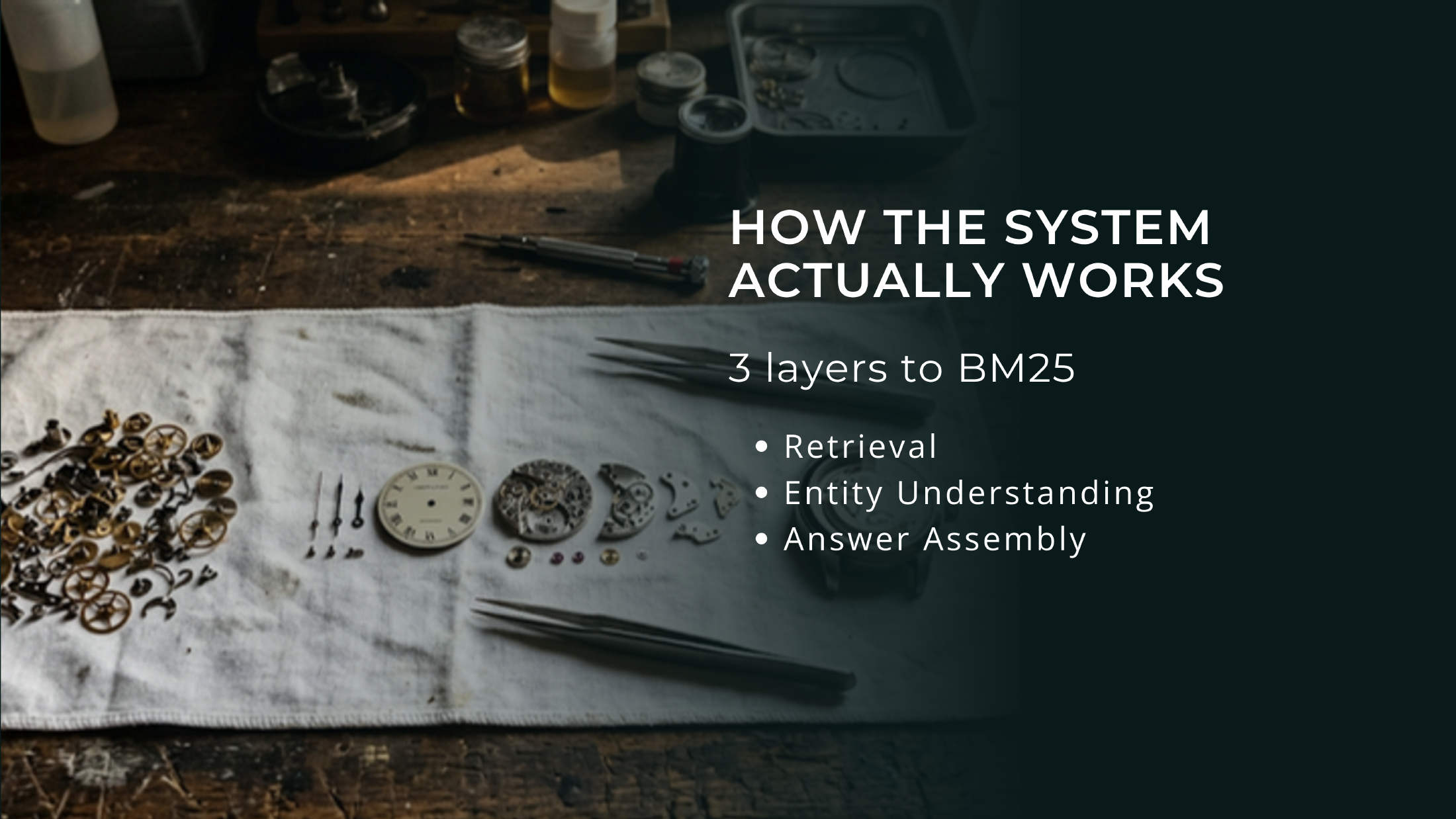
- BM25 (Best Match 25) is framed as a retrieval layer with three components: retrieval, entity understanding, and answer assembly ("knowledge graph / KP retrieval on steroids").
- "If you're not everywhere, you're not eligible."
The five pillars
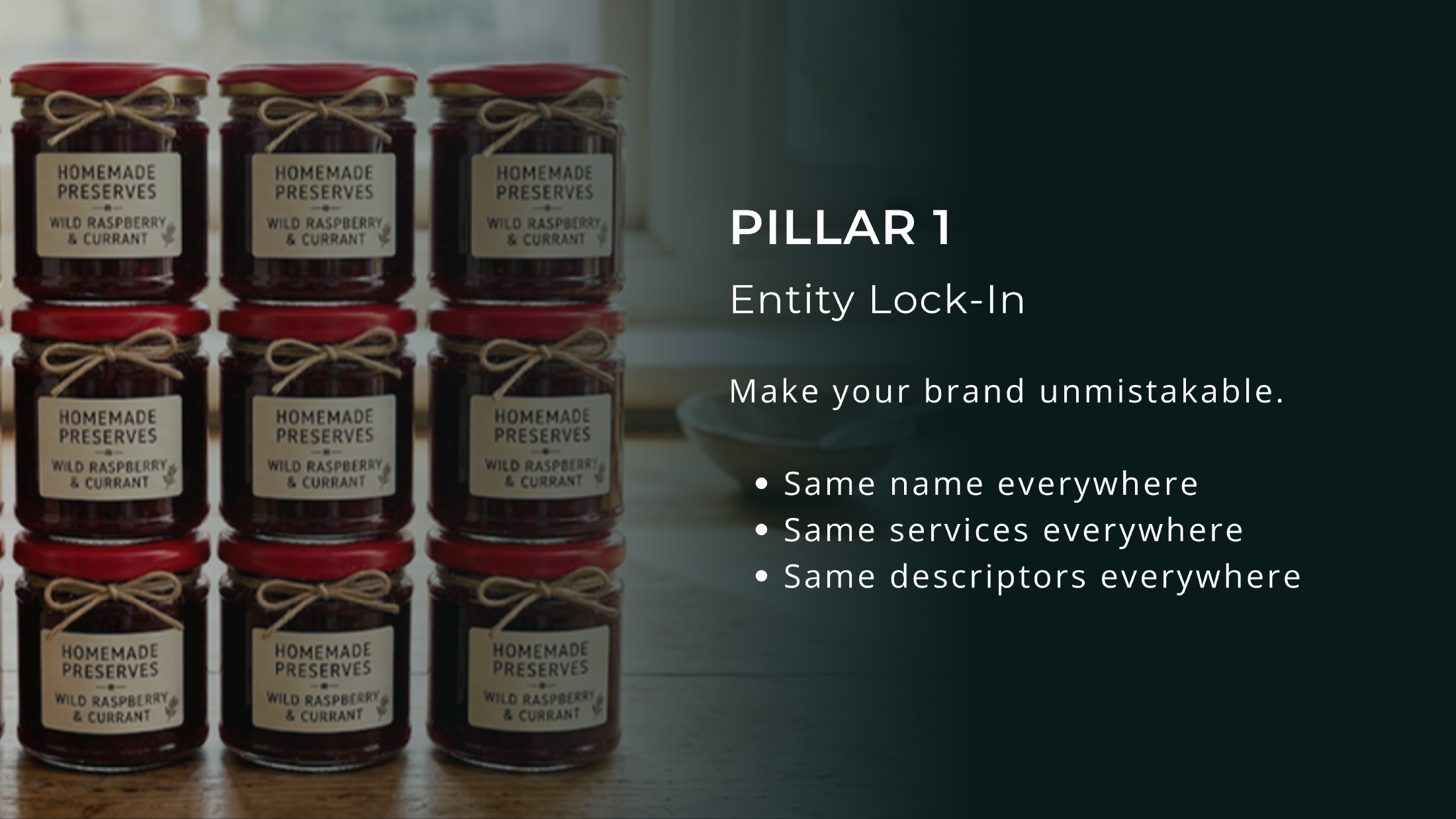
- Entity lock-in: make the brand unmistakable; same name, services, and descriptors everywhere. Reinforce who you are, what you do, where you do it, and what's in it for the consumer.
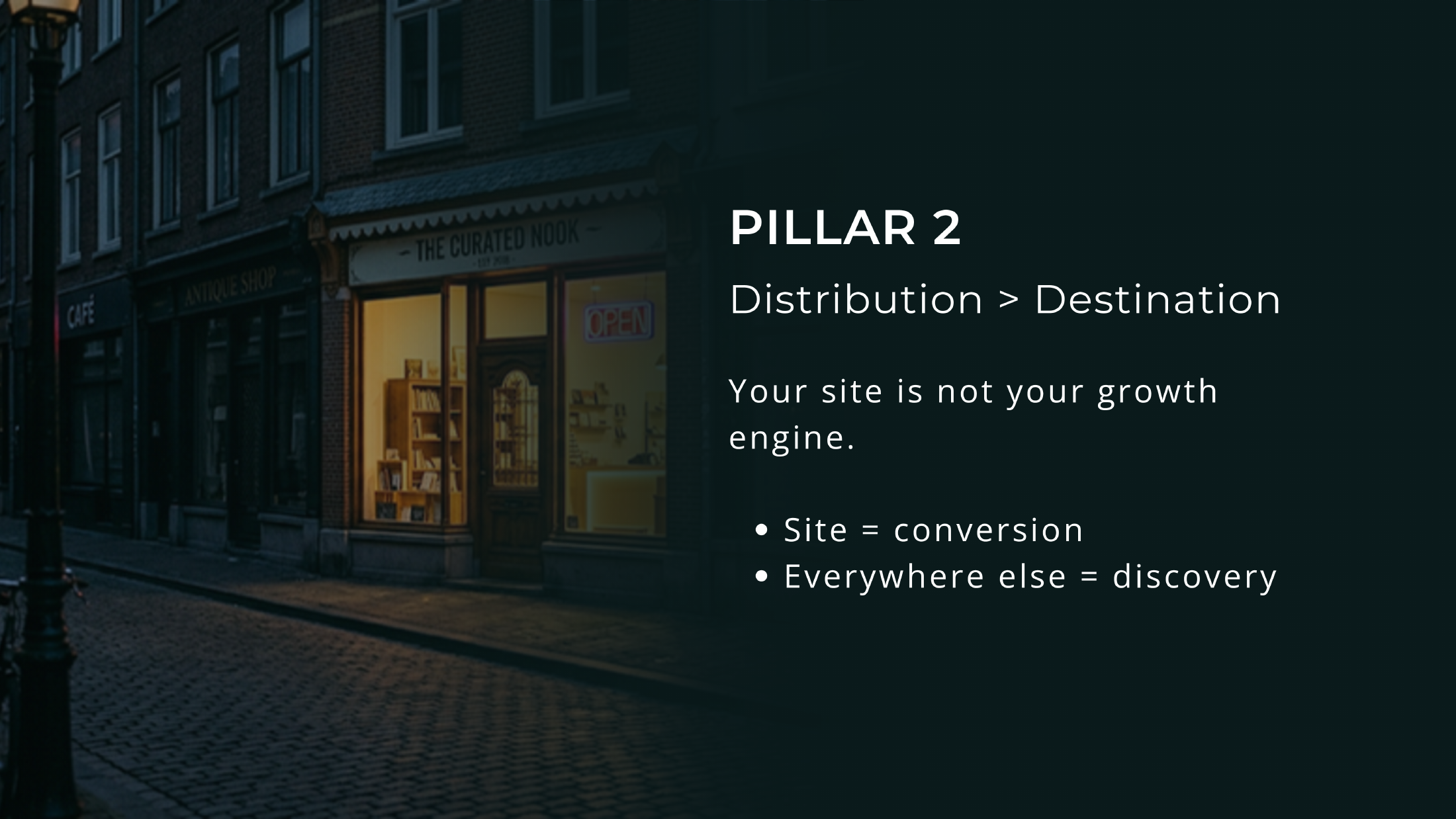
- Distribution over destination: be everywhere (Reddit, social, YouTube, video, in-person events). Site equals conversion; everywhere else equals discovery. Measures calls/leads/cash, not UTM attribution (calls out iOS 14 breaking meta-ad attribution). Likes physical events: lunch-and-learns, community goodwill, philanthropy.
- Co-occurrence engineering: combine entities to create node connections (example: "SEO Spring Training" plus "Digital Marketing Conference AZ" / "Chandler, Arizona"). Force entity associations via video and content.
- Surface area expansion: volume of mentions beats strength of one page. Deck framing: "1 page = weak, 50 mentions = signal, 500 = dominance." Build links to social accounts too.
- Query interception: win queries like "best way to...", "you are a...", and "I need..." before Google decides, via PAAs and "ask anything" tools.
The Claude "Board of Directors" build
- Distribution: a QR code / short link (
fvshort.click/seost26) opens a Google Doc that links to a Trace /app.traceworkscreenshot SOP holding three downloadable skill files (delivered via Dropbox, flagged "can't virus scan"). - In Claude: Customize -> Skills -> + (Upload Skill); upload three files: Fusion Line Gap Analysis (full market gap analysis by website/brand name), the project/agent markdown files (about twelve markdown agents with job descriptions: content director, strategic analyst, project manager, SEO/PPC specialist, viral video specialist, brand strategist, keyword specialist, financial analyst, neuromarketing/psychoanalyst, and more), and the MuVERA skill.
- Project instructions: tell the agents they are an advisory board (his is named "Future Vine") that must debate and reach consensus on any strategy, must start every conversation by creating a
log.mdfile (to reload context after hitting the context window), and must invoke cascading waves of agents asynchronously in parallel until the job is done. - Live demo prompt: "create a marketing strategy for [website]" or "audit [website]." Example shown: New England Aquarium (NEAQ), Boston. Output runs in waves (Wave 1 discovery/competitive analysis, Wave 2 strategic foundation) and produces an executive summary, five strategic pillars, 12-month targets/KPIs from board consensus, and persona sections.
- Monetization: he cleans these strategy decks into slides and charges clients $2,500 to $3,000 each.
- Caveat: "trust but verify... always have that human in the loop"; AI screws up.
Geo-grid demo
- Prompt: set up a geo grid and create a keyword list of primary terms plus neighborhoods.
- Boston Metro example: 23 official Boston neighborhoods, 80 keywords across 6 clusters; builds a JSON file and a Python script and outputs a multi-tab spreadsheet (keyword stack, content stack, questions, priority level, search intent, long-tail, page/content format, content type, competition level, notes).
MuVERA and content
- MuVERA expanded as "Multi-Vector Retrieval Algorithm, Fixed Dimensional Encodings"; framed as the basis of Google's NLP and as multi-vector analysis. Credits JP for introducing him to it. (Technical accuracy unverified; this is his framing.)
- BERT described as bidirectional; "reading with Google."
- MuVERA covers a topic from multiple angles (high intent, common, uncommon, rare, fringe) rather than promotional hype; HVAC example contrasts Carrier vs Trane warranties. Layer MuVERA plus BERT for "360-degree" coverage.
- Says he killed "80 to 90 percent of our tech stack over the last year" using these techniques; still uses an EAV (Entity, Attribute, Value) custom GPT to find keyword gaps via clustering and a Guerrilla Marketing GPT for shoestring campaign ideation.
Distribution sprint and "link fortification"
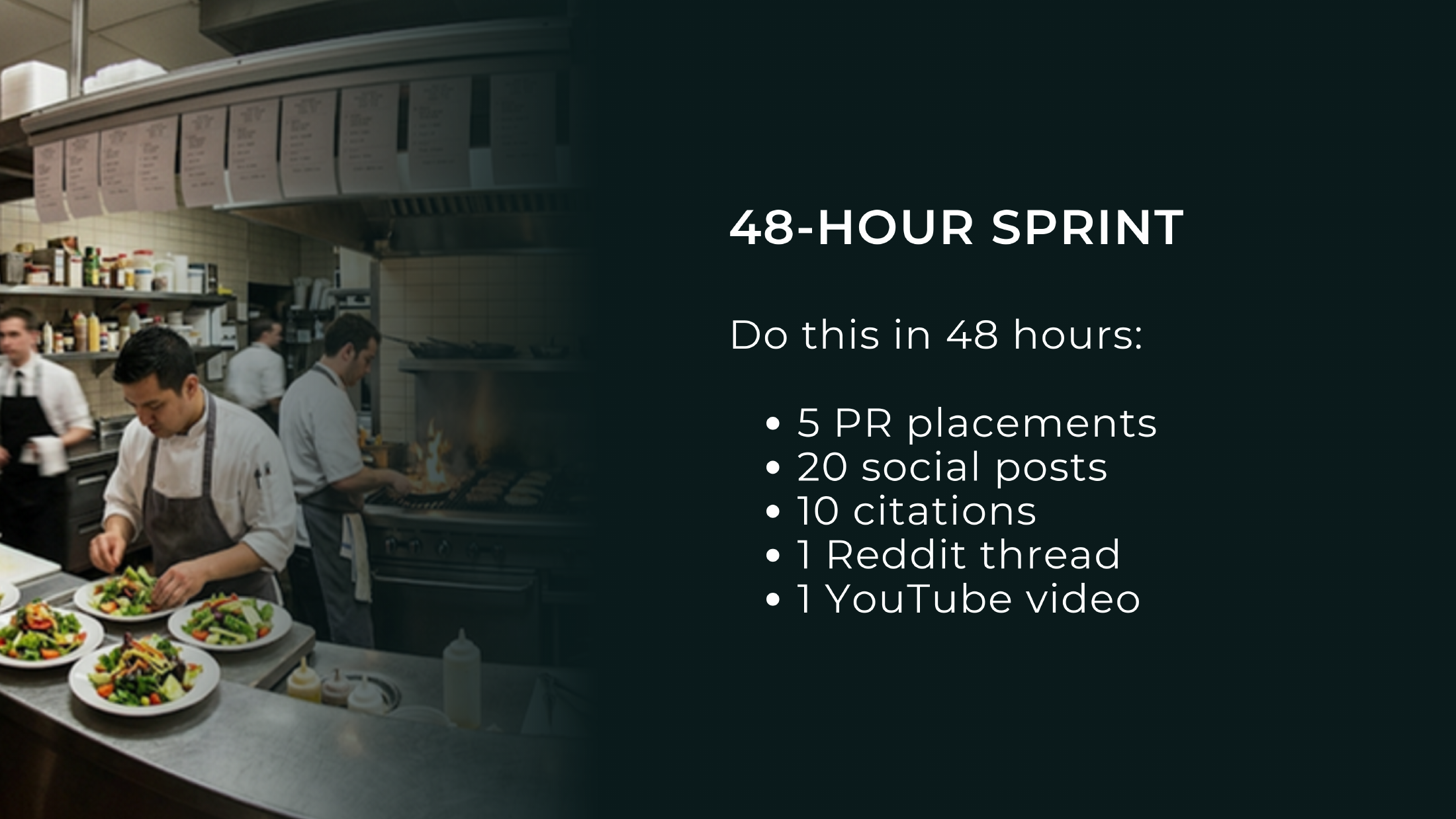
- 48-hour sprint: 5 PR placements, 20 social posts, 10 citations, 1 Reddit thread, 1 YouTube video.
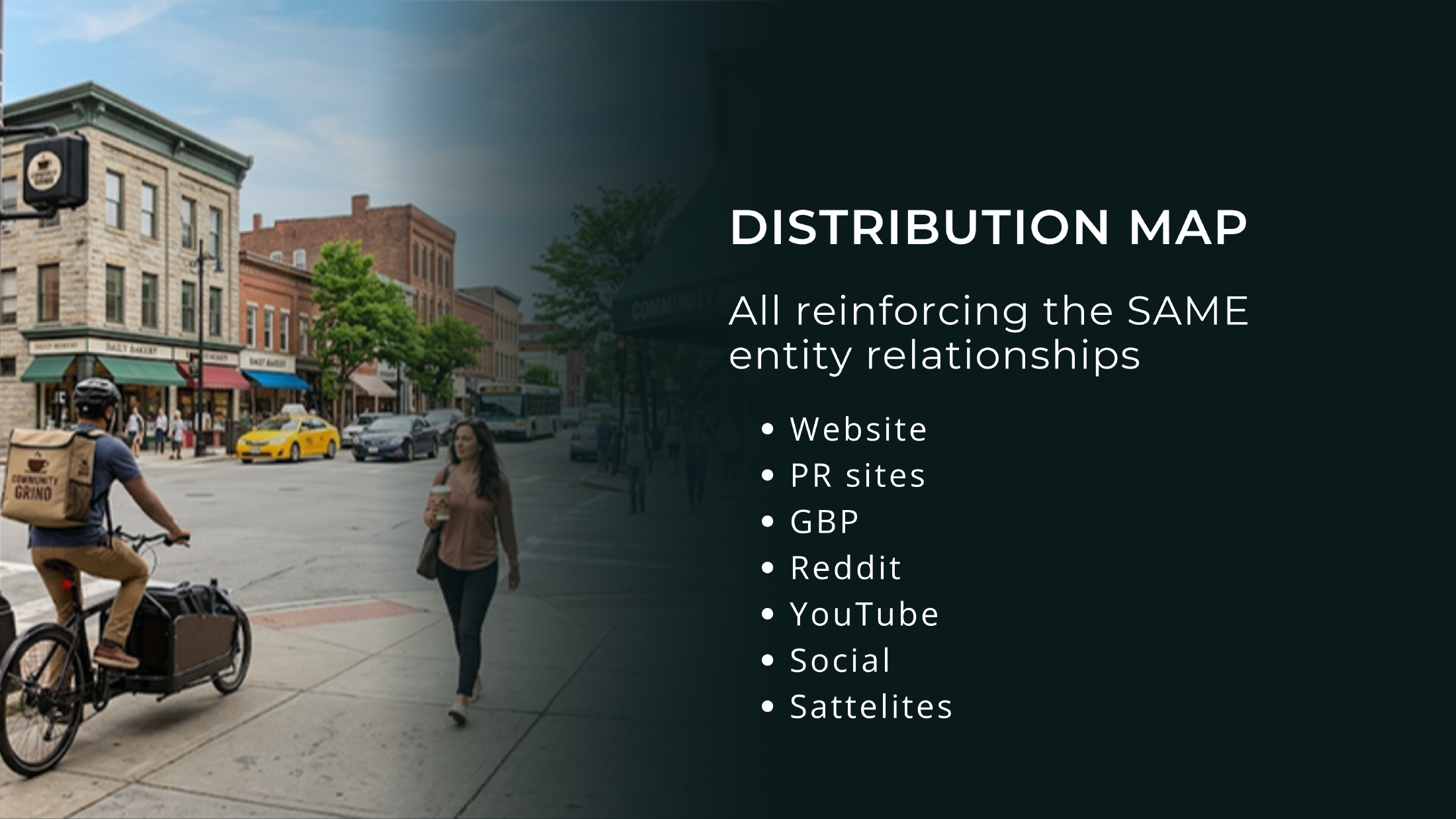
- Distribution map (deck): website, PR sites, GBP, Reddit, YouTube, social, satellites, all reinforcing the same entity relationships.
- "Link fortification" equals tier linking rebranded: publish on a high-profile third-party site (e.g., a search engine journal) and build links to that placement and to your own Twitter/YouTube profiles. Punchline: "We're fortifying, guys."
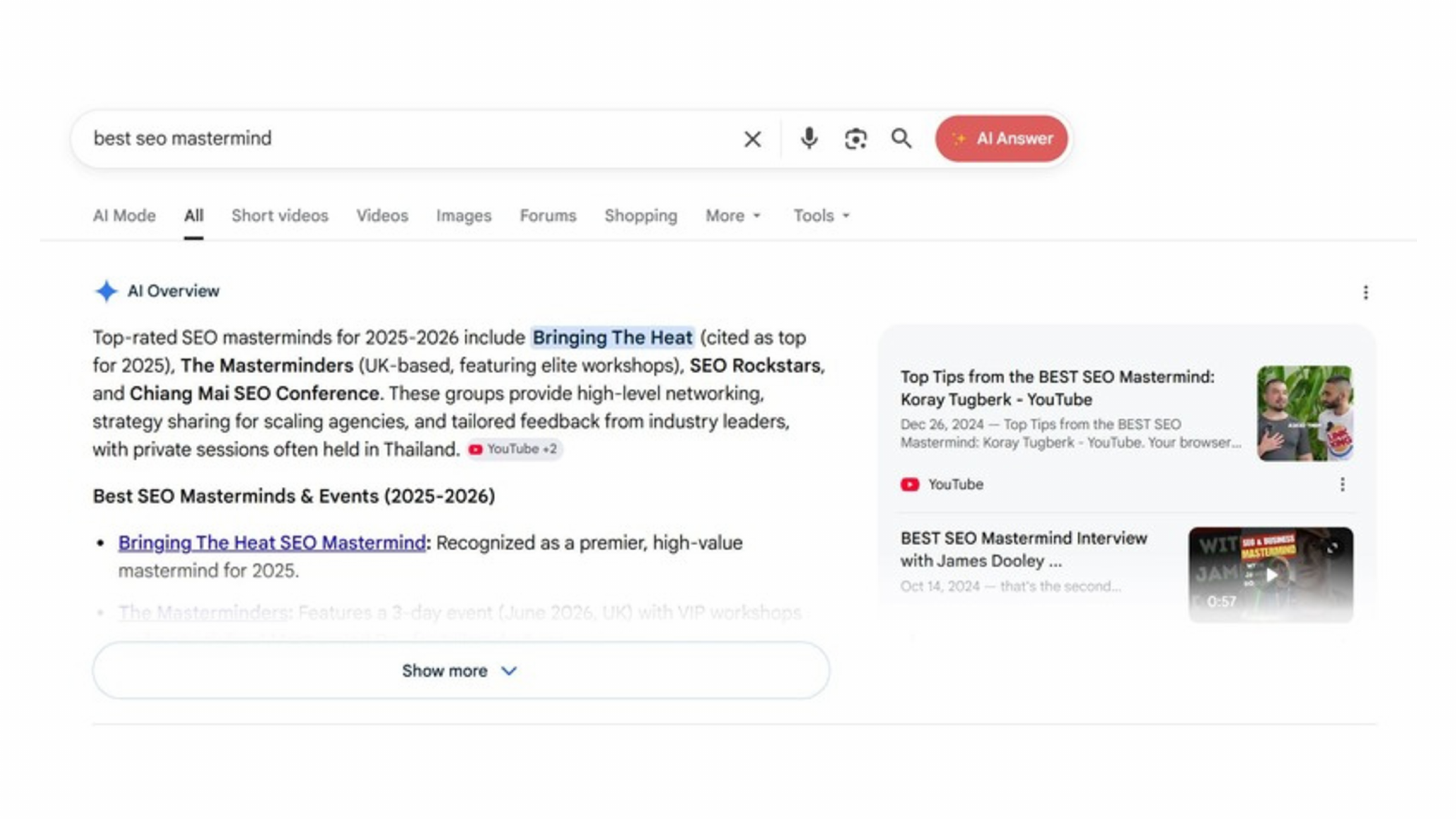
- Nashville case (with Dre doing most of the work, plus Holly): a high-level "best SEO mastermind" subdomain got into the AI overview via brand reinforcement and mentions across multiple properties.
- Reddit works via rage bait / human emotion ("intent behind the intent"); attack from common/uncommon/fringe/rare angles.
- Closing slide: "SEO is no longer just optimization. It's narrative control." / "Make the system adapt to you."
Slides
Slides (25)

















Source
Synthesized from the SEO Spring Training Day 2 conference recording and Brian Kato's deck (Brian Kato - Square Peg SEO.pdf, 25 image-only slides). Some figures and the MuVERA characterization are Brian's own framing and are marked unverified where the source notes flagged them. The knowledge folder these notes were drawn from is not part of the live site.